
Zippy Frames — Online Journal for European & Independent Animation

Interviews


"Why Must I Always, to Your Taste, Be So Silent, Pure and Chaste?' Interview with 'Virgin Fandango' Animation Director, Marcy Page
Eliane Gordeeff
'Virgin Fandango' is a short animated film featuring Portuguese tiles, directed by Marcy Page, and serves as a hymn in homage to women. Marcy is a renowned animator and co-producer, having won (as an NFB co-producer) two Academy Awards for best animated shorts: Chris Landreth’s 'Ryan' (2004) and Torill Kove’s 'The Danish Poet' (2006), in addition to the remarkable 'Madame Tutli-Putli' (Chris Lavis and Maciek Szczerbowski), which won the Grand Prize Canal, the Grand Prize for Best Short Film, and the Jury Prize for Best Design. Given this track record, one would expect nothing less than something "great." Yet Virgin Fandango exceeded my expectations. I was truly moved by its narrative and technique. The film begins with the Virgin Mary, mother of Jesus, and brings her into the real world, alongside other women and their struggles. I will let the words of the animation diva herself explain how she created this masterpiece.
Title and Theme of the Animation Short
ZF: "Virgin Fandango” has a rather provocative title. How did you choose that title?
MP: Mary, mother of Jesus, literally dances the Fandango in the film. But “fandango” in English can have a light added irony. It can refer to an “extravagance” or an unnecessary “commotion”, “a big fuss”. Mary is a Jewish woman who is revered by Christians (particularly Catholics) and is one of the few women mentioned multiple times in the Muslim Quran. So, she positively transcends many religions as an icon of love, forgiveness, and female spirituality. Yet historically there has been a lot of “theological warfare” (persecution of “heretics”, sectarian divides, etc) — in other words, “extravagant commotion” —about her Virginity. Rather, a misplaced focus. How a story is mythologized raises interesting questions.
ZF: What is personal about this story, or what motivated you to tell it, and why, through Portuguese tiles? Moreover, in what way do you think the technique was fundamental to representing the chosen theme?
MP: The film is, in part, a love letter to Portugal, where I spend part of the year. The film uses hand-painted and fired azulejos, like those that decorate many buildings and are featured in murals, mainly of saints and royalty. I thought experimenting with “tile possibilities” could create a kind of animation language—the design surface could be animated, but they are also physical objects that could dance in stop-motion; they could be broken; reformed like mosaics; repeated to form patterns; come off the walls and floor, etc. Pushing a traditional medium, often used to deify the powerful (and sometimes used to represent Mary), in an experimental way also reinforces the film’s subversive intention to honor a less recognized side of history, the history of women.
The film is a short celebration of famous women in song and dance—a musical. I hoped that it would playfully remind us of the vast history of powerful, intelligent, and creative women. The topic felt more urgent given the political realities of the last decade that have made many of us wonder, after lifetimes of resisting misogyny and repression, really, do we still have to protest this? Seeing the erosion of women’s rights in the U.S., where I was born and raised, was chilling to me. So the film was also an exercise in resisting authoritarian bigots and, in my own way, trying to be a “cheerful warrior”. There are glimpses of about 170 celebrated women of history. While viewers might know some, most they will not recognize, reminding us of our ignorance and maybe inspiring us to greater interest.
Another playful intent of the film is to question the myth surrounding Mary, who is often regarded as passive and mute. Apart from the controversial story of her baby’s conception, what do we know about her? We are told she gave birth in a stable, was forced by a tyrannical king to flee with Joseph and the newborn babe as refugees to Egypt, that she raised this son who became a rebel teacher to the disenfranchised, and that she witnessed him being crucified for his words. Could such a woman simply be epitomized by the phrase, “Let it be”? I think that if she could speak today, she would have a lot to say, particularly about repressive political forces.
Animating Tiles: The Process
ZF: Animating tiles is not as simple as simply drawing on paper. What was the biggest technical or production obstacle you faced during the creation of Virgin Fandango, and how did the team find a creative solution to overcome it?
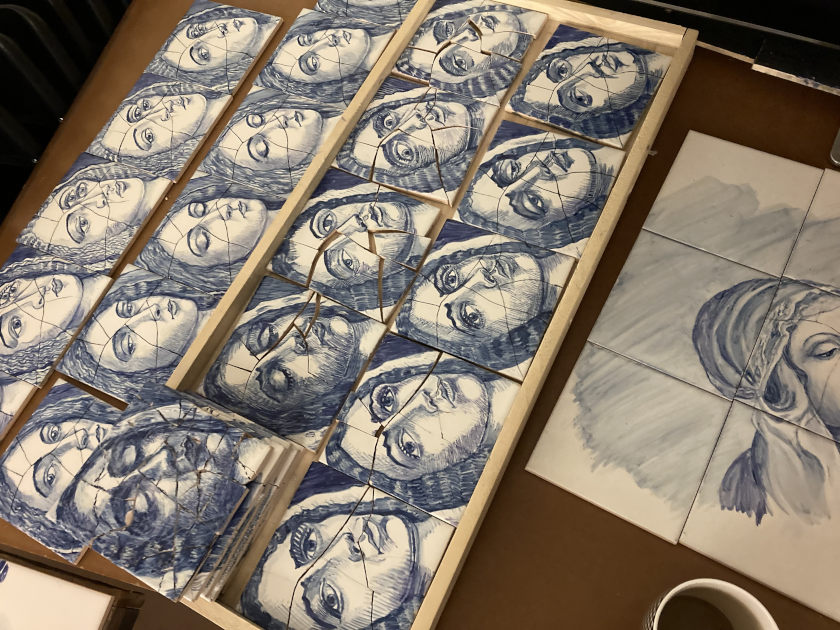
MP: When I was struggling to figure out how to get my drawings onto these opaque tiles, I tried all sorts of clumsy transfer techniques. Regina Pessoa solved this major production challenge. She showed me how a mini-projector could, from my computer, to project drawings down onto the unpainted tiles. Abi Feijo was a producer on the project, and we were able to convert a few recycled enlarger stands to hold mini-projectors and eventually found a few tile-painting artists who could carefully trace the projected drawings with cobalt paint onto the pre-glazed tiles, which were then fired. Of course, we also had to get a kiln and install it since there would be lots of tiles to fire. Over 12 thousand it turned out. Managing all those tiles was yet another production problem.
ZF: What was the working dynamic like with your team (animators, storyboard artists, etc.)? In an original project, how do you balance your unique vision with the contributions and feedback from the team?
MP: My partner, composer and sound designer Normand Roger, and I are lucky to share a house in Portugal with animators Abi Feijó and Regina Pessoa. Their company, Ciclope Filmes, co-produced the project with our newly formed Quebec company Blue Dada Productions. So it was like an “extended family” production, mostly self-funded. But we did get a small grant from ICA and some post-production assistance from the NFB.
It was an auteur project with a tiny team, so there wasn’t actually much conflict. I wrote (and rewrote) the lyrics and scenario, storyboarded, designed, and animated the hand- drawn animation for the surface of the tiles. Normand composed the music to the lyrics, and we recorded my voice for the animation guide track. I shot the pencil test sequences timed to this track, which formed the basis for the tile painting. Abi always encouraged me to exaggerate my pencil animation style more, and they all liked the inclusion of natural elements, like Mary walking off the wall into the flower petals in my storyboard, and keeping the audience aware of the tiles.
The interaction got more complex with the tile painting. There was finally a small core team of four other artists who did the lion’s share of the tile painting work with me. The team included Belinda Oldford, Antonio Nicolás Guillén, André Marques, Neuza Viegas, and a few enthusiastic women interns. Since we were all novices to the technique, we learned from each other, and each person’s own style is evident in the finished azulejos. I assigned them different sections of the painting that seemed to suit their strengths. Abi was very critical in giving me the confidence to do the stop-motion, setting up the shots, and technically directing the shoot. He also brilliantly composed and edited the film, and we interacted extensively throughout the process to keep it lively. After the feedback from “the family” and friends, my rap improvisations, for example, were way too long, so we trimmed them.
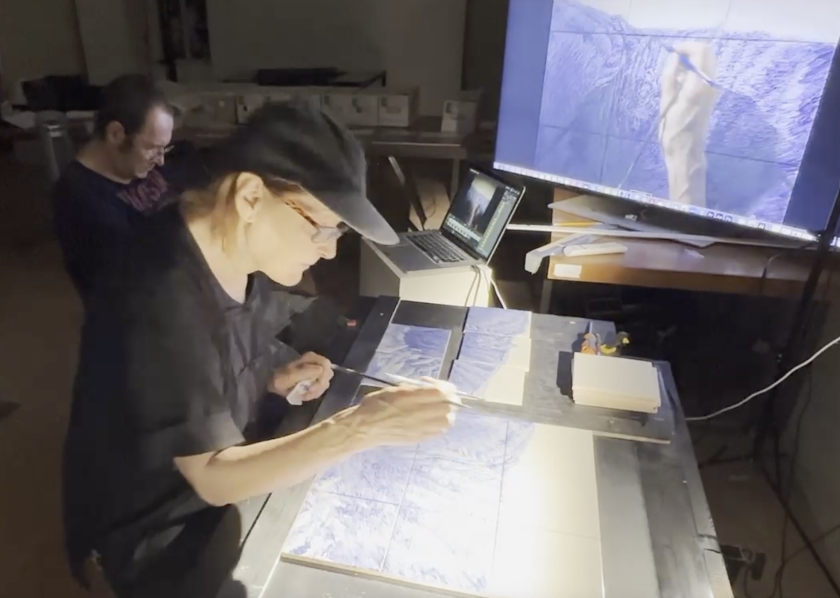
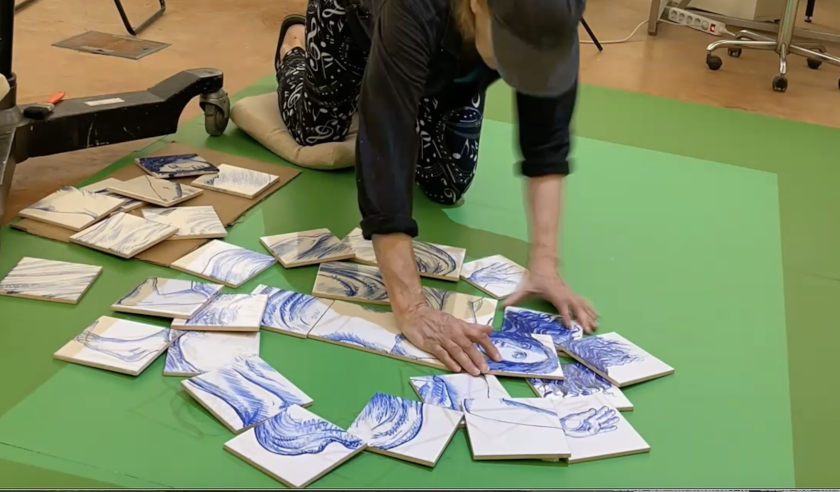
Marcy Page at work during the production of 'Virgin Fandango'
Animation and Music
ZF: Animation is a marriage between visual and sound. How was your collaboration with the sound designer or composer? Can you tell us how the music or ambient noises help build the characters' personalities?
MP: Normand Roger is the film’s composer and sound designer, and my husband, so the marriage idea is especially true. I probably would not have attempted a “musical” without him. He was very patient with all my lyrics revisions. Though we had a main song for Mary, a kind of narrative thread, he was versatile in creating the other musical bits that made the film a musical and not a video clip. He composed many period references for the writers’ sections: using ancient instruments for the most ancient writers, Enheduanna, Sappho, and Mirasaki Shikibu; an English-style country dance for Jane Austen and Charlotte Brontë; a square dance for the more recent and often censored writers. Hildegard of Bingen had a cameo with “the flying nuns,” which was the only unoriginal musical interlude—Normand recorded a version. And Normand created a good base for the rap music we used in the end credits and for the hand-jive tune used with Rosa Parks, Coretta King, Eleanor Roosevelt, and Shirley Chisholm.
Normand convinced me that we didn’t need to replace my voice, but just to improve it. He worked with many very talented musicians, including Denis Chartrand.
But perhaps the most wonderful addition to the music was Braga Fora – Coro Comunitário de Mulheres, an inspiring Portuguese community women’s chorus comprised of women of all ages and backgrounds, directed by Catarina Silva and Rebeca Rego—over 70 fantastic women! Their voices played off of Mary in the beginning, had a crucial role in the chanting that led to the “Archeology” sequence, and made the finalé more rousing.
ZF: If you could highlight a scene or sequence that you are especially proud of – whether for its technical complexity, emotional impact, or a 'magical solution' you found – what would it be and why?”
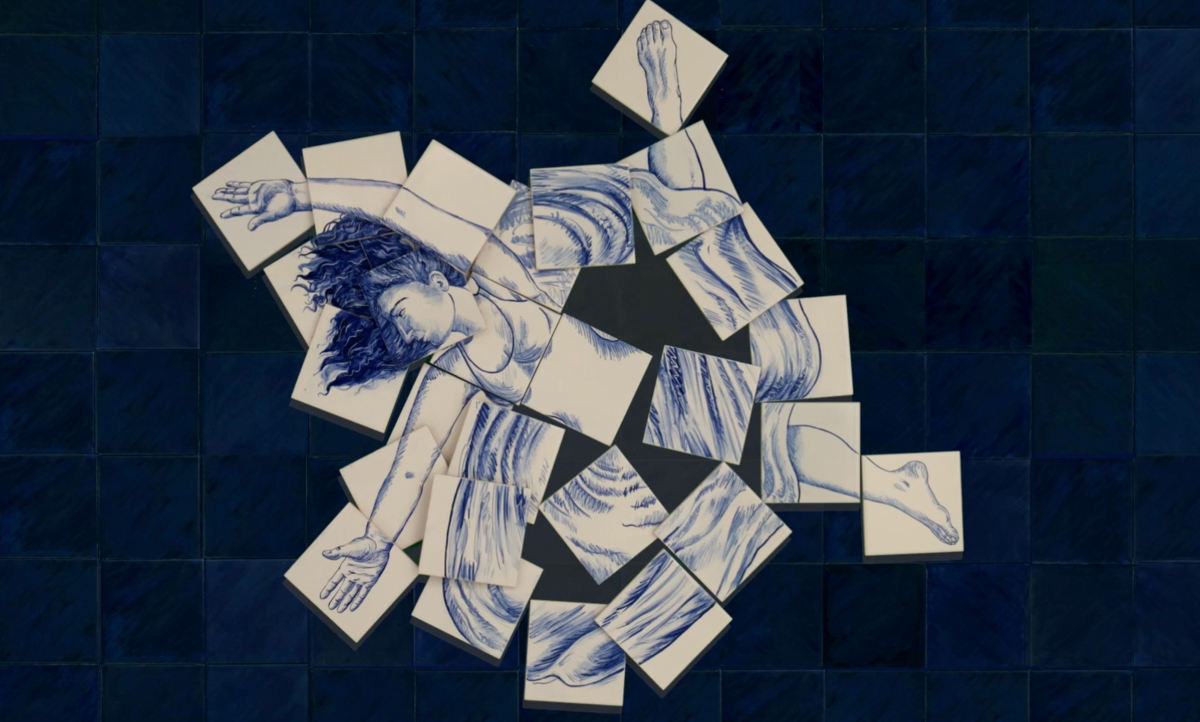
MP: One of my favorite scenes was Mary solo dancing, in which her body parts and the fabric of her dress were made up of individual tiles. Neuza and I painted the tiles, which are bolder because of the relative scale. It was the most ambitious stop-motion sequence of the film. The setup for the scene was almost life-size, and it was definitely the most chaotic to manage. Rigging, lighting, and staging this particular set were the most challenging. And it was the scene in which Mary must start to be the freest. As I was not so experienced with stop-motion, choreographing the tiles and shooting her big dance moves (with a lot of help from Normand) was both exhausting and exhilarating.
ZF: The chosen theme is very complex; you, as the creator, went to the foundations of Western culture and religion to address a crucial issue in all current societies: freedom, respect, and female identity. How did animation, as a medium, allow you to address these issues in a way that perhaps live-action couldn’t?
MP: Animation allows you to playfully condense and integrate many women in a short scenario and relate to unrelated women. For example, Ruth Bader Ginsburg did keep up her exercise regimen in real life, but could she do the splits three meters off the ground as she somersaults over Hillary Clinton and Michelle Obama? Would international Suffragettes do steps together reminiscent of the South African gumboot dance? Could Mary, in skeletal form, spin around with the holy ghost? Animation allows us the poetry of mashing up different ideas, different people, and different sounds in concise yet provocative ways.
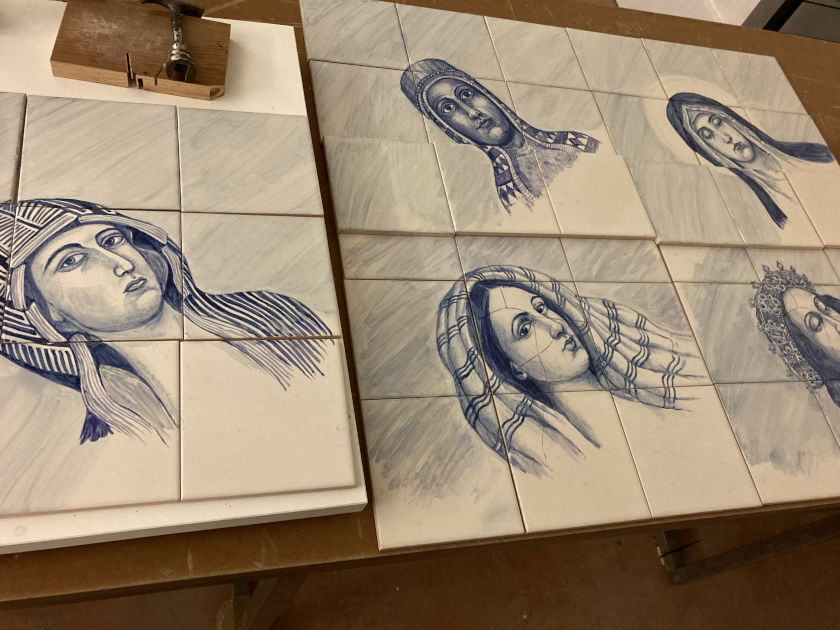
Another example is the fluid power of animation in depicting Mary's character. She has historically always been an interpreted construction of so many different images and ideas of her. So she is rarely “on model” in the film, and in one sequence I could “quote” her interpretations by historical artists like Rafael, Botticelli, and Bouguereau in a metamorphosing series of drawings. But these historical depictions, predominantly by men, are always restrained, so she asks during this sequence, “Why must I always, to your taste, be so silent, pure and chaste?” More varied and reinforcing the idea that she is interpreted by all of us, are her kaleidoscopic faces as she is first coming to life on the church wall in tiles. This transformation sequence included images collected from animator friends, mostly women, who were asked to send me a single drawing of their idea of Mary. Some like Joanna Quinn and Laura Gonçalves, and of course, Regina, Belinda, and Neuza came to the studio and painted directly onto the tiles themselves.
It was great fun to try to emulate their drawing styles. These women included: Caroline Leaf, Lynn Smith, Michèle Lemieux, Wendy Tilby, Amanda Forbis, Michèle Cournoyer, Michaela Pavlatova, Nina Paley, Janet Perlman, Veronica Soul, Diane Obomsawin, Shira Avni, Louise Johnson, Joanna Priestly, Candy Kugel, Florence Miailhe, Alice Guimarães, and Mónica Santos. This also served to represent the most important and influential group for me personally—Women Animators!
ZF: How was the selection of female personalities that appear in your short film? I was really surprised that you represented Marielle Franco, a congresswoman from Rio de Janeiro, assassinated for political reasons, and not only that.
MP: I started with historical women who profoundly influenced me, and then tried to reach beyond my own cultural experience. I was encouraged to check out Olympe de Gouges, Hildegard of Bingen, Elizabeth Freeman, Jane Addams, Hypatia, Hatshepsut, Sister Rosetta Tharpe, and others. I made and remade countless lists. Of course, I could only scratch the surface, even adding some women who were powerful and influential but with major flaws. And there were personal fixations… my mom was a nurse in WWII, so there were historical women from that time. Then I often just found myself touched by a particular story or request. Like when three young Iranian women studying animation asked if Mahsa Amini was in the film. And a Brazilian animator told me about Marielle Franco and her assassination. Hence, the small dedication to more current martyrs. The list is eclectic. I will make a website in the coming months with paragraphs about the women I included, just something cobbled from the internet, but all these 170 women deserve more than a few frames.
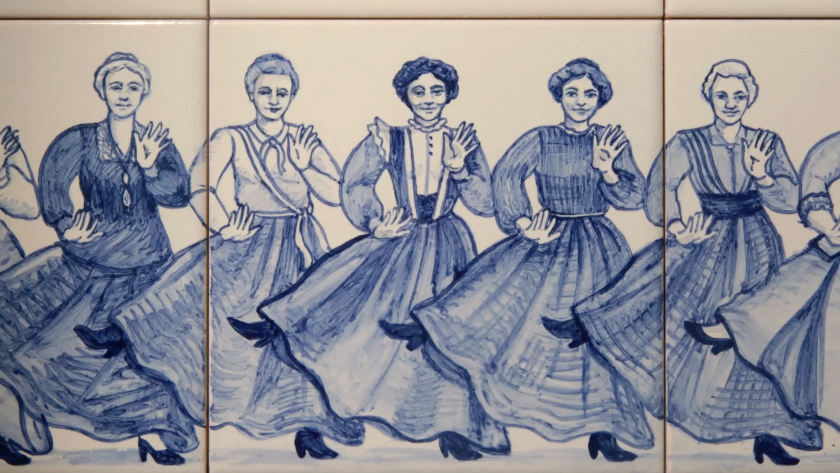
Virgin Fandango, Marcy Page
The Animation Market and New Directors
ZF: After finishing Virgin Fandango, what is your vision of the current festival circuit for independent short films? And what's coming next? Are you already developing a new idea, or are you interested in moving to a larger-scale project?
MP: I don’t know what to expect or what projects will come next. The film has a distributor—the Portuguese Short Film Agency —, so it will circulate in Europe and other places, but we will, of course, try to show it in Canada and try it in places in the U.S. where I have never been. The right to protest and to vote is a powerful thing. Time to be a cheerful warrior and lobby for regime change!
ZF: Finally, what advice would you give to a young animator or director who is starting to create their first independent short film now, also taking into account new technologies?”
MP: If you have a passion for it, make that film. Don’t wait for funding…just start. Consider it more a calling than a job. AI may take away some opportunities to practice our art to make a living, but on the other hand, the tools for making animation are becoming much more readily available.
Watch an Excerpt from the 'Virgin Fandango' short animation film:
'Virgin Fandango' will premiere at the 2026 Annecy International Animation Film Festival, 21-27 June 2026.
contributed by: Eliane Gordeeff
Want to read more free articles like this?
Keep this professional animation journalism effort relevant and updated. Become our patron
Read More About:
Related Articles

Zippy Frames is the premier online animation journal promoting European and Independent Animation animation since 2011
Zippy Frames
Quick Links