
Animateka 2021 Winners / Animated HerStories
ZF Team
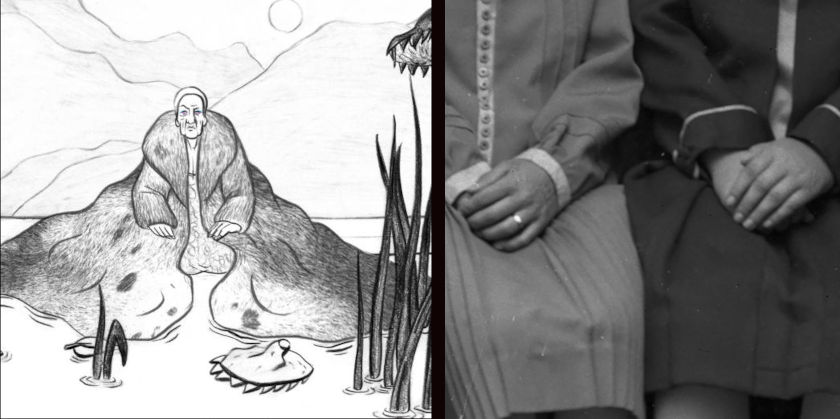
Marta Pajek's 'Impossible Figures and Other Stories I' took home the Grand Prix of the 2021 Animateka Festival (29 November - 5 December 2021, Ljubljana, Slovenia. Here's the list of all winners, followed by an exclusive reprint of the text on the HerStory programme (curated by Olga and Michał Bobrowski for the Slovenian festival)
GRAND PRIX:
Impossible Figures and Other Stories I (2021), Marta Pajek, Animoon/National Film Board of Canada
Justification: The jury unanimously loved a film which beautifully and powerfully visualises a past era full of hope, trust and belief in a bright future with a life for anyone. The artist creates a story which gives space for various understandings and memories.
Special mentions of the members of the main jury
Soetkin Verstegen:
Bagatelle (2021), László Csáki , Umbrella
Justification: In this political study of composite colors, the texture of intense drawing intertwines with the graininess of photocollage.
Maja Gehrig:
Epidemia (2021), Kristjan Holm , Karabana
Justification: A film that is interactive in a particular way, linking the word of the hour with a physical reflex. With it the author draws the audience into a cryptic collage in which nothing is complete until everything disappears in the final mighty yawn of the ground.
Igor Hofbauer:
Hide (2020), Daniel Benjamin Gray, La Cellule Productions/CUB Animation/The National Film Board of Canada
Justification: I give this award to a brilliant film, in which the hidden eye of the observer/protagonist suspects rather than shows or reveals the life of a family. It is both a touching story of a childhood and a tale of loneliness told through a variety of artistically engaging, yet subtle elements.
Gerben Schermer:
Steakhouse (2021), Špela Čadež, Finta Film/Fabian&Fred/RTV Slovenija/Miyu Productions
Justification: For visualising a tragic reality in human relationships and making us aware of hidden conflicts, which unfortunately still happen.
Viva Videnović:
At Home: The Moon (2020), Tomasz Popakul, HBO Europe
Justification: For capturing the repetitive non-sense of the world we live in and the predominant feeling of emptiness when one walks fearlessly but the rest are absent.
THE ELEPHANT: Children Jury Award
The Invention Of Less (2021), Noah Erni, Studio uuuh!
Justification: We've chosen this film because it shows us, in a funny way, how we can kick our habits that are bad for the environment.
YOUNG TALENT AWARD: A School of Arts (University of Nova Gorica) and Academy of Fine Arts and Design (University of Ljubljana) Award
Night of the Living Dread (2021), Ida Melum, National Film & Television School
Justification: As for our main prize, we decided to give it to a film that won us with its clean, sleek animation, a universally relatable story, and a message about self-acceptance.
Special mention of the student jury:
Kurent (2021), Miha Reja, University of Nova Gorica - School of Arts/Zvokarna
Justification: Our special mention goes to a film that stands out for its accomplished visual style.
;DSAF AUDIENCE AWARD
Granny’s Sexual Life, Urška Djukić, Émilie Pigeard
Zippy Frames exclusively reprints the catalogue introduction from the Animated HerStories programme, presented during the 2021 Animateka festival, prepared by Olga Bobrowska & Michał Bobrowski
| Animated HerStories |
In film and animation studies, the category of „HerStory” may be understood in at least two ways. The basic meaning of the term assumes historical investigations into the presence of women and women-identifying persons at various stages of film production. As such it is a means of affirming women’s agency in the film industry. Historically, regardless of the economic and ideological foundations of production mechanisms, the studio structures across the world operated within intrinsically patriarchal hierarchies that would delegate women filmmakers to the children's film production departments, as well as placing them in positions of assistants, editors, animators within the group, etc. Therefore, any “product” signed, co-authored or co-developed by women creators appears as an especially valuable “herstorical” record proving that the absence of women filmmakers in film history is a consequence of power relations, and not a result of women’s lack of interest in cinematic expression.
Naturally, there were exceptions to the rule; the rare cases of animated films directed by women within the studio system, however spectacular in their technical mastery, seldom questioned the conservative conventions of their times. We have consciously rejected such films for the purpose of this selection. Respecting the pioneering role played by such filmmakers as e.g. Hermína Týrlová (Czechoslovakia) or Alma Duncan (Canada), we were searching for expression liberated from chains of conventional fairytale storytelling or commercial practices as well as reproduction of patriarchal vision of society. Thus, we arrived at the second possible understanding of the term “HerStory” that is a quest for radically new, emancipatory aesthetics and philosophy of filmmaking.
While curating the programme, we focused on the works that explicitly or implicitly convey Kathleen Shannon's call to stop being invalidated by people who call us idealistic or naive or too emotional or all these other things they could have said to silence the brilliance of ordinary people. This is why we open this retrospective with Jenn Storm's 'Assembly' which directly refers to the ideas of Shannon who was the creator of NFB „Studio D” (a groundbreaking phenomenon for the artistic, social and political film history).
When animation opened up for feminism, the conventions exploded. The liberated creativity displayed a strong inclination towards experimentation, collage, and mixing of techniques. Rejection of the formal purity became a political choice.
The presented programme consists of four parts, bound by the concept of “HerStory”.
Part one Got to Speak Up explores the films of a clear political standpoint that combine feminist awareness with a raw, loud, and intentionally unpleasant style.
The programme Got to (Re)Create presents the works of women storytellers who reverse and reinterpret conventional narratives, reinforcing patriarchal world order with the means of perverse appeal and ironic perspective shifts.
Got to Be Real is focused on self-exploration of identities and seemingly mundane, daily situations experienced by women of any color or sexual orientation.
Eventually, in the Got to Do My Research part, we follow experimental works that test the limits of the animated medium.
Methodical implementation of “HerStory” concept in animation studies implies a completely new approach to film history as a knowledge about the canon, technological development of medium, and aesthetic valuations and judgments. Stable and fixed categories defining techniques and genres, historical overviews of golden eras of studios and national schools - all these do not attest to the dynamics of women’s agency in animated film. Women filmmakers have treated - and continue to do so - animation, live-action and documentary filmmaking, photography, performative arts, poetry and literature, painting and sculpting, etc, as complementary forms of expression, equally stimulating in an act of overthrowing the conventions, detonating the established order, and building new qualities that soon can be demolished again (Olga and Michał Bobrowski)
Want to read more free articles like this?

Keep this professional animation journalism effort relevant and updated. Become our patron

Read More About:
Related Articles
FIND THE RIGHT FESTIVAL
Zippy Frames is the premier online animation journal promoting European and Independent Animation animation since 2011
Zippy Frames
Quick Links