
Animation Darkish Spots in Hauntological Tones: (Thematic) Notes on the Margins of Animafest Zagreb 2025
Mikhail Gurevich
Again, obliged to say, I haven’t had a chance to observe this edition of Animafest Zagreb (June 2-7) in person and, again, obliviously, missing the ‘life dynamics’, atmosphere and vibe, and with that, the vivid context of opinions and emotions, and the rest of the perceptual aura. Instead, then – moreover, that almost retrospectively already – will be looking for and into the different contexts and comprehension clouds. After all, festivals as such are in larger measure creatures of contextualizing, aren’t they, and thus, tend to instrumentalize our grasp and receptivity. And also, at times, by luck or intention, ‘thematizing’ the entire field of vision, context at large, let’s say.
Sharpening the agenda
Speaking of which, this year Animafest Zagreb was presenting a special, openly thematic program, with a grand theme indicated in the title as 'The World Is on the Edge', divided by subthemes (which looked huge and challenging themselves): Migrants and Refugees, War, State Terror, Protest and Activism. This kind of contextual ‘actualization’ is telling, for sure; and perhaps served for programmers, besides the rest, as a means of moral justification of the whole festival enterprise in the time 'out of joint'. To me, for one, it’s clearly a necessary point nowadays; and this particular take, throwing certain light on the entire content, coincided with my personal thematization – angle of attention. I tended to read – even if reading-in, to an extent – similar issues.
Or – to put it on a different plane. I was reminded lately, by some occasion, of Derridean notion of ‘hauntology’, which initially meant to indicate some 'atemporal' traces of certain ideological constructs embedded in collective conscience, spectres of/from our accumulated cultural baggage – and then later widely and loosely applied by many to diverse socio-cultural phenomena. I’d take this as a philosophic metaphor – and stretch it somewhat further: to the perception and practice in our field (selection/contextualization included) – tangibly ‘haunted’, in present-day ‘group mind’, by the painful agenda of the time, with all the demons of (shared) past in it, albeit differently interiorized and reflected upon.
Winners and beyond: undercurrents
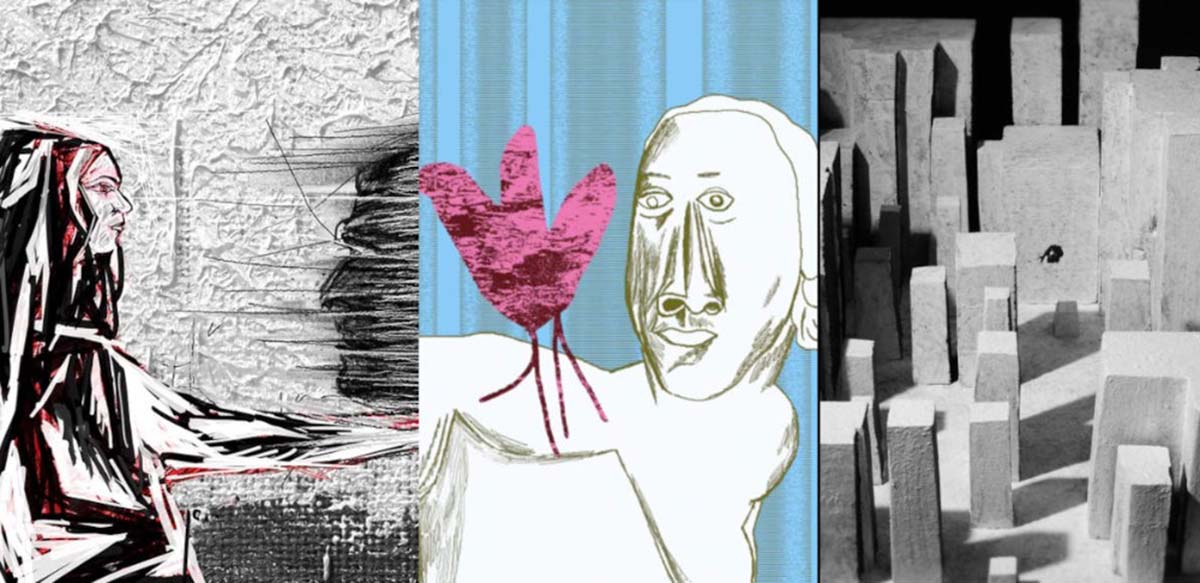
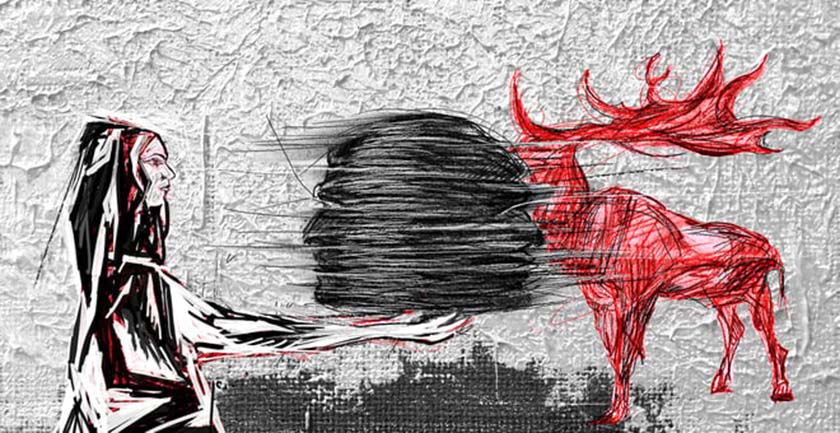
Starting with Grand Prix: Sasha Svisrsky’s 'Dull Spots of Greenish Colours' (Germany, 2024). A remarkable work indeed, to my mind; I would skip for now, though, the detailed look into it, leaving, hopefully, for a special occasion at a later point. Nevertheless, tempted to use it as a lens to look into specific details elsewhere.
The jury formulation reads: “…Through a skillful blend of techniques, it [<the film>] delivers a profound message in a way that feels both philosophical and organic. It invites us to question our relationship with the media — not only on a societal level, but also in terms of our personal and even physical experience of the world.” Something, of course, got left aside in this statement. Say, the specific nature of the ‘personal’ here. And then, the fact that it’s also a direct speech utterance, in the immediate sense, goes along with the dense monologue written and read, or rather almost recited, by the director himself. Both the textual material and visual flow, Svirsky’s trademark idiosyncratic imagery, might seem to be ‘haunted’ by the feeling-memory of deep trauma, imaginary or real, but palpable regardless, though given here as if in abstracted mode. And in this sense, it kind of generalizes the experiences and approaches of works around in the lineup.
As in ‘Urosh’ (‘Uroš’, dir. Mato Uljarević, Montenegro, 2025; Zlatko Grgić Award for Best First Film Made Outside an Educational Institution), that shows a more tangible, biographical touch. Though not indicated directly anywhere except for the first name in the title, the film clearly builds upon the iconography-stylistics and the very image, not to say the legend of personality, of Montenegrin artist Uroš Tošković. Narrated-pictured as if in the first person, ‘first hand’ mode (yet another almost direct speech case), it tells and draws, in fine-rough charcoal, how this artist, or the conditional hero, ‘alter ego’, goes through, in time(s) and recollections, his long-life experience, historically bounded and entrenched, traumatic in this or that way on every stage: child’s memories of the old war nightmares mixed inevitably with the newest ones, hard-lived emigration years and else. And, importantly, how all that definitely plagues his work and the very artistic vs. existential choices – up to readiness to bury the artistry for good, literarily and figuratively.
‘Moral Support’ by Vuk Jevremović
As an estrange echo to that for me, and a lesson in art and social history, stands ‘Moral Support’ (dir. Vuk Jevremović, Croatia, Germany, 2024; Special Mention in Croatian competition, also presented in the main one). Genre-wise it could be considered an extended music clip, in specific politically charged, passionate tradition, historically tuned and flavored – on a song (a camouflaged speech, if you will) about bloody class struggles of 1920-s in Slovenia, then of Yugoslav Kingdom: “the eternal fight between different political concepts and the tragedy of the human victims behind it”, synopsis goes – and it does feel like that, in albeit old-schoolish a bit, but powerful moving fresco. (See more, and a different take here). Jury notes that it’s “rooted in the revolutionary avantgarde of 1920s yet fresh and topical” – no wonder, I’d add, in hauntology angle, it’s exactly an “always-already” presence, sort of imprinted, in feel and expression alike, experience, to refer to a related Heideggerian term-notion.
The similar feel grips me in Iranian film ‘Like Friend, Like Dear’ (dir. Malek Eghbali, 2025) – manifesting yet another facet of ‘world on the edge’ thematization catalog – with its tense mood of impossible-inevitable existential choices under pressure without a choice; and filling the air silence here can be read as a ‘zero-sign’ expression-substitute for first-person speaking. (See more here).
And then, in Panorama, there comes ‘The Dark Globe’ (France and Italy, 2024) – puzzle assembles. Donato Sansone, a trickmaster-at-large, goes for a handy-work this time, arranging in real time a deconstructed origami of total recall, that is, humankind's self-destruction, in all the various ways and modes. And the presence of the real-human-director’s hand in (pixilated) action, along with the cut-out one as well, adds a first-person touch to the utterance, in a ‘materialized’ speech gesture. A sacramental, haunting question got imprinted right on the palm, shown in the final closeup: “We live inside a dream nightmare?”.
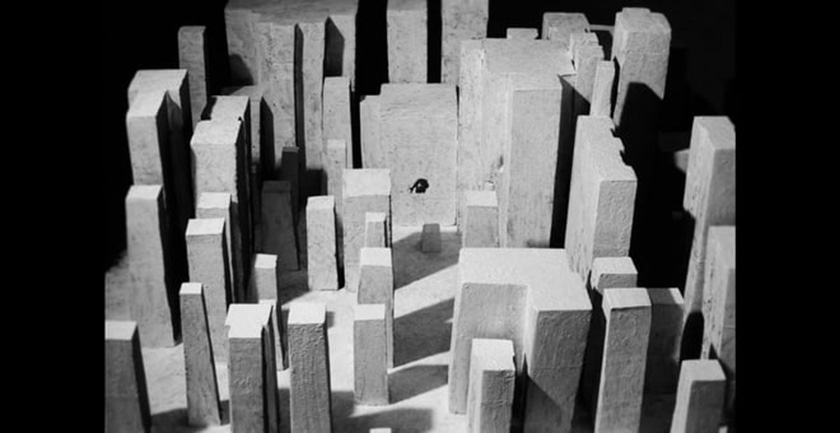
The Graffiti by Ryo Orikasa
To complete the apocalyptic mood and take – in wholesome verbalization: alongside in Panorama there stands ‘The Graffiti’, Ryo Orikasa’s one more dive into the whirlpool of animating the ‘textual matter’, as an act of utmost, overdrive reading. And this time it’s, besides all the rest (that deserve special analysis) and immediately, about the catastrophe of and in the language as such, both on the sides of signified and signifier; eschatology read aloud and visualized in pan-graffiti absorbing the minds and, finally, the world itself.
An old, sad joke from Soviet-era Jewish emigration folklore comes to mind: when suddenly-forcefully being offered boundless choices to leave – a sweet-hopeless dream for locked-up-forever subjects – a poor sod somberly trifles over the globe, given to him for this matter, and asks the exit visa officer – haven't you got a different one by any chance?..
In this regard, all things considered, I cannot help but notice here a certain ‘Russian émigrés footprint’ (or rather, more accurately, mainly of ‘relocants’, as this newest forced wave is now coined, albeit semi-ironically), which carries along, builds up its own specific actualization that can be sensed in the films below.
Starting again with Svirsky's film – despite its 'abstraction' in form-style, not just 'personal', but in depth, almost immediately autobiographical. With wife-collaborator Nadezhda, they had fled Russia soon after the start of this outright war; and here he, in essence, presents a pretty uncompromising insight into the generational history, reflects upon experiencing those recent decades, ‘fat’ and indulgent on the surface, in some sense, with all the ugly consequences-to-come brewing underneath.
Those would be exhibited manifestly in the film ‘09.01.berkovich’ by Anya Ryzhkova (Student competition, Bauhaus University, Germany, 2025) – on the one of the most bizarre-cruel political trials of late: of a theater director and poet Evgenia Berkovich, together with a playwright Svetlana Petriychuk, for "public calls to terrorism" in the play and production which had been receiving highest professional awards just few years back. Here is her defendant’s last statement, before verdict, written and read, literally, in verse – and in almost jeeringly clear-perfect lines and rhythms, holding to a firm line; stylized, I’d say, as a kind of ‘serious parody’ on Russian classic poetic tune (with much of the overtones lost in crib-prose translation, I’m afraid, but even so, must impress by the sheer audacity of the gesture). Ryzhkova (who moved abroad in early age and was schooled there) goes for a minimalist-rough move, not that much illustrating this unique performative act of ‘spoken word’ genre but just frames it, directly and figuratively, through behind-the-bars sight and on-screen textual matter alike – with humbly-expressly sobering effect; arresting your consciousness in more than one sense. A peculiar kind of animadoc, isn’t it, bordering perhaps the direct-action cinema tradition. (Not coincidentally, the fragment of this film opens a collective reel ‘Animators Against War - 13. Political Prisoners', included in the "The World Is on the Edge" program.)
Father’s Letters by Alexey Evstigneev
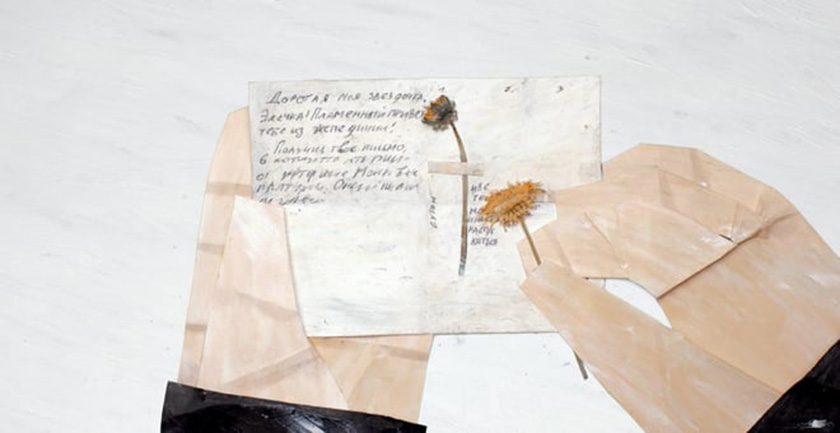
And another variety of the genre, if you will. As a historical perspective to all that – ever-needed, and sadly-weirdly actualized again – inevitably appear ‘Father’s Letters’ by Alexey Evstigneev (main competition, France/Russia, 2024; to my knowledge, made in fact fully in France, coproduction is indicated to accommodate some of the collaborators). Back to Stalin's 'big terror' times, 1930s – from a Gulag camp, a professor-meteorologist, condemned to hard labor there, writes to his little daughter pretending to have gone on a long expedition full of exciting explorations, Northern Lights and other wonders; in quasi-direct utterance, narrator-actor’s sweetish recitation. A childishly awkward drawing-cutouts – maybe with a nod to an old-good-Soviet grand-style of children’s books and magazines illustrations, for an informed eye – juxtaposed in a coda with museum-wise prison-life artifacts; as another juxtaposition bursts into view: colored with flags and tuned to enthusiastic marches, seemingly happy crowds rallying through celebratory capital streets and squares, in the same fatal year of 1937, when the father was executed in his ‘expedition’. Isn’t it yet another sad rhyme through times… Under-digested, halfway-reflected upon past holds-haunts even worse.
And finally – or rather before all, in the order of screenings – the very festival trailer made for the current edition by Varya Yakovleva, herself also a 'relocant', with a position strongly expressed in many ways. Reportedly, this commission came with a request to reflect the yearly general themes, and beyond, maybe just the atmosphere of the times – and she did deliver. The trailer seems to go beyond the bounds of this supposedly semi-functional auxiliary genre, almost up to the integral extra-short film in its own right (and also reportedly, as some colleagues present there have noted, was being received and even discussed as such). It carries over the thematic-artistic sensibility of the agenda, possibly bringing into focus its loose facets. With Varya’s idiosyncratic ‘bodily’ imagery (that might look strangely kindred to Svirsky’s oscillations) and disquietingly dramatic, if also sarcastic in a way, moves-transformations as though focalizing the overall state of anxiety.
Airier fare
On the lighter (if slightly) side – to note a few other works that caught the eye.
In Croatian pool, ‘Adaption 2.0’ (‘Adaptacija 2.0’, dir. Darko Bakliža, 2024) – plays seemingly with the history of costume, as means to camouflage the ‘body image’, or the whole civilizational bells and whistles in/through that; or, according to synopsis, AI prompted/imposed tricks and attempts to adapt yourself, in turn… Wittily inventive, albeit with limitations, and somewhat unsettling despite, or precisely due to, an ironic prism.
And a couple more in Students. ‘Urban Duo’ (dir. HongYu Yue, China, 2024) juxtaposes generational-social layers/modes of Shanghai bustle with quaint formalist twist – literally ‘boxing in’ those contrasting lines – to unveil the uneasy warmth of connection. Then, in ‘The Crooked Heads’ (‘Na krzywe łbya’, dir. Jakub Krzyszpin, Poland, 2025), a troubled teenager's story, within no less troubled milieu and the city alike, is being told-drawn closely following the best markings of Lodz school: idiosyncratic stylistics – as if half-done, drafty as expressive means – uncovers the real, hardboiled existential tension.
And so do indeed even those ‘lighter’ entries on the festival menu - accentuating the general themes and moods, after all. When the world is definitely on the edge, edgy goes, through different ways, the times-sensitive animated film.
'Animafest Zagreb' took place from 2 to 7 June 2025 in Zagreb, Croatia
contributed by: Mikhail Gurevich
Want to read more free articles like this? Keep this professional animation journalism effort relevant and updated. Become our patron


Read More About:
Related Articles

FIND THE RIGHT FESTIVAL
Zippy Frames is the premier online animation journal promoting European and Independent Animation animation since 2011
Zippy Frames
Quick Links