
Reaching Out to the Outside: A Conversation with Julie Roy
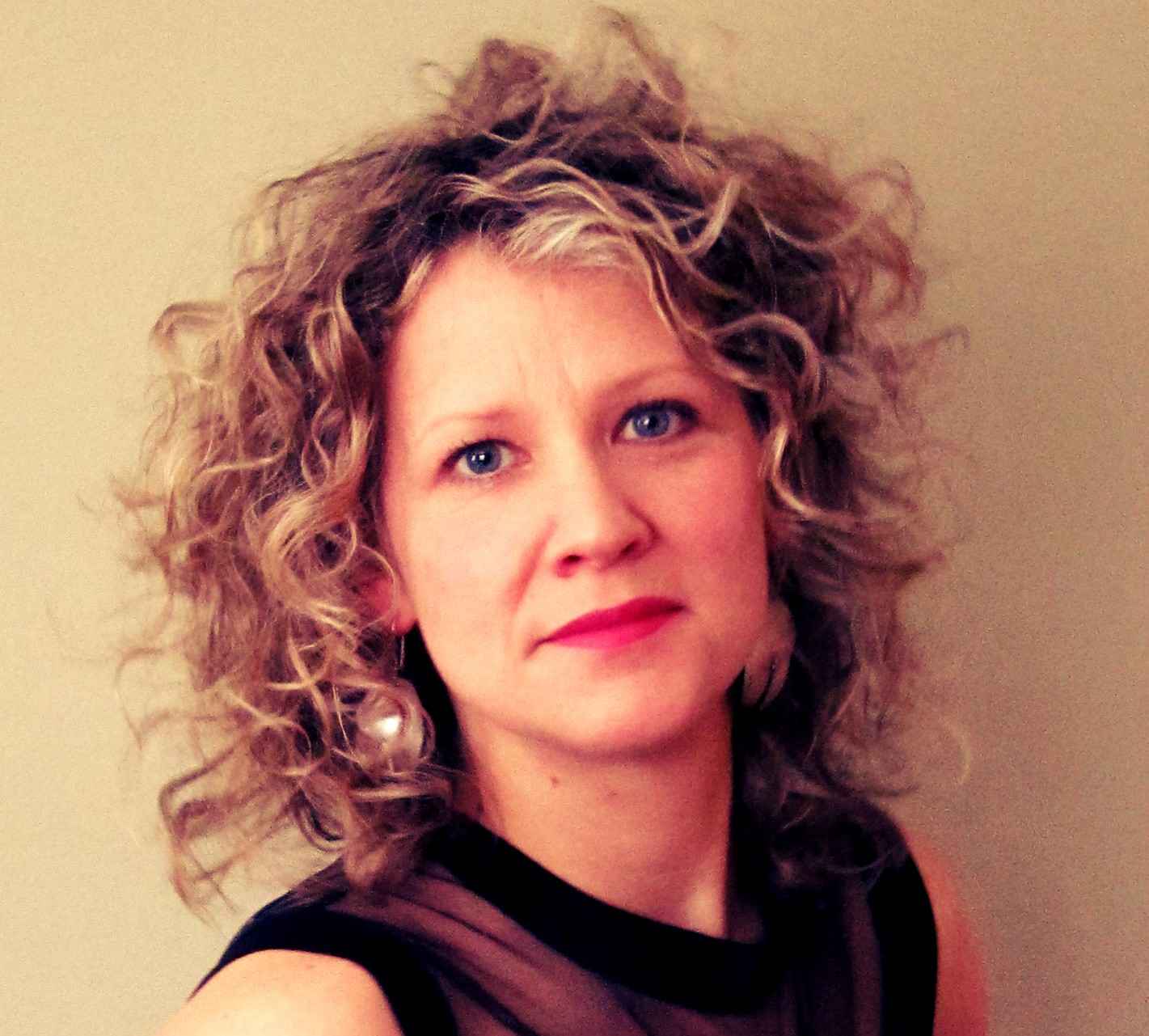
With over forty films in her NFB portfolio, Julie Roy remains a vigorous and curious producer who keeps her mind and eyes open for new artistic challenges, creative twists and technological game-changers. In the Annecy 2019 competitive categories, the National Film Board of Canada presented three short films and one VR experience, among them two projects directly overseen by Julie Roy. As much as it is fascinating to discover Roy's standpoints and expectations towards artistic animated shorts' production, talking to her gives also an opportunity to reflect upon two underappreciated, yet essentially meaningful aspects of contemporary art-house animated film culture – creators' and viewers' ability of critical analysis, and re-evaluation of women filmmakers' status in international animation scene.
ZF: In this interview I'd like to focus on your creative personality, and intellectual standpoints you employ in your work, however before it comes to this, please guide us through the films presented in Annecy that were made with your involvement (i.e. Uncle Thomas: Accounting for the Days by Regina Pessoa and The Procession by Pascal Blanchet and Rodolphe Saint-Gelais).
JR: Uncle Thomas... is my second collaboration with Regina. I have known her for years since I was a marketing manager of Tragic Story with a Happy Ending (2005), and I also worked on the production of Kali, the Little Vampire (2012). As soon as she pitched me the new project, I was immediately interested in it, and that's because it was personal, and I was happy she returned to subjects that are close to her. Even the first draft was really moving. It was a challenge for her to make a personal film that would be universal, and for me to find financing for such a personal work. As the NFB, we were there from the very beginning, but we were looking for funds, first unsuccessfully in Germany, later on we found a co-producer, Les Armateurs in France. Let me say – and it's not because of the interview, or because it's Regina – but it seems to me that she is one of the most serious and talented artists in animation who is humble, works hard, and has this intelligence to hear the comments of those around her, she analyses them in order to improve her work. Not every artist has such an openness. Regina worked closely with Andreas Hykade on the script, but in fact, she was open to every comment she received. Interestingly, she went far in the sense of technique with the use of stop motion, a new color palette, and compositing. I was really proud to be a part of this production and to work so intimately with Regina.
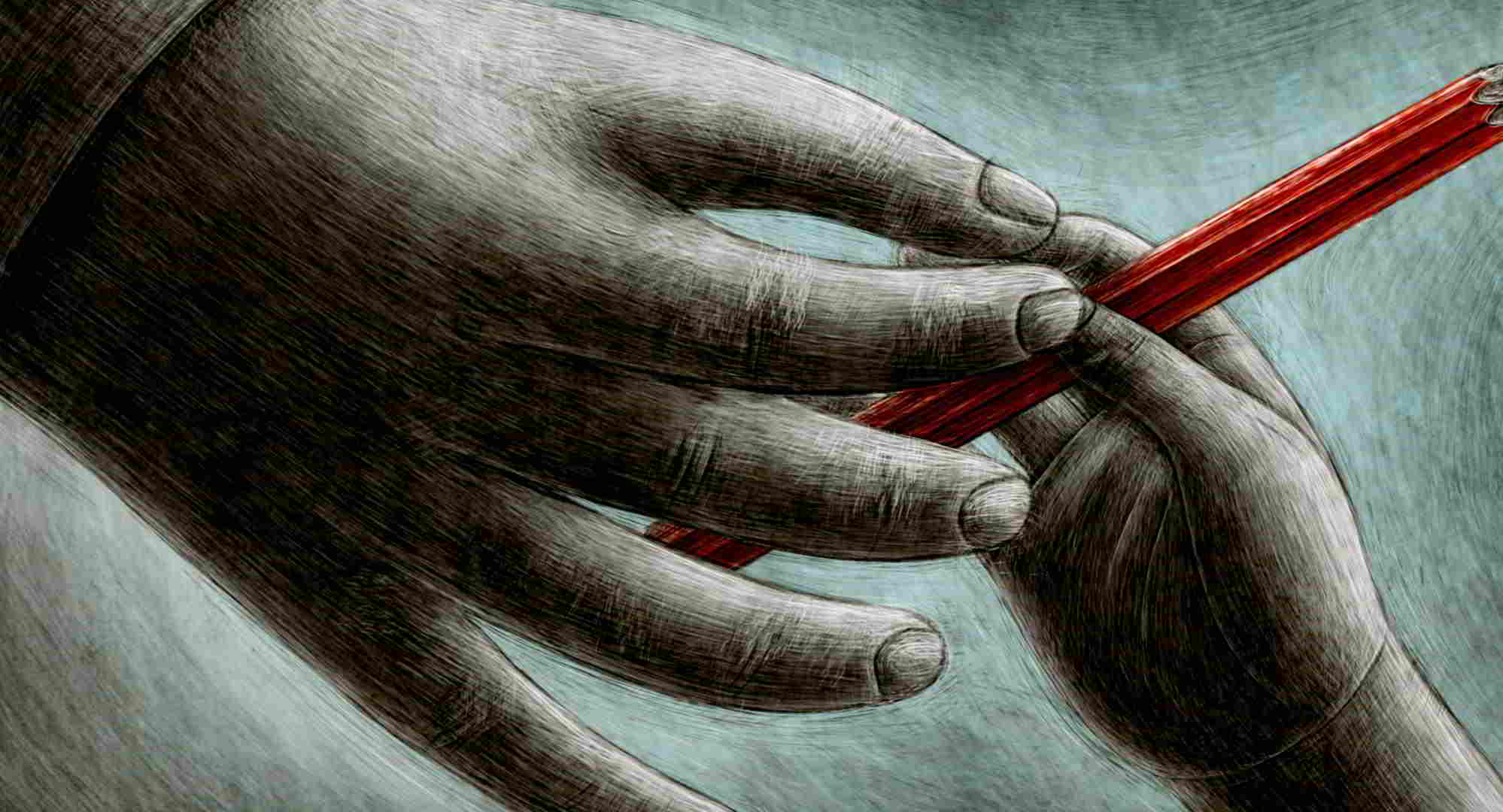
Uncle Thomas: Accounting for the Days, Regina Pessoa
ZF: In a conversation I had with Regina Pessoa, she spoke about living and creating together with the film crew in a countryside mansion in Portugal. She spoke of quasi-family relationship between the collaborators. As a producer of such an endeavor, haven't you had a feeling that it might be a risky way of working?
JR: That's a good question because it was risky indeed. However, on the other hand, Andreas Hykade, who lives in Germany, even as a friend, maintained that necessary distance. And I was, of course, based in Montreal, so I was also able to say sometimes: “Hm, I don't think we exactly understand what you want to say over there”. In the end everything depends on the filmmaker. Regina needs to experience human connection while working; she needs to connect really intimately with the collaborators so she can feel confident and comfortable. I remember visiting her in this “paradise” in Portugal, and at that moment, I understood why this environment had been created there. There was a sense of serenity around this countryside house, a garden, a pool where she swam every day. I think this feeling of being grounded allowed her to stay focused on her work.
ZF: And how did the process look for the authors of The Procession?
JR: That's a completely different adventure! It is Pascal Blanchet's and Rodolphe Saint-Gelais' first professional film. The concept came from Pascal, who is a famous Québécois illustrator. Every two years, NFB opens the contest in pursuit of emerging filmmakers. Even if he didn't win, his work caught my attention. And I read his graphic novels where I found a sense of music, editing, and lightning, so I thought animation was a natural medium for him. I was impressed by Pascal's designs, so I approached him and offered to work for NFB. He said, “Of course,” and that's how it started. At first, Rodolphe was a chief animator, but he contributed so many ideas that he eventually became a co-director. Finding really good collaborators for the first film is a lot of work. Pascal did the design, background, coloring, and so on. Rodolphe animated with the help of two animators, Nicolas Brault and Brenda Lopez Zepeda. Pierre Lapointe, a famous music composer, joined this small crew in the very beginning. Very early in the production, he sent music sketches, and that influenced them a lot, and so guided by the music, they planned mise-en-scène, the way to animate, etc.
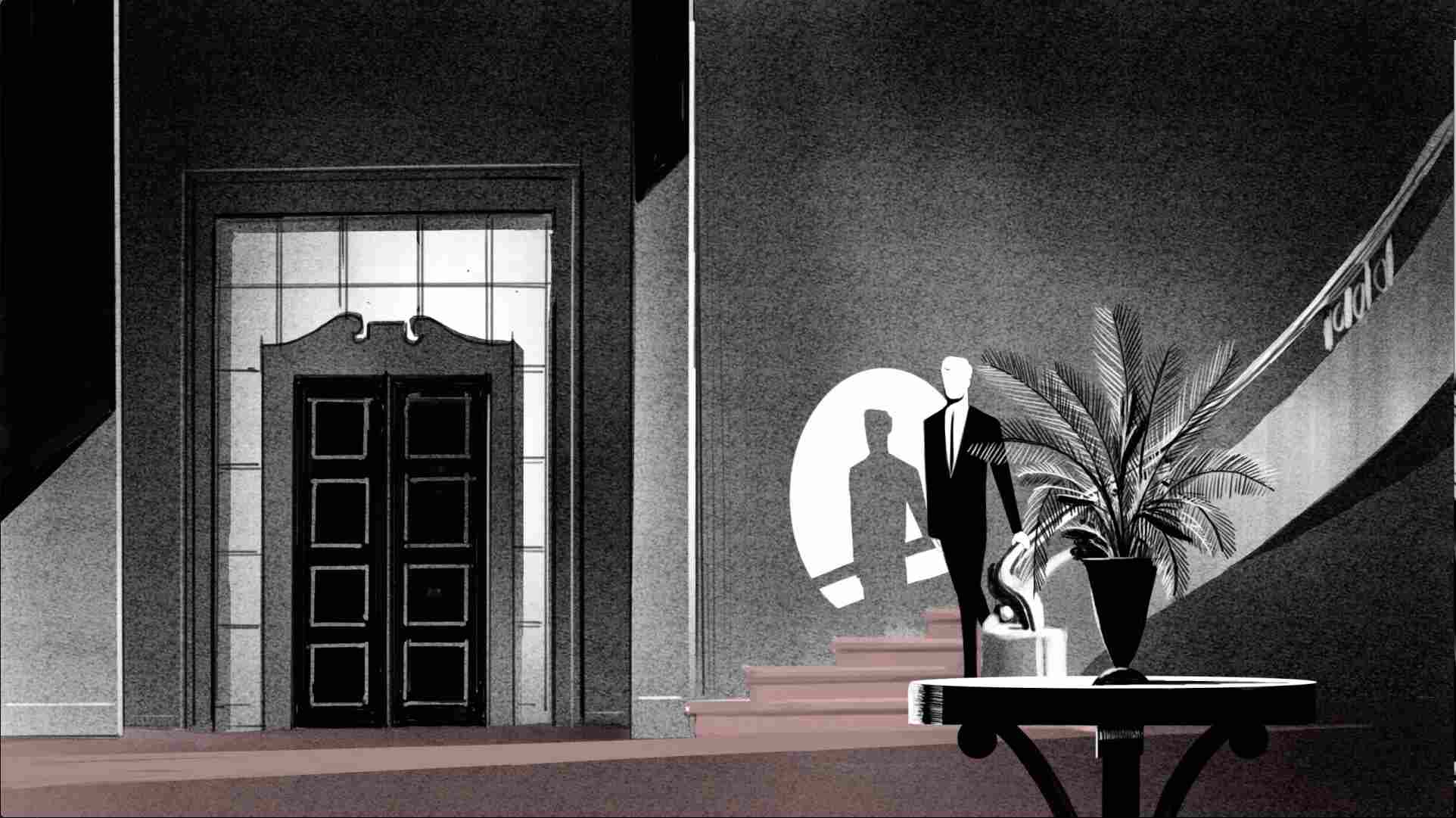
The Procession, Pascal Blanchet and Rodolphe Saint-Gelais
ZF: After twenty-five years at the NFB, you still scout for the authors...
JR: And this is the funniest part of my job. It's great when you find a talent and say, “Hey, your graphic universe is interesting, I would like to work with you!”. But it's challenging because there is a concept, yet there is no film! First, I suggested that Pascal worked with a scriptwriter, Sylvain Charbonneau. But then the editing! The production took some two years, and it's difficult to stay focused on all initial intentions and motivations during such a time. At some point, Pascal and Rodolphe have been a bit lost in storytelling since they have been editing by themselves – we just talked about necessary distance, well... here it was not the best idea. So I said: “Ok, stop editing by yourself, you need to work with Isabelle Malenfant”. She really challenged them, and that moment was the peak of the whole process! At the beginning, it was a story that seemed more like a collective portrayal of the family members, and this somehow lacked emotions. The focus moved to the love story between the two characters, and soon it became clear that it was a good solution, and this is how we continued. Every production has this moment of vertigo: “My God, are we going to make it?”. It is a natural stage, but you need to have good collaborators in order to achieve distance, receive advice, and improve your own project.
ZF: Let us speak about your academic background. You mention frequently that as a member of the animation scene, you are interested in critical analyses of the animation culture. What do you find most fascinating as a subject of critical analysis in regard to animation? What are your assumptions for this kind of research?
JR: If I distance myself from the role of the producer, I like to observe an animated film from a new point of view. Let me give you an example: in 2015, in Montreal, I programmed a special retrospective on the subject of womenhood and sexuality. I invited four women filmmakers to choose a film on the subject, but I also invited a sexologist to join the panel discussion. I wanted her point of view because she was not from the cinema culture. Sometimes I think there is something schizophrenic about our work milieu: we always discuss the same subjects with the filmmakers, animators, and illustrators, but here we were listening to her analyses conducted from a completely different perspective. We should reach out more to people from the “outside”. I had already used such a method while working on my MA at the University of Montreal. I wrote the thesis about the films of Michèle Cournoyer, and in the process, I interviewed a psychiatrist who commented on the films. This is how I've discovered completely new subtopics in her work. I think we need more such experiences that open up our minds and give depth to the films. In both France and Canada, I see more and more young filmmakers entering humanities studies at the universities, working on an MA or even a PhD, and this trend is really interesting. What's more, I think this experience makes me a better producer in the sense that I know how to analyze the film, how to evaluate it artistically and intellectually. I also use this mean in order to improve some projects. Once we had been making a film about near-death experiences, the discussions with a university professor with scientific expertise on the subject helped us improve the script.
ZF: Would you consider yourself a feminist or a supporter of a feminist change in the contemporary film environment?
JR: I don't know if I'm a feminist, but for sure I'm a supporter of feminism. Everybody's talking now about equality, but I did my share of writing and programming before it became sort of a trend, hence my interest in Michèle Cournoyer, feminist literature, and the feminist wave of the 1970s, etc.
ZF: In this case, please let me ask you a question. I'm addressing women of the animation scene who have been engaged in feminism for some time now. After a sort of two-year social media hype, I believe we are now facing a backlash. Contemporary feminist agenda of intersectionality on the one hand disperses in the internal conflicts, on the other hand, anti-women environments decisively struggle against women's rights defined as freedom of procreation and sexuality, workers' rights, and civil rights. Have you experienced backlash before, and if so, do you have some advice on how the contemporary feminist movement can respond to it?
JR: I work for public service in Canada, and we are obliged to be an example, so I don't think NFB is the place where you can actually experience that much backlash. NFB has a lot of policies for fighting harassment in the workplace or discrimination on the basis of culture, ethnicity, gender, sexuality, or race. Certainly, in the history of the studio, women were underrepresented, but importantly, I work with the artistic animation short format, and this is a completely different world from feature animation or TV shows. In recent years, I have observed an increase in the number of women joining the animation scene successfully. Five years ago, I wrote an article Women in Animation: Facts and Perceptions where I analyzed gender diversification among winners of the Grand Prix and selected works at the festivals in Annecy, Ottawa, and Zagreb since the year 2000. There were fewer than 25% films made by women selected to Annecy, and fewer than 20% in Ottawa and Zagreb. Fewer received awards. How representative is that if we consider the percentage in submissions? It would be interesting to see selection based on parity, and maybe it's going in this direction. Features, VR and TV shows are still problematic though. Wherever there is technology and a business model, we hardly find women there.
ZF: How to encourage submitters and selectors, then?
JR: There are ways we develop at the NFB. The director of the NFB has taken initiative in parties, not only regulating the number of films in production but also the budget aspect. And the last edition of the contest for emerging directors was dedicated only to women. It was interesting how this initiative succeeded. We had the same number of proposals – about fifty – and in the end, we asked the competitors whether they had still applied if the competition rules were different. Many said “No, not necessarily” and that the specificity of the 'only-women-competition' was encouraging for them. It was hard to believe that, still in 2019, there is such a lack of self-confidence among women creators, but I'm an optimist and I believe in evolution, so we won't need to have this kind of conversation in ten or fifteen years. In order to progress, we need more and more model women filmmakers such as Anca Damian or Signe Baumane, strong authors of incredible films.
ZF: So here we arrive at yet another angle of critical analysis of animation culture. But let's speak for the end about the VR productions in which you have been involved to a greater or lesser extent. What are your expectations regarding the development of this medium?
JR: I'm interested in the development of technology, and I'm also interested in VR. Chris Lavis and Maciek Szczerbowski made Gymnasia and I think this is one of the most interesting VR I have ever experienced. It doesn't look like anything else, and I think this is a matter of the point of view. VR explorations, anyway, open up for change of perspective as well as research into ethics. Naturally, it's another way to work with animation, also in the sense of storytelling and communication with the audience. I don't know where the medium is going but it is very interesting when all these aspects are considered.
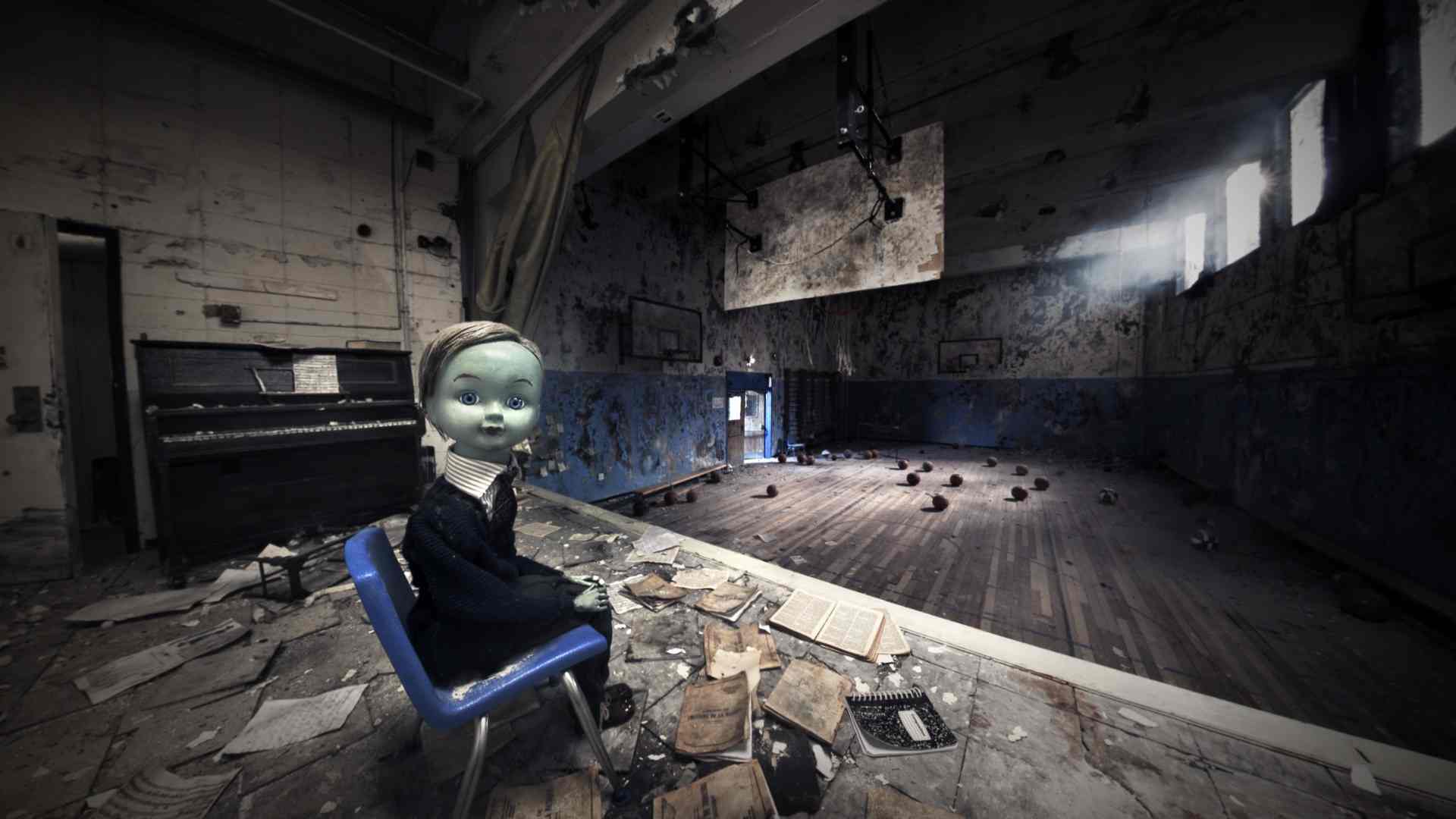
Gymnasia, Chris Lavis and Maciek Szczerbowski
ZF: So, how does this new way of work look from your perspective?
JR: If production of animated film at NFB may be “one woman/ one man show”, VR production requires a big crew from the very beginning: programmers, designers, etc. With all these many different collaborators, the production has a completely new itinerary. For the film, we write a script, draw a film, and edit, but here all the production steps are mixed together, and again, this interdisciplinary approach is exciting.
ZF: Since we recalled Gymnasia already, let me ask you about your new plans with Maciek Szczerbowski and Chris Lavis.
JR: I'm very, very proud to work with Chris and Maciek on their new short, but this is going to be a fifteen-minute, linear, traditional, puppet film. I spoke highly about Regina, and I also want to speak highly about Chris and Maciek. They are brilliant and smart. Each time we face a challenge, they always find an exceptional way to resolve the problem. I think the script they wrote is one of the best I've ever read. It's called The Young Girl Who Cried the Pearls, and the production, scheduled for two years, should start by the end of this year. Perhaps VFX effects will connect this new film with Gymnasia, but this will be the only connection. Every project brings change.
Olga Bobrowska, Annecy Festival 14.06.19
Want to read more free articles like this?

Keep this professional animation journalism effort relevant and updated. Become our patron