
THEM by Robin Lochmann
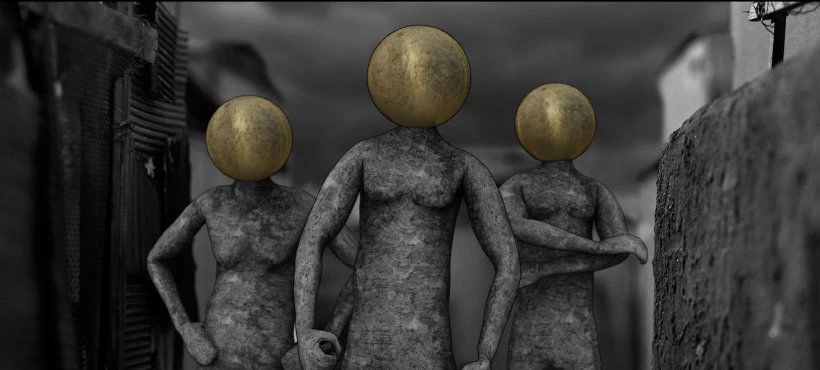
In a forgotten village, where everyone is cut from the same cloth, a new, self-proclaimed leader arrives changing the local way of life. Dividing lines are carved out as the once unified society is torn and segregated. THEM is a cautionary tale of misguided ideologies, destructive leadership and of being an outsider. But most importantly, it is a film about celebrating what we have in common rather than what separates us.
Zippy Frames talks to Robin Lochmann about the socially conscious animation short film, THEM, which now premieres online.
ZF: How long has this idea been gestating, and what was its genesis? Contemporary social events, personal story, or something else?
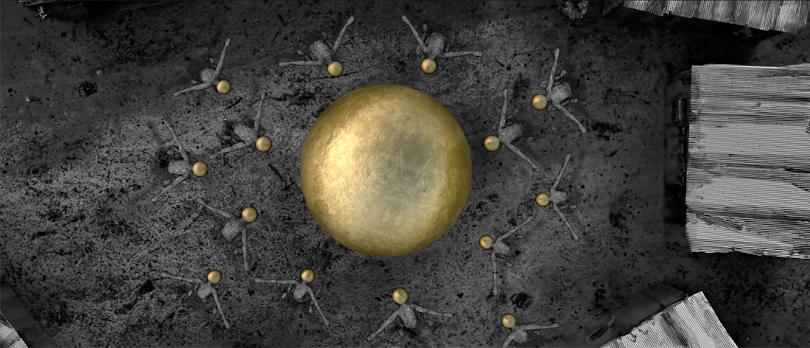
RL: The idea fell into place rather quickly after I had been experimenting with a miniature river that was originally intended for a music video. The video was canceled, but I still liked the image of this golden river in a blackened landscape. I started placing some tiny characters into the scenes and then thought it would be interesting to tell the story of a society’s rise and fall from a bird 's-eye perspective. This was also just after Trump was elected, so having a leader who was dividing the people seemed appropriate. It was important to me that, although the film is full of symbolism, it would still be clear what was happening and that the story remained accessible. Using color to show different ideologies or beliefs was a way to simplify a larger concept and leave room for the audience to read into it what they saw fit. Once I had these elements, the script practically wrote itself in a couple of days.
Watch THEM by Robin Lochmann
ZF: When making films that have a direct social connotation, it is tempting to forget the ramifications of the story itself and go for the "message". But here the story itself is worked out well. Did you have a lot of drafts, ideas, or did everything come in naturally?
RL: The final film is actually pretty close to the first draft. I bounced the script off some friends and made a few slight changes, but the heart of it didn’t change much.
ZF: Was the decision to have your characters' faces just a simple globe (no identifying facial characteristics) already there from the start of your development process?
RL: Yes, it was there from the beginning. I started by testing stop-motion sketched characters, and in the early versions, they still had eyes. But it was always important to me that they didn’t have any other features because otherwise the story wouldn’t work. They should feel human in their movements and mannerisms but the audience should not view them so much as individuals but rather as a group that has a unified agenda. The only thing that they identify with is the color.
ZF: Why did you first shoot the background and then have the mock-up with the actors? And why use sets at all and not 3D?
RL: I love miniatures! I wanted to keep a handmade feel to the film even though the characters are digital. I did some tests myself before teaming up with some great miniature artists and prop makers in Berlin who brought it to a whole new level. Shooting all of the backgrounds first helped to know the exact placement of the characters and how much room they would have to maneuver in.
Making of THEM:
ZF: The actors' input is really quite strong. I remember watching the film, and one of the characters had to spit on the other character. It felt very real; what kind of instructions did you give to them?
RL: That’s nice to hear. Ryan James is an actor friend of mine who did all of the movement and a large part of the voice work. We had one day to capture all of the movements, and we only had one motion capture set up, so he had to do all of the different characters himself. When two or more characters would interact together, we would just count out all the beats so he could hit the mark. This worked surprisingly well. He was also reading early drafts of the script, so he knew the project well, and there is certainly a lot of his personality in those movements. The actual task of doing the motion capture was fun because it felt like two adults playing pretend like children for a day. It was great.
ZF: Mo-cap can be both expensive and requires expertise as well. How did you figure all these out (and budget-wise) along with your producer?
RL: I still had intended to do the characters in stop motion until a few weeks after the shoot. But then I started seeing affordable motion capture solutions coming out that were getting some pretty decent results. It wouldn’t have been possible to do this even a year earlier because the technology wasn’t available unless you went to a really expensive motion capture stage. I found someone in Denmark who had been testing some different setups and let me use one of his kits for a day. The hardware wasn’t actually on the market yet, and the software was still in beta, so there weren’t many resources to learn from. There was a lot of trial and error and clean-up work needed on the mocap data, and it took some time before I had a workflow down to actually get the characters into the scenes. This was by far the most painstaking part of making this film.
ZF: What do you think is the power of art and indie animation shorts during these times? Can it inform, alert, and make people protest? How would you like for the "Them" project to reach out to your audience?
RL: I do believe that culture can shape society. But I don’t think that it happens overnight or from one film or one piece of art. I see THEM more as being a small part of a much larger conversation. I don’t think I will be able to change people's minds with one short film, but I do feel like the message is one worth pushing out into the world, and maybe it’s one extra drop in a larger pond. Being convinced that the message was worthwhile helped keep me motivated during the whole production.
ZF: What about your collaborators?
RL: I spent many hours working on this film, but I couldn’t have done it without the brilliant crew of people who helped. We never had a budget for the film, so it was all done out of my own pocket and by people being convinced of the idea and wanting to help. I had some really talented people who helped me in every department,t and every collaboration added something new to the film.
Film Review (Vassilis Kroustallis)
There are films that state the obvious and still feel relevant. THEM by Robin Lochmann belongs to this category, not just because of its zeitgeist (immigrant influx and our own behaviour); it will orchestrate a three-act narrative which follows a well-trodden path, but is still beguiling in its unfolding. Make no mistake, this is the setting of the underprivileged; the sets only alert to the fact that even in these settings, hate can erupt at any given time. Greed, natural resources exploitation, and a lot of human stupidity ignite interaction; at the same time, the perfect globe as a non-identifying face both reveals and conceals (when colored) the common humanity element. THEM is energetically shot, poignantly scored, and competently laid out as a case for re-cognizing our common need to be together or perish.
About Robin Lochmann
Robin Lochmann was born and raised in Ireland, where he studied media and film production. After college, he worked on various film and TV productions in a variety of capacities before moving to Berlin in 2009, where his focus shifted more to post-production. He continues to work in post as well as bringing his own ideas to screen and makes music videos, short films, art films, commercials and branded content.
Credits
Written, Directed and Animated by Robin Lochmann | Director of Photography: Mika Ceron | Music: Thomas Moked Blum | Produced by Robin Lochmann, Mathias Schwerbrook | Motion Capture Performer: Ryan James | Miniatures: Berton Pierce, Claudia Brugnaletti, Alex Friedrich | Sound Design and Mixing: Frank Kruse | Voice Recording: Ryan James | Foley: Carsten Richter | Mixing Assistant: Maxim Romasevich | Editing and Postproduction: Robin Lochmann | Postproduction Assistant: Laura Adel | Grading: Federico De Luca | Fluid Simulation: Alex Mackay | Associate Producer: Julia Radke | Voice and Vocal Performers: Ryan James, Yalin Özer, Keegan Luttrell, Gregory Norton, Patty Mulloy, Estrella Bonilla, Ljubina Krnjajic, Marco Wedel, Henning Koch | Set Assistants: Hamed Mehravaran, Filippo Spreafico, Keegan Luttrell | Thanks to: Birgit and Peter, Frank Nagel, The Post Republic GmbH, Michael Reuter, Petra Kader-Göbel, Alexis Jang, Martin Stebbing, Jilianne Schröder, Patrica Trenkle, Maria Swiderski, Nikolai Stefansky, Filmbauarbeiter GmbH & Co KG, Delight Rental Services GmbH, Twopair Films
Want to read more free articles like this?

Keep this professional animation journalism effort relevant and updated. Become our patron