
Shorts
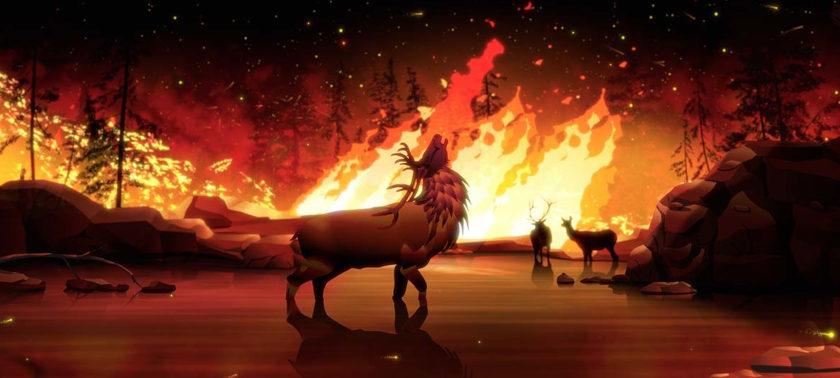


Yellowstone 88: Song of Fire by Little Fluffy Clouds
ZF Team
In the summer of 1988, dry lightning sparked a fire in the parched and drought-ridden landscape of Yellowstone, igniting a blaze that would scorch over 1,500,000 square acres of the park.
The incident also sparked a TEDx talk by George Monbiot, which the crew of Little Fluffy Clouds attended. A small indie California studio founded by Europeans, Betsy de Fries and Jerry van den Beek. Little Fluffy Clouds studio purposefully stays, as its creators state, "small and nimble so that we could take time to create our own films and life, and be true to our own core artistic impulses and beliefs". Together, they created Yellowstone 88: Song of Fire, an animation short.
Watch Yellowstone 88: Song of Fire
Zippy Frames talked with Betsy de Fries and Jerry van de Beek
ZF: So, did the film come originally from the Betsy de Fries poem Song of Fire, and the poem itself was the result of the TEDX talk by George Monbiot?
BdF: My partner, Jerry van de Beek, and I read and watch a lot of conceptual pieces about life on this planet. George Monbiot’s TEDX talk on Trophic Cascade was a glorious realization for me personally. It is inspirational that the presence of an apex species, in this instance, Wolves, can change an entire ecosystem for the better. Jerry and I are fascinated with the family structure of Wolves and had long wanted to make an animation about them – in addition, Jerry wanted to make an animation about the giant old-growth Redwoods. In researching those two themes, we came upon the story of the fire in Yellowstone Park, which destroyed over 1,500,000 square acres of the park. It didn’t take long to discover that this event is recognized as being one of the earliest incidents caused by climate change. And this was the kernel or spark that led to the project.
ZF: Was it easy to research the event itself? Did you go to the park yourselves to see its past and present?
BdF: Yes, there’s a lot of information about the Yellowstone fire online and on the park’s website. We read as many facts about the event from as wide a source base as possible. These sources included talking to National Park Service personnel and fire professionals who worked the fire about their experience during the conflagration for both interest and accuracy. We reviewed NPS sites, read the local and national newspapers' daily reports about the fire, along with post-fire analyses – public and private - and watched as many videos as we could find of the fire and those that covered animal and bird behaviour during forest fires.
Due to the pandemic lockdown, we have not been able to go to the park, although it’s on our radar to do just that and to meet and talk with the many people there who helped us with our research.
ZF: Do you think that if you had a simple narration here (instead of a poem) it would have worked the way you wanted to work? And can you tell us more about Peter Coyote's involvement in the film?
BdF: A simple narration would not work in the same way that the poem, which lends a certain rhythmic cadence to a story, does - and this also guides the animation. We wanted the power of the spoken voice to carry the viewer along the journey, and we wanted to impart a magical impact to it. Yellowstone, as with many other UNESCO heritage sites, has a true spirituality about it. The dark skies reveal spectacular starscapes and allow us to see and feel our fragility on this planet and our small place in the cosmos.
Apart from being a respected author, director, screenwriter, and narrator of many films, theatre, television, and audiobooks, Peter Coyote was also our neighbour for many years -and a Buddhist Zen Master. He read the mission statement for our previous animation, As The River Flows, one that tells the story of the return of the charismatic River Otter to the Northern California watershed. Peter is a great environmentalist and a big supporter of ecological rebalance. This was the first time Peter had ever recorded a poem, but in just a few takes, he brought something very special to the project, a different style than we first imagined. That reading changed the animation; it inspired us to reassess and rework certain scenes to add or emphasize meaning. Peter’s involvement, although brief, was incalculable to the whole process.
ZF: The movements in Yellowstone 88 are very potent, and the contrast between characters and their backgrounds is a constantly changing one. How did you accomplish this in terms of animation (software, etc.) and compositing?
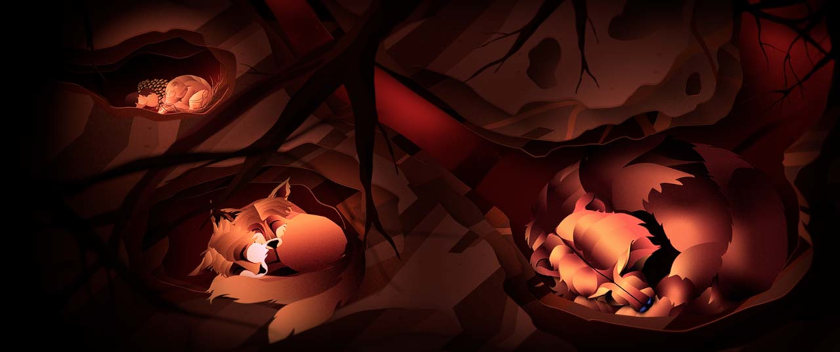
JvdB: When we start on any animation project, we create style frames and test animations to get a feel for the characters and the environment they live in. In the story, we find our characters in two main settings, the fire and the snow. Because of that, the images are automatically high in contrast, so we decided to push that and make that part of our visual narrative. We also always liked the look of shadow puppets you see in Indonesia. It’s amazing the effect you can achieve with simple shapes. Using both those ideas, we started constructing scenes in After Effects by stacking layers and adding a 3D camera to create depth.
ZF: It seems that the images complement the poem here; still, I was wondering if you had more animation scenes that you drew and animated, yet did not fit into the final film.
JvdB: We didn’t really remove scenes from the film, but we did change the scenes over time. It takes a long time to complete a project like this, as we can only work on it between paying projects. A lot of the time, we end up working really hard on it, then laying it down for a month or two, and then getting back to it. You never just start up from where you left off. You revisit everything first, and often you see things slightly differently, so you make changes. On top of that, when we started working with Peter Coyote for the reading of the poem and Mark Murphy for music, timings changed, and their input led to new ideas. It’s perhaps not the most efficient way of working, but for us it was important that we told the story as best as we could.
ZF: Mark Murphy's score is as grand and dramatic as the theme itself. How did you collaborate with him?
BdF: Mark Murphy’s score was outstanding from the very first version he sent over. He came on board towards the end of the animation production. His studio, Secrets and Machines, is in Dublin, and he was in lockdown over there, and we were in lockdown over here in California. That meant we were forced to work together remotely, but it wasn’t a problem. We sent him the poem and each work in progress, with as much of the animation in place. Detailed notes were written, and then we jumped on Zoom, like everyone else, and collaborated that way. There was a lot of back and forth. After Peter read the poem, we added and lengthened some scenes, which required re-timing and adjustments to the music. This took time and much discussion, but resulted in an even more magnificent score and animation.
ZF: Are the 1988 wildfires still a traumatic event for Yellowstone National Park nowadays, or is it perceived as a thing of the past?
BdF: Fires of this magnitude will always leave their scars on the landscape and in the minds of the people who witness or suffer from the event, and so the fire is commemorated at Yellowstone Park. What’s important is what we learn from them and how we make changes for the better to prevent such tragedies from happening again. It’s an ongoing task. As we can see from events in Paradise, California, and Lytton, British Columbia, the past has fast caught up with us now.
The fires at Yellowstone Park are acknowledged as being a direct result of climate change, coupled with modern man's intervention in nature and the standard National Park Service fire suppression policy of the day. Years of drought, a lack of understanding of wildfire and its place in the health of forests, constant underfunding and slashing of infrastructure budgets, and a policy of fighting every fire rendered the park vulnerable to a major conflagration.
Multiple lessons in wildland fire management were learned from those harrowing months - lessons that continue to shape ongoing policy, communication, and command structures, and changes in critical ecological doctrine. The prescribed burning techniques of the Native American tribes that populate the region were reviewed and, in some instances, brought back. It is a continuing and ongoing process.
ZF: People could say that nature knows what it does best, so let's leave it to its devices to destroy and recycle itself. Is this a view that you share?
BdF: Fire plays a huge part in the renewal of healthy forests and wild lands. As we see today in the West, burn areas are natural control points for subsequent wildfires. The continuing growth and encroachment in forested areas and wildland interface areas are unsustainable. The suppression of all fires is unworkable both practically and for the renewal of the land. Prescribed burns are a necessity. We must quickly relearn the old ways of land management and act responsibly as true stewards of the land. A larger question is - can we allow nature its rightful place in a people-centric world?
For instance, wolves are magnificent apex creatures, and we are big supporters of their being reintroduced across the planet to do what they do best in sustaining and rebalancing the planet’s ecosystems. Beavers are the same.
Decades after the Yellowstone conflagration, the rural community of Paradise, California faced a similar fate resulting in unparalleled and unimagined devastation and loss of life and just recently soaring temperatures of 121°F/49°C, caused the catastrophic destruction and loss of life in the small Canadian mountain village of Lytton, British Columbia, a place where the normal average temperature is 62°F/ 17°C. That is a wake-up call. Rewilding seems impossible in our overcrowded world, but it is essential if we are to have a world of balanced nature worth living in.
Film Review (Vassilis Kroustallis):
The sense of urgency is palpable in the flowing depiction of Yellowstone's 1988 wildfires, in which no humans are present, but the flora and the fauna need to find a way to rekindle themselves. A drama with necessarily highly contrasting color tones, the film still feels like a quiet (yet potent) description of the event, largely due to Peter Coyote's matter-of-fact narration of the inevitable and the poem itself; there is no need to feel sorrow or pity for the forest creatures. They could take care of themselves, yet the rhythmic nature of the poem suggests a cycle that needs to be observed -and refined. With a camerawork that painstakingly attempts to capture movements and scenes from the sky to the ground and below the ground, and a score that always keeps you alert, Yellowstone 88: Song of Fire is a thoughtful chronicle of an event and a place, whose sheer observation can motivate feelings -and hopefully action.
About Little Fluffy Clouds
Little Fluffy Clouds is an award-winning Bay Area production studio specializing in high-end motion graphics and animation in all forms. Talented, imaginative, experimental yet pragmatic, we bring a unique edge to everything we do. Our compulsion for storytelling, interwoven with a constant eye for exploration, development, and investment in the latest technologies, allows us to think freely, playfully question, concept, dream, draw, code, animate, and deliver experiences that enable our clients' ideas to shine. Diversity of style is the LITTLE FLUFFY CLOUDS watchword.
Little Fluffy Clouds on the web, Instagram
Want to read more free articles like this?
Keep this professional animation journalism effort relevant and updated. Become our patron