
Festivals



African Animation, Reclaiming the Image (Guest Article)
ZF Team
Guest Author: Mohamed Ghazala
From Early Pioneers to a Continental Renaissance
This week in Cairo, Animatex Animation Festival launches a celebration that has been decades in the making: the anniversary of African animation. What begins in Egypt will continue across multiple countries, marking not only a historical milestone but a collective reclaiming of voice, image, and creative agency.
For much of animation history, Africa has appeared on global screens as scenery rather than source. Hollywood blockbusters like 'The Lion King', 'Madagascar', and 'Tarzan' borrowed African landscapes and symbolism, yet were conceived, produced, and creatively controlled outside the continent. African cultures were visible, African creators largely absent.
This imbalance has deep roots.
From early American cartoons of the 1920s and 1930s that portrayed Africa through colonial fantasy, to contemporary studio productions, the continent was framed as exotic, wild, or primitive. These representations shaped global imagination while excluding African perspectives.
Yet animation in Africa did not begin with foreign studios. It emerged from within African societies themselves, grounded in oral storytelling, ritual performance, puppetry, shadow theatre, and symbolic visual traditions. Long before digital tools, African cultures already understood movement, transformation, and narrative continuity, the foundations of animation.
This anniversary is not simply about celebrating films. It is about reclaiming authorship.
Creating Under Constraint
Colonial policy actively restricted Africans from producing their own images. The Laval Decree of 1934, enforced across French West and Central Africa, required official permission to use cameras or sound equipment. This effectively delayed indigenous filmmaking, including animation, until independence in the 1960s.
Despite these obstacles, pioneers emerged.
In 1936, the Frenkel Brothers produced 'Mafish Fayda' in Cairo, introducing one of Africa’s earliest animated characters. In Egypt, Ali and Hossam Moheeb founded the animation unit at Egyptian State Television in 1961, followed by 'The White Line' (1962), which helped train a generation of animators.
Across the continent, similar breakthroughs followed. Algeria’s Mohamed Aram created 'La fête de l’arbre' (1963), using animation to promote environmental awareness and post-independence identity-building. Niger’s Moustapha Alassane produced politically charged, folkloric works such as 'La mort de Gandji' (1965) and 'Bon Voyage, Sim' (1966). Egyptian animator Ihab Shaker advanced experimental approaches with 'The Bottle' (1968). In South Africa, William Kentridge transformed charcoal drawings into powerful political animations confronting apartheid and memory. In the Democratic Republic of Congo, Jean-Michel Kibushi adapted Tetela folklore into stop-motion with 'Le Crapaud Chez Ses Beaux-Parents' (1991).
These artists were not building entertainment industries. They were establishing a presence.
Working with cut-outs, puppets, charcoal, and found materials, they developed an animation language shaped by necessity, cultural memory, and social urgency.
Is There an African Animation Style?
Africa is not a single aesthetic. It is over fifty countries and thousands of artistic traditions. Yet common threads appear across its animation.
African works often draw directly from folklore and oral storytelling. They favor symbolic imagery over hyper-realism. They engage openly with politics, the environment, and community life. And they frequently embrace hybrid techniques, blending drawing, stop-motion, puppetry, and digital tools.
This is less a formal “style” than a shared ethos, cultural specificity combined with creative resilience.
Where mainstream animation often prioritizes polish and spectacle, African animation tends to prioritize meaning.
Education, the Quiet Revolution
A turning point came with the growth of animation education across the continent.
Egypt now hosts programs at the Cairo High Cinema Institute, Helwan University, Minia University, and Fine Arts faculties. Tunisia’s ISADAC and universities in Tunis and Sfax train digital artists. Kenya supports emerging talent through ADMI, Visualdo Institute, Equip Africa, and Nairobi Institute of Technology. South Africa leads with The Animation School, SAE Institute, CityVarsity, and False Bay College. Regional initiatives such as Triggerfish Academy and international collaborations have expanded access even further.
This educational ecosystem has transformed animation from an isolated practice into a professional pathway. Students now graduate with both technical skills and cultural confidence, prepared to tell African stories for global audiences.
From Shorts to Features
For many years, African animation lived primarily in short films and experimental works. Feature-length projects seemed unattainable.
That is changing.
Zimbabwe’s 'The Legend of the Sky Kingdom' (2003) marked Africa’s first animated feature. South Africa followed with 'Tengers' (2007). Egypt released 'The Knight and the Princess' (2019). Nigeria entered the field with 'Lady Buckit and the Motley Mopsters' (2020).
Studios such as Triggerfish Animation Studios in South Africa, Animation Lab Africa in Kenya, and Les Films de la Brousse in West Africa now produce shorts, series, and features. Streaming platforms and social media have further expanded visibility, allowing African animation to bypass traditional gatekeepers.
African creators are no longer waiting for permission.
Creative Strengths, Structural Challenges
African animation today demonstrates remarkable strengths: cultural authenticity, inventive aesthetics, and strong engagement with social realities. Films and series address identity, leadership, environment, and history. Projects like Yellow Fever, A Kalabanda Ate My Homework, and Kizazi Moto: Generation Fire show how African animators merge local narratives with contemporary forms.
Yet serious challenges remain.
Animation is capital-intensive. Many studios struggle with funding, infrastructure, hardware access, unstable electricity, and limited distribution. Technical polish often trails global competitors, not due to lack of talent, but lack of resources.
There is also growing pressure to conform to international visual standards, risking the erosion of local aesthetics in pursuit of marketability.
The central tension persists: how to scale globally without losing cultural identity.
Co-Productions and Global Reach
International collaborations have accelerated visibility. Disney’s partnership with Kugali Media on Iwájú brought futuristic Lagos to global screens. Triggerfish co-productions like Zambezia and Khumba reached international cinemas. Tinga Tinga Tales introduced African folk stories to children worldwide. Disney+’s Kizazi Moto showcased creators from across the continent.
These partnerships provide funding and technology, but also raise questions about ownership, creative control, and narrative framing. Long-term sustainability depends on building strong local industries alongside global alliances.
Animatex and the Power of Festivals
Festivals now play a critical role in shaping African animation’s future.
Across the continent, events such as CTIAF in South Africa, LIFANIMA in Nigeria, AAFFia in Ghana, CANIMAF in Cameroon, Meknes Animation Festival in Morocco, and Animatex in Egypt provide platforms for screening, training, and professional exchange.
Launching this anniversary at Animatex carries symbolic weight. Cairo has long been a cultural hub, and Egypt was home to some of Africa’s earliest animation experiments. The celebration reframes African animation as a living movement, not a historical footnote.
Beyond Film, Toward Digital Worlds
African animation increasingly intersects with gaming and interactive media. Nigerian studio Maliyo Games collaborated on Iwájú: Rising Chef. Cameroon’s Kiro’o Games created 'Aurion: Legacy of the Kori-Odan'. Kenya’s Usoni imagines a future where Africa becomes humanity’s last refuge. Morocco is investing heavily in gaming infrastructure, positioning itself as a regional hub.
These developments signal a broader creative economy where African animation expands beyond screens into immersive digital worlds.
Africa is not just telling stories anymore. It is building universes.
A Continental Turning Point
African animation has traveled a long road, from colonial silencing to digital renaissance. It has survived through ingenuity, cultural memory, and relentless experimentation. Today, it stands at a turning point.
Education is expanding. Studios are growing. International audiences are paying attention. But the future depends on local investment, regional collaboration, and unwavering commitment to African perspectives.
This anniversary, launched at Animatex and echoed across countries, is more than a celebration of past achievements. It is a declaration of presence.
African animation is no longer peripheral.
It is reshaping global narratives, expanding animation language, and reclaiming the right to self-representation.
And that is what we celebrate.
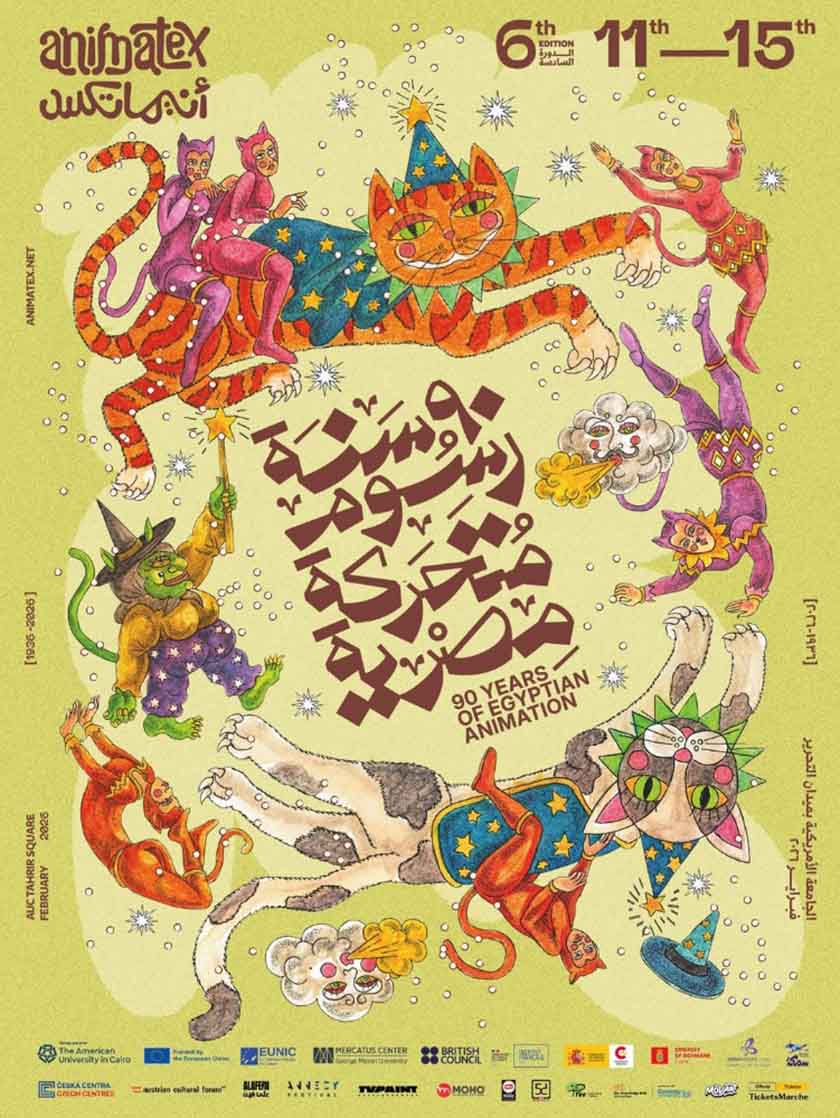
Animatex Festival poster - 2026
Animatex festival takes place from 11 to 15 February in Cairo, Egypt.
Contributed by: Mohamed Ghazala, Ph.D.
Want to read more free articles like this?
Keep this professional animation journalism effort relevant and updated. Become our patron