
Reviews 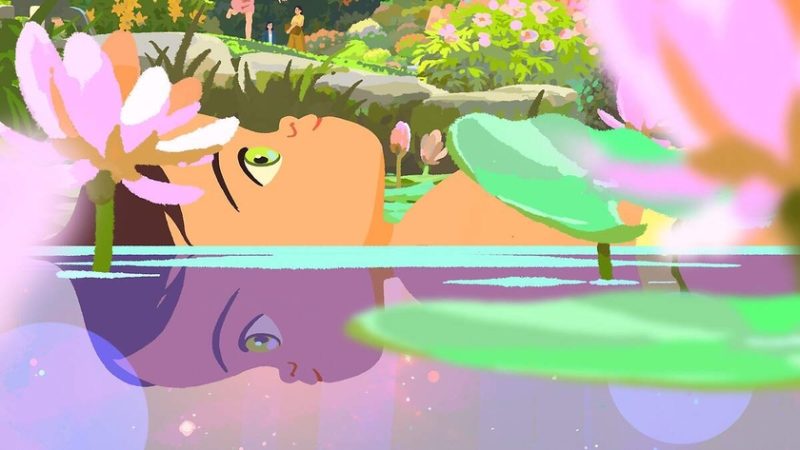
‘Little Amélie or the Character of Rain’ by Maïlys Vallade and Liane-Cho Han: Film Review
Olivia Popp
As a first collaborative effort between Maïlys Vallade and Liane-Cho Han and the feature film debut for both, ‘Little Amélie or the Character of Rain’ (original title: ‘Amélie et la Métaphysique des tubes’) has taken the summer film world by storm—pun intended—with its inventive approach to depicting the life of a young girl, hardly three years old, as she encounters the world around her. The screenplay—by the directors along with Aude Py and Eddine Noël—is adapted from Amélie Nothomb’s 2000 bestselling autofictional short novel, ‘Métaphysique des tubes’ (English title: ‘The Character of Rain’). After world-premiering in the Special Screenings strand of Cannes and winning the Audience Award at Annecy, ‘Little Amélie’ most recently played at San Sebastián International Film Festival in the Perlak section and scooped the Audience Award for Best European Film.
It’s 1970s Japan as told through the big green eyes of two-year-old Amélie (Loïse Charpentier), a girl with two siblings and born to Belgian parents—her father, Patrick (Marc Arnaud), is a diplomat—and, curiously enough, a girl who believes herself to be God, in a way: non-speaking and disinterested in mortal things. Because of this, her family is told she’ll be nearly vegetative all her life, until everything changes when she hits her third birthday. Amélie is revealed to be a precocious, fast-talking child with plenty of opinions and a zest for life. This zest, however, brings into question the many societal boundaries put in place as a sheltered, white child in post-war Japan, her childlike enchantment and pure curiosity clashing with what she is told she can and can’t do or what is and what isn’t.
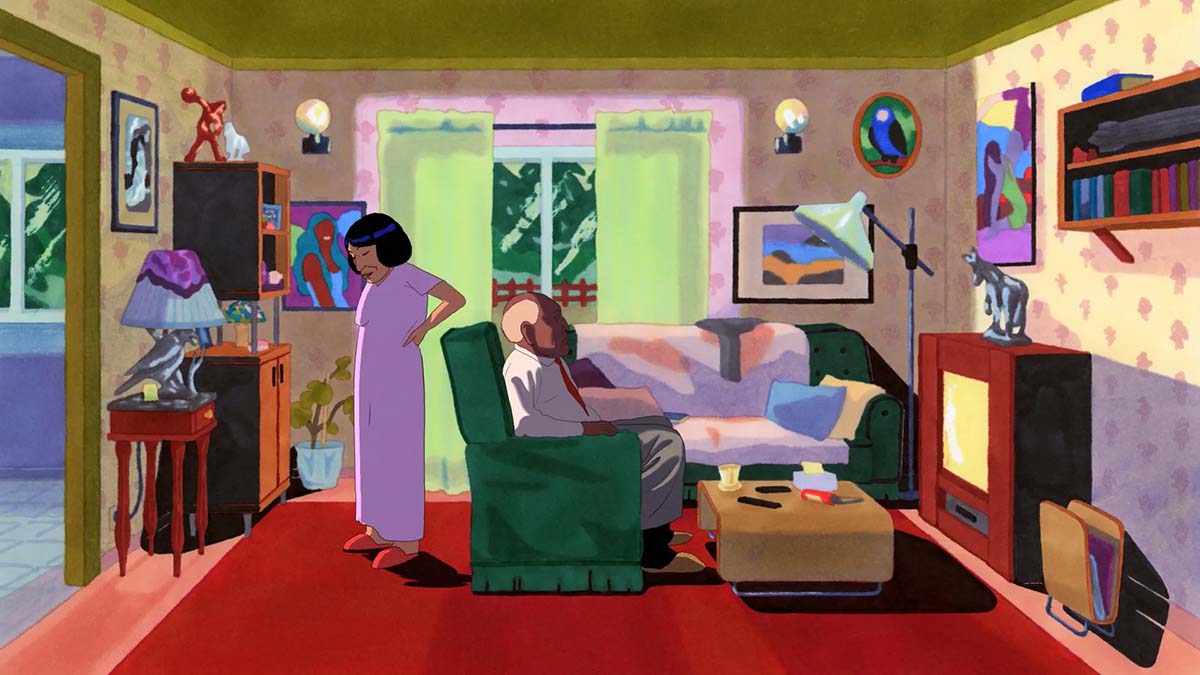
As we dive deeper into the psyche of Amélie and its pinch of magical realism, the film’s bright colours illustrate the little girl’s outlook on life in storybook quality. Japan of half a century ago is brought to life in such vivid quality, with special attention to the small details: the red of Japanese maples, the soft fuzziness of pink flowers, and the warm glow of traditional lanterns. However, something existential lingers beneath the surface, exemplified by the blue shadows of scenes that poke at the film’s darker elements; the film’s extraordinarily heavy themes often purposely butt heads with the animation style’s bubbly, welcoming quality. For instance, Amélie’s naïve insistence that she is Japanese is met with immense resistance, as she sees Japan as home and maintains a close, tender relationship with the family’s caretaker and her ad hoc nanny, Nishio-san (Victoria Grosbois), made out to be in her late 20s or 30s.
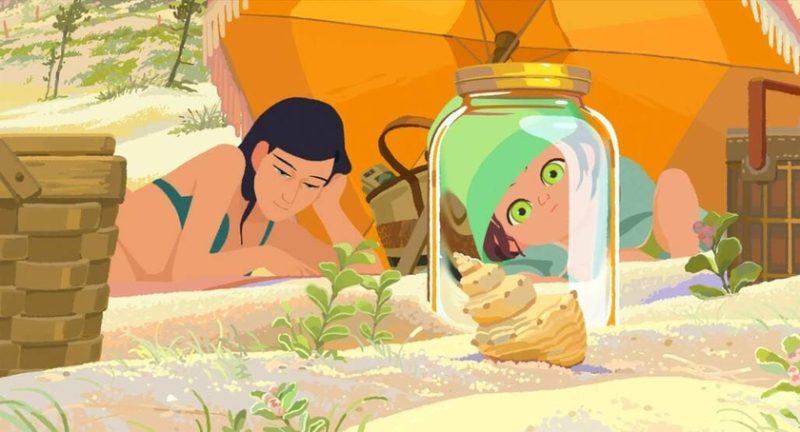
Nishio-san quickly becomes Amélie’s favorite person, as she grants the young girl many liberties and spends well-needed quality time with her—and the film’s music and orchestration by Mari Fukuhara is most present as tumbling piano played by the woman. Nishio-san’s role in the story has another dimension: her reluctant retelling to Amélie of the harrowing death of her family during World War II by Allied attacks further gets at the contextual conflicts that gnaw at the story. This is furthered by Kashima-san (Yumi Fujimori), their strict Japanese landlady who holds a heavy grudge against the family for being on the side of the “enemy”, decades after World War II, in light of what is undoubtedly immense trauma she holds within her
With this in mind, the filmmakers engage in a very careful balancing act. Young audiences may not understand the depth of this story, but still will be enticed by the relatability of the curious Amélie, while adult audiences have to grapple with both Amélie’s worldview and that of the complex sociohistorical space around her. In this sense, the story is not fully fleshed out through its short runtime of 78 minutes, with many of the themes skimmed over rather than the gap between the girl’s perspective and the so-called “real world” being interrogated. ‘Little Amélie’ has the potential to also be a valuable tool for learning—such as Amélie trying to wrap her head around such intense hate at a young age, what is meant by cultural differences, or working to understand the death of her beloved grandmother—but many of these crucial moments are landed on only briefly.
The film is capped off by what is implied to be the child’s attempted suicide, an incredibly intense narrative point that is given little space to breathe. Nonetheless, it’s hard to fault the filmmakers for never reaching these heights, given the hard task before them of finding that happy medium. Vallade and Han succeed particularly through the venture of cultivating a visual style that manages both the light-hearted and not-so-light-hearted, and some scenes are unforgettable, at that. ’Little Amélie’ could also plausibly be set out as a miniseries for kids, where her growth is brought on by a new event in her life; regardless, in the feature film format, the story is best positioned to market itself as a universal one for all ages, given the industry’s bias for animation as a format only for younger audiences.
Watch the US 'Little Amelie' trailer:
The film played at the San Sebastián International Film Festival. US release: 7 November 2025
contributed by: Olivia Popp
Read More About:
Related Articles

Zippy Frames is the premier online animation journal promoting European and Independent Animation since 2011
Zippy Frames
Quick Links