
No Talk, All Action: Representing Emotions through Body and Sound in Animafest Zagreb’s 2025 Croatian Competition 2 (GoCritic! Review)
The representation of the body is immensely flexible in animated films, exceeding mere depictions of physical appearances. When cleverly combined with music, it can convey emotions and cultural mores, operate on a symbolic level, and function as a tool for storytelling. The animated films shown in the Croatian Competition 2 program at the 35th Animafest Zagreb (2–7 June 2025) use the body and the soundtrack to explore a vivid spectrum of emotions, bypassing narration and dialogue.
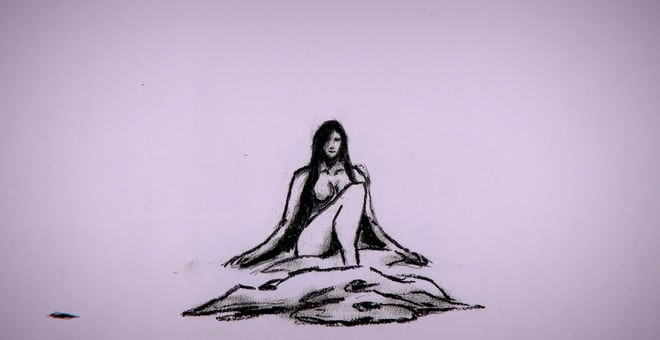
A female protagonist exploring her inner world is featured in Petra Balekić’s ‘Shadow’, a 2D black-and-white computer animation. The woman’s slender body is shown from various sides and angles as it moves and bends in the empty whiteness of the screen. When her touch shifts from caressing herself to digging her fingernails into the skin, the sound turns into a shrieking noise, signifying the emotional struggle with her own body image. At times, the figure doubles as she moves, with the previous position lingering in a paler shade. The body and its shadowy double interact through touches and embraces, culminating in the collapse of the shadow into the dominant figure, symbolizing the woman’s ultimate acceptance of herself.
While ‘Shadow’ shies away from eroticism, Rafael Cuculić’s ‘Adhesion’ embraces it fully. It opens with a penis falling to the ground, from which a pair of male legs stems, humorously referencing the famous painting The Origin of the World by Gustave Courbet. The remaining parts follow suit to complete the male body in 2D black-and-white computer animation. When a woman’s arm reaches out of a black hole, caressing the man, it leaves a wound that makes him run away and curl up. But the penis has a mind of its own; it detaches and flees from the body to follow the woman into the black hole, as the tribal drumming in the soundtrack intensifies, reminding us of the primordial connection between music and the body. The man runs after the penis, down the orifice, and manages to recompose and drag himself out of it, only to melt into a pile of mush. The woman’s acceptance of his insecurities and wounds seems to be the sole cure that restores him back to life.
Adhesion
The tribal drums of ‘Adhesion’ lead us to Danilo Dučak’s ‘Rain’, a film inspired by the eponymous folk song from the region of Istria and sung by local pop music legend Livio Morosin with Anica Franjul. Although ‘Rain’ uses a wider palette of colors, its combination of 2D computer animation and hand drawings shows the bleak rainy atmosphere of a Mediterranean town where, in a shabby room, a naked woman in stockings spends her time with a giant human heart representing her loved one. The rain tapping on the windows and the melancholic song underpin the gentle eroticism and love between the two as the woman places the heart under glass, exhibiting it like a centerpiece. But kitchen knives persistently lurk in the background, reminding us that there is a very fine line between deep love and toxic obsession.
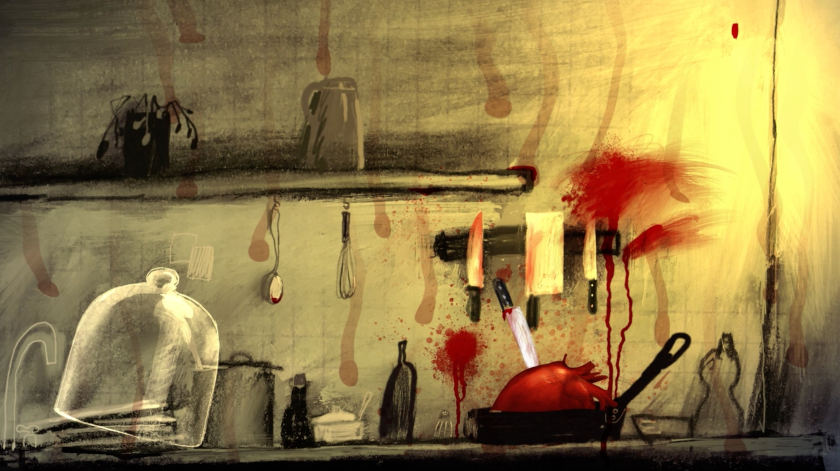
Rain
Vuk Jevremović’s ‘Moral Support’ also drew inspiration from a song, this time by the Slovenian avant-garde band Laibach, which refers to a clash between communist miners on strike and the proto-fascist, government-supported Organisation of Yugoslav Nationalists in 1924 in Trbovlje.
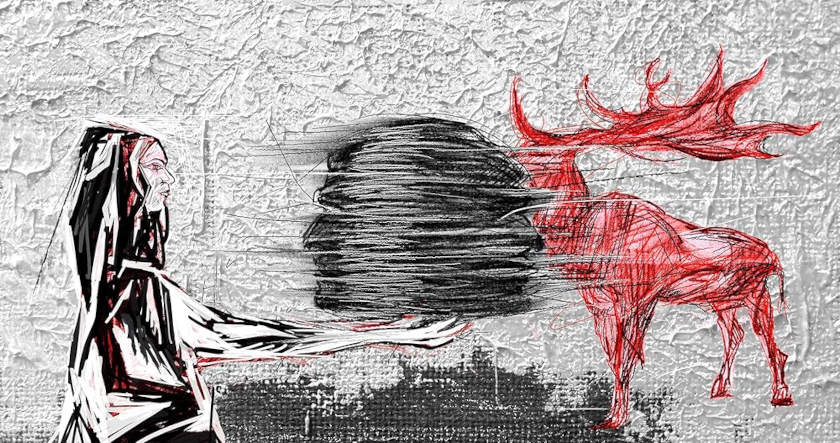
The film, which won a special mention, avoids mimesis by representing the event through clashes of red (communists) and black (nationalists) in various techniques on paper, ranging from pencil drawings to oil brushstrokes. The dynamic sequences quickly shift from human body parts bleeding in rivers and miners toiling in the factory to avant-garde techniques ranging from cubism, expressionism, dadaism, and suprematism, matching beautifully with Laibach’s electronic body music. By directly quoting Malevich’s ‘Black Square’ and Lissitzky’s ‘Beat the Whites with the Red Wedge’, ‘Moral Support’ represents political turmoil and human suffering in more abstract ways than the above-mentioned films, though equally interesting.
The four films use the human body to represent various emotions and inner turmoils, with the soundtrack as the main supporting element. In ‘Shadow’, the shrieking noise is a metaphor for the woman’s struggle with her body image, while the male body in ‘Adhesion’ can be complete only after inner drumming pushes him to reach out to a person of the opposite sex. ‘Rain’, on the other hand, shows how misperceived emotions can be as seductive as a voluptuous body, intensifying them through a melancholy melody, and in ‘Moral Support’, Laibach’s industrial but danceable song turns body parts into art material that is consciously used to depict a political conflict. Without resorting to dialogue, which is almost by definition didactic, these filmmakers let the body and the sound speak volumes.
| Related: Croatian Competition Program I at Animafest Zagreb 2025 |
contributed by: Erika Roša
Want to read more free articles like this?

Keep this professional animation journalism effort relevant and updated. Become our patron

Read More About:
Related Articles
FIND THE RIGHT FESTIVAL