From The Singing Revolution to the Animated Revolution of My Favorite War: Interview with Ilze Burkowska-Jacobsen
Kropka
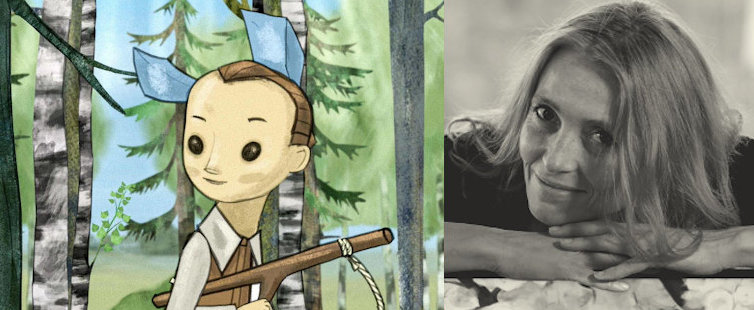
Director Ilze Burkowska-Jacobsen answered by email a few questions about her film My Favorite War, winner of the Contrechamp competition at the Annecy Festival 2020. An animated documentary that suggests not every pastime was necessarily better.
ZF: Do you remember what you did on September 6th, 1991?
IBJ: Thank you so much for this question! Yes, I do remember. I was in Norway, starting my second school year there. Just for that weekend, I was in Molde, a little town by the fjords. I watched the news and I watched out of the window the spectacular mountains of Romsdal Alps. I told myself, you have to remember this moment. (The Parliament of Russia had made this historic decision). And some minutes later, I received small white roses from my friends there. They said, Congratulations, your country is free now!
ZF: How do you define the animated documentary as a way of approaching reality?
IBJ: Animated documentary is a specific way of storytelling. It’s an artistic choice. In my case, I knew that there was no archive footage where those emotions from the soviet times that I wanted to reveal are documented. I could choose to make a fiction film, but then I would be asked to add something that did not happen to make the story more edgy or dramatic, or richer. Now it is how I felt it. And with facts from my life. Including the themes in the exam essay, or the school's cook who got famous for stealing. Including the right visuals of the details. Drawing the props, costumes, or locations is cheaper than making them, if I might joke a bit.
ZF: The history of communism in Latvia, and I think of the Baltic countries, is almost unknown to the rest of Europe. My Favorite War is a film not to forget, and spread what happened there with communism?
IBJ: Yes, it is. But at the same time, I wanted to show how tragic such an authoritarian regime can be for the people. How does it feel to know that the people you love stand on opposite sides politically? Kind souls, both my Father and Grandfather, their ground was split by the inhuman system.
ZF: When and how did the idea to make My Favorite War come to you?
IBJ: Here comes the confession: the idea to make this film is based on one of those five war stories you saw in the film. I have “collected” war stories from people around me for a long time, and I wanted to tell them. Just a few of them I managed to include in the film at the end. What I thought was - I will tell the stories from my region that have made an impression on me and combine them with the echoes of World War Two in my school years - like that crazy story of the cemetery defilement by our school in 1986, and voilà - I’ll have a script. But it didn’t turn out so easily.
Watch My Favorite War Trailer:
ZF: Blessed are those who do not have to choose. But what happens when you have an excess of supply to choose from and it demands our attention every second, creating an anxiety disorder? Where is the balance?
IBJ: Yes. That is a challenge of our lives. To stay focused. Everybody is talking that time was slower in the past. We experienced how the feeling of time changed during the pandemic. And even then, when the time is slow, you still have dozens of possibilities to choose from. So, yes, that is a burden and a blessing of democracy. You have to make your own choices and reflect on those “what's” and “whys”.
ZF: Why did you choose animation if the film could have been made entirely as a documentary, or even a live-action film?
IBJ: I couldn’t make this film as true as I wanted with the documentary material or as a fiction.
ZF: It was hard to find the funds for the film?
IBJ: Yes and no. In the beginning, I got a lot of trust from the Norwegian Art Council and the Norwegian Film Fund. Then, both the Art Council and the state film center of Latvia give their support. And then it got difficult to get the top financing. TV stations were not keen to give much money for this strange inter-genre film. At the end, we struggled enough. I’m enormously grateful to those who supported the film, Swedish and Estonian television included. As well as my regional film center in Vestfold, Norway, and the Free Speech Foundation in Norway.
ZF: Do children have to pay for the actions of their parents?
IBJ: No. But as an adult, you have the right to question the choices your parents have made in their lives. To make up your own mind, to understand the context of the time or the system.
ZF: Do you think there are still remains of guilt and shame in the Latvian population caused by communist propaganda, like we see in your film?
IBJ: Sadly, not. No one has been a KGB agent, no one has done anything wrong. It seems that everyone has been a part of some secret resistance movement, believing that the free Latvia will come to us somehow out of the blue. Ok, I’m exaggerating. A few honest people are stepping forward to admit their past actions. And since there are so few of them, I thank those few for their courage. It means there is shame. And it sticks very deeply. We are not used to complete honesty and openness yet.
ZF: With the health crisis, some philosophers warn that China's authoritarianism may be is the next model of global control. Others said that capitalism has collapsed, and we will be back to the community as a system of organization. And some others said that individualism will be accentuated even more. What do you think as a survivor of an authoritarian regime that saw your country's transition to democracy?
IBJ: I’m worried. Democracy, openness, and solidarity come slowly. It needs mutual trust between people and between people and the state. Today, in Europe and other places, we see how threatened democracy is. Democracy is a process, not some static position, and democracy needs our protection today.
ZF: You told me you are still busy preparing the sound for the Norwegian version of the film. After the award in Annecy, are you planning a commercial release both in Latvia and Norway?
IBJ: Yes. In Latvia, we are planning to release the film in late September or early October. While in Norway I still don’t know the date of release.
ZF: At the Contrechamp competition, there was another film: True North, based on real events in North Korea. The film talks about forced labor camps for those disloyal with the regime. Did you watch the film, and what do you think about it?
IBJ: True North touched me deeply. I have seen several documentaries from North Korea, and I think this film was the best to reveal the suffering and pain the people have. I think it is the best way to tell about this regime and situation. There are so many documentaries that have tried to take those light angles to please the western audience - “let's make comedy”, “let's make musical”. It's all ok, that helps to keep the issue up in the agenda, but this form in the animation in True North I found so sincere.
ZF: According to the democracy index, in 2018, Latvia obtained a percentage of 7.38 out of 10. What is your vision of Latvia today?
IBJ: Latvia is a country on the move. I’m happy that more and more people are engaging in the process of building society. Even a few years ago, people didn’t believe that they had the possibility to make a difference, to make a change. Now I see more and more courage to speak out and act. So, to be a non-typical Latvian - I’m optimistic. Because, we are supposed to believe that everything will end badly. So this is my process of getting rid of the homo sovieticus in me, I’m saying loud: It will not/ won't end badly!
ZF: What do you prefer, salted or normal butter?
IBJ: Salted. It’s more taste in it.
ZF: What does it mean to you to have won the second edition of the Contrechamp category in Annecy?
IBJ: I don’t know yet. I’m very happy on the behalf of our team. We were a small but dedicated and flexible team. We were like partisans in a big battle, but we made it. “Annecy is the best possible starting point for the films road out to the world”.
ZF: Last year, Gints Zilbalodis won the same competition. We expect the next year the new film by Signe Baumane. What is happening with Latvian contemporary animation? And how do you see the industry there?
IBJ: Compared to other countries, I know that animation has a high status in Latvia. It comes with our tradition to value decades-old films as national treasures. The explanation to all that is our poetic way to look at life. I think we are still romantic, despite everything we have been true.
ZF: You are an artist with a social commitment spirit. Your project, My Body Belongs to Me, won an Emmy in 2018. What do you think that in other countries of the E.U. are going against sexual education to prevent child abuse?
IBJ: Norway has an open society with a good system of education. Norway is a leading country in the world in protecting children’s rights. Finland has screened our series “My body belongs to me”, so they are brave too. Other countries are welcome to follow the example.
ZF: Making the revolution by singing is a very poetic and powerful way to achieve freedom. Do you like to sing?
IBJ: I do. But I'm a very bad singer. I sing mostly when I’m alone. In a company, when singing, I can only get others out of the melody tracks. If I have to sing in social gatherings like birthdays or so, then I’m singing very quietly. Still, music is very important in my films. I’m a romantic, remember?
Contributed by: Kropka
Want to read more free articles like this?

Keep this professional animation journalism effort relevant and updated. Become our patron

Read More About:
Related Articles
Zippy Frames is the premier online animation journal promoting European and Independent Animation animation since 2011
Zippy Frames
Quick Links