

Shorts
 .
.


Marbles by Natalia Spychała
Olga Bobrowska
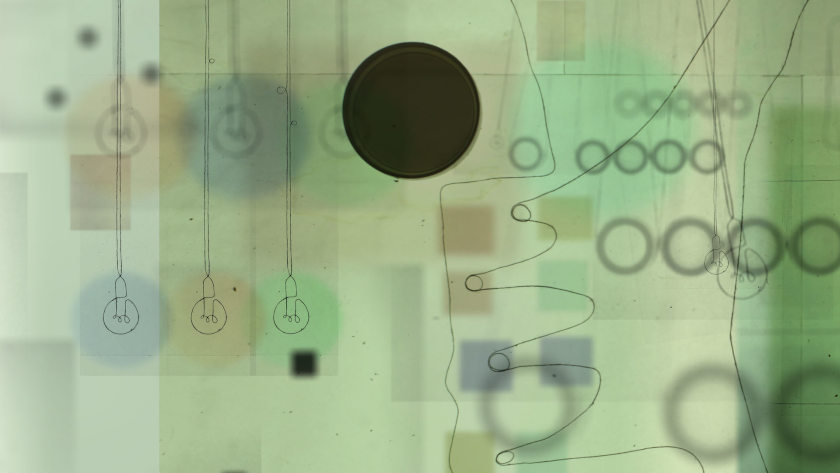
The hypnotizing pendulum sets a particular mechanism in motion. A body, space and variety of objects form a rhythmic system of interdependence. The sound interwaves with the image, creating the music of repetitive events. What is the cause and what is the effect? A stop motion animation made with threads on the glass plates coated with vaseline - Film Synopsis
Natalia Spychała talks to Olga Bobrowska about her acclaimed experimental animation short Marbles.
OB: Marbles was completed in January 2019. Do you still remember your initial emotions and ideas?
NS: The moment when Marbles became Marbles happened after the first animation tests of the threads on a backlit multiplane. At that moment the visual metaphor I had searched for absorbed the shape I wanted to develop further. Following that the whole structure of the film has emerged. This had happened almost a year before I completed the film.
OB: How did you arrive at this particular visual metaphor?
NS: It was my last year at the film school. I have just finished an abstract film, and I was not very eager to start another production. But I was recalling some past ideas. In the third year I've tried to animate threads on the water. Already back then I was looking for a way to visualize how everything around you and within you remain interconnected by the patterns of cause and effect. I've started from there. I wanted the thread to be integrated into the structure of interdependent connections. I've also searched for a narrative line. I explored the feelings that arise from visual – but not cognitive – experience of a film. I left behind the idea of animating on the water but I was still interested in the ways the thread moves and behaves when animated at the surface. I wanted to find a language adequate for this specific project.
OB: How did you find a balance between the artistic spontaneity that we can sense from what you just said, and a precise planning which – as I assume – preceded the filmmaking process?
NS: In the pre-production there is a moment when you have to focus on the structure, and move from animation tests to shooting. There were a few scenes that I liked a lot, and I wanted to build upon them. I self-imposed certain limitations on my expression. I asked myself what is the best framework that may be established for such a story. And that was a 'day'. The scenes I've mentioned presented some ordinary experiences. The idea of what they add up to, i.e. everything that happens from dusk till dawn, appeared at that moment. Further limitations were related to particular scenes. When it comes to the precise planning I must admit (I think for the first time!) that I could have pushed it more. If I had studied empirical, physical problems, I would have 'translated' their mechanisms into employed organic elements. Importantly, during the process I have been frequently showing my progress to the others and many people have seen it as machinery-like design. So it was and was not rigidly planned. I gave myself a lot of freedom in post- production so I could move around all the elements in order to arrive at assumed emotions and feelings. You don't necessarily have to do everything for real if you can reach a desired impression.
Watch Marbles trailer:
OB: The concept you framed was based on planning but at the same time it aimed at representing some elusive sensations. And then you commissioned two animators: Urszula Domańska and Katarzyna Adamkiewicz. How did you explain all these to them?
NS: Dividing the filmmaking process into working on the segments made the cooperation easy. I asked Urszula and Katarzyna to animate particular elements. We've been operating within an assumed framework: an element was moving as a part of a wider group in, let's say, two seconds. Frequently I would speak about the movement, Ula [Domańska] would ask me to do a gesture, and in two hours I would receive a perfect shot. We had a lot of luck but we also have similar sensitivities in regards to animation and visuality. At the final stage of putting all the elements together of course we needed to be more precise. I think the animators felt comfortable with the task given but at the same time they had a space to freely exercise their expression.
As for me, I've learnt a lot about being concrete about my own premises which helps you to be respectful to your co-workers, and also doesn't generate too many outtakes.
OB: Can you explain the technical aspects of Marbles?
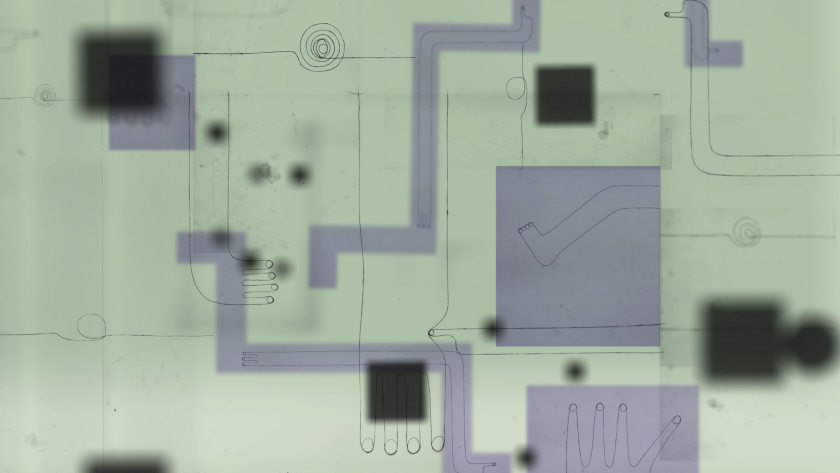
NS: First there were experiments with the thread on the water. Then I was experimenting with various techniques that allow animating a thread but at the same time enable it to stay in the same place. It was important to me because this effect exactly corresponds with what I had in mind. I was trying to do it on the multiplane with motion control but I've realized I would need some three years to execute it. I expected having a lot to clean in the post-production but the textures that came out from shooting seemed more organic. To sum it up: it is an animation of a thread on the vaseline moved around a backlit table, and composited in the post-production what gives an impression of a multiplane.
OB: The strength of Marbles lies its inner dualism. Despite being a non-narrative film, it tells a condensed story about what's happening in the course of one day. While animation enables immersion into images, the music adds another narrative level. How did you work with Pimon Lekler?
NS: He is amazing! And he is only twenty-five! Pimon creates great music for films but he is also a virtuoso of 'mumbling' for animation! We did the sound along with the creation of the images but the sound would never precede them. The cooperation started when we moved from tests to the structure. I wanted the score to be dense and rhythmical in a sense of interconnections between separated sounds, a sort of a 'symphony' where everything works together perfectly but you can also punctuate each particular sound. Of course it's difficult to talk about music so we spoke about the things that music can do to you. Similarly to animators stitching final images from separate elements, Pimon was also building the score from various auditory components. Sometimes I would give him descriptions, e.g.: 'we're in the kitchen, the pipes from the neighbours whisper', or 'a kettle whistles, cutlery waits for the breakfast', etc. They were somewhat poetic but always concentrated on a space. During the first recording we were going around the house and we were 'catching' sounds like flushing the toilet, knocking on things. Sometimes a sound would interest us so much that I would later include a visual reference in the film. We didn't want the score to be only a 'music for animation' but we wanted it to be an autonomous music piece. It’s an uninterrupted connection between two worlds: one of abstraction, the other one of a concrete matter.
OB: How would you characterize your authorial style?
NS: Huh.. It's a well-balanced fusion of experimentation, intuition and method that I use to create a structure. It's important to balance between improvisation and conceptualization of the theme.
OB: You appear to be very open towards listening to and following your inner sensitivity, but at the same time, the way you comprehend the artistic process seems nuanced. What's the foundation of your working method? I don't mean artistic inspirations that every artist possesses and reworks, but I'm interested in what stimulates your process of reaching the planned effect?
NS: One should have their own artistic authorities. What I do is keep notebooks with statements, a collection of quotations from artists of various disciplines on working methods, the structure of their work, reasons why they create, and why it is personally important to them to create, etc. While working on Marbles, I visited Magdalena Abakanowicz's exhibition. Abakanowicz said that a difference between a craftsman and an artist lies in the fact that the former makes great works in their own technique, and the latter creates techniques for their own works. Another important notion comes from Antonisz [Julian Józef Antoniszczak], who said that visuality is a form of art itself. It's important to have such remarks in mind because you can hold onto them when you start doubting. Another thing is that Marbles was my graduation film. After four years of various failures of artistic or general nature, years of going back and forth in the academic system, I felt that I had to let go of a lot of things and follow my instincts.
When we speak about the process, I want to add that I consider filmmaking as an intellectual work more than an artistic one. I'm fascinated with the phase of conceptualization. Whenever I animate a film, music video, or make visuals for a theatrical performance, it's always the most interesting part of my work. Everything I do comes out of this curiosity. I'm interested in solving a visual equation. I'm looking for the best methods to represent particular matters. In order to do this, you need to overtake the issue, digest it, transform it, and relate it to other things. It doesn't matter if the issue is super simple or highly complex; the process is always (almost) the same. Such an attitude requires continuous development of a humanistic approach when you keep on searching for ideas and inspirations that allow you to pierce a bubble, and to move beyond it. I am an animator, but I can still be close to other aspects of life and art whenever they speak to my interests. I’m becoming more and more familiar with my working method,s and I know what I'm comfortable with. And I also know that because of the (sometimes difficult) experiences I had during my studies at the film school.
OB: So let's dig deeper into the subject of the Film School in Lodz. Over the last 10 years, we have been continually presented with outstanding works that demonstrate the vitality of an artistic ferment within the school. Do you adhere to some shared artistic identity, or do you find yourself more as an individual?
NS: I don't think about this. The strength of the school is with the people: the students, the younger and older teachers. I got into animation in the 2000s, in the times of the so-called 'renaissance' of Polish animation, when it was possible to relate to the current achievements instead of focusing on artistic heritage. The school certainly helps by connecting you with all kinds of artists. You may recognise the style of some other schools or universities, but there's no such thing as ‘Film School in Lodz style’, and I find this a positive thing. Polish animated film culture has a long tradition, and it is of utmost importance to have something to reach for. At the same time the bar level hangs higher than elsewhere. Especially when we think about the role of animated film in the 1970s, when the visual language and its metaphors were vivid.
OB: What's the message behind the contemporary metaphors of Polish animation, and what kind of experiences are the animators trying to mediate these days?
NS: At this moment, it is impossible to name a specific trend. We need the time distance to do this. Animators build their metaphors from the personal experiences that may be detached from the surrounding conditions. There's no specific subject that is especially common for Polish animators. I'm convinced that our obligation is to never take short-cuts when expressing ourselves, even if the problem we care about has already been depicted a thousand times. At the festivals, I've seen a lot of films discussing worldviews or problems resulting from inequalities. If the majority attempts to explore these concerns deeply, there are some that lack a quality which is very important to me, i.e., presenting the viewers with a way of reasoning that led you to certain positions. Whenever I watch a film related to political, feminist, or gender issues, I hope to enter a space where questions are asked, even if they're not the easy ones. There's a lot of talk about women's animation. Well, I've always felt animation is a woman. It's also not surprising, considering the fact that right now, practically only women study animation in our school. But what's then a 'Polish women's animation' category after all? This is not known at this moment. What I know is that I don't want to be a part of any agenda.
OB: But don't you think that once facing a critical social situation – say, such as current violation of human rights in Poland – those who use means of expression (the artists) in order to grasp attention of the others (viewers), should stop looking for undertones, and rather step into agenda and take a side?
NS: I'm not talking about nuances or undertones. I'm looking for an expression that makes me believe that the artist really has something to say on the subject. Everyone has their own moral fibre, so the artists should speak up for others and use their voice to loudly and decisively disagree. I embrace all civic attitudes, and I believe the artists should advocate for a change. But I am not inclined to create an engaged art. It's more a matter of personality than of a worldview. What's happening now – it was the first time that something knocked me down to react to the current political situation. It was an impulse to get involved in co-creating #sprzeciwpolek (#polish_women_resistence). Social and political problems as a theme of the film cannot be underestimated. At the same time, I refrain from confusing a film with an agitating poster. I see a difference between a film made in the course of two years and a protest film that was made as an instant reaction to something that happened. But it's a very difficult subject; you also have to confront the questions of nihilism or of valuation criteria in the arts. There are many angles to this conversation.
OB: It has to be noticed, though, that the 'protest animation' #sprzeciwpolek presents a great artistic quality while it strongly expresses the anger many of us feel now. Not only did it resonate as a form of 'agitation' (soon after its release, the students from Poznań and Hungary created their own films as a gesture of solidarity), but it has also just begun its festival life at Animateka (Ljubljana).
NS: For sure, it's satisfying to hear that, especially given the time within which it was completed. But more important than the artistic quality is the scale of the involvement. When Weronika Szyma proposed this initiative, we knew it needed to be done immediately. I downloaded almost fifty files in forty-eight hours – nobody expected such a response. Instead of the planned one minute, we ended up with almost eight. What I personally like about this initiative is that it proposes another way of protesting. The fact it became so widely acknowledged and inspired other artists or students proves that such acts can make an impact as well.
OB: The readers will have to excuse us for drifting away from Marbles, but it's a momentum for Polish women, and it's impossible to stay indifferent. Nevertheless, there's a classic but ultimately important question: what happens next?
NS: I'm in the very early phase of the development of a new film. It's going to be a film about thinking. I want to start shooting next year. I'm searching for the technique. I'm doing the tests. I don't have a structure yet, but I have a subject. I've done visual research. I still have to reach a metaphor.
Film Review (Olga Bobrowska):
Marbles by Natalia Spychała: An Experimental Delight
A backlit table. A thread. A vaseline. And a hypnotic music by Pimon Lekler. This might be a recipe for a brilliant animated miniature that exploits our disposition for immersion. But there is one more, and crucial, ingredient that cannot be duplicated. It is the author's self-awareness in regards to use of the film language. Natalia Spychała (a recent graduate of the Film School in Lodz knows very well how to translate intimate emotions, ordinary observations, and temporary sensations into experimental visual storytelling. Her tone might be delicate, but the syntax is firm. Threads evolve into outlines of body parts, flowerpots, or light bulbs swaying above the cut-out objects, paper backgrounds, and table planes. Every single action implies another one. Any discord in the overwhelming impression of continuity may be traced back to the state of harmony. Vaseline smeared on the surface blurs the perception as if we were supposed to see with our own eyes the elusive and detailed nature of everyday experiences. In such a scenery, Natalia Spychała develops the simplest narrative – somebody wakes up, drinks a coffee, goes out, and goes back. A space that can be easily recognized as a kitchen transforms into a stairwa,y only to present itself as a dynamic urban landscape. And there is nothing more to it, no instant catharsis, no explanation for take-away. Only the viewer's mind has wandered far across personal memories and recollections, and all of a sudden, it is up to us to move forward while experiencing the here and now.
CREDITS:
Marbles, 2019, 5'32''
Written and directed by Natalia Spychała | Animation by Natalia Spychała, Urszula Domańska, Katarzyna Adamkiewicz | Music & Sound by Pimon Lekler | Artistic Supervision: Piotr Dumała, Piotr Milczarek | Produced by PWSFTviT (Państwowa Wyższa Szkoła Filmowa, Telewizyjna i Teatralna)
About Natalia Spychała
Graduate of the Łódź Film School, Poland, director and animator. In addition to making short animated films, she explores stop motion and digital techniques by co-creating projects that combine animation with literature, theatre, music and new technologies. She runs a stop motion studio, Fabryka Animacji, where she works and organizes animation workshops as well as art events for children, teenagers and adults.
Want to read more free articles like this?
Keep this professional animation journalism effort relevant and updated. Become our patron
Read More About:
Related Articles

Zippy Frames is the premier online animation journal promoting European and Independent Animation animation since 2011
Zippy Frames
Quick Links