
'The Angst And The Bliss' Animation Short by Lucia Malerba and Niccolò Manzolini
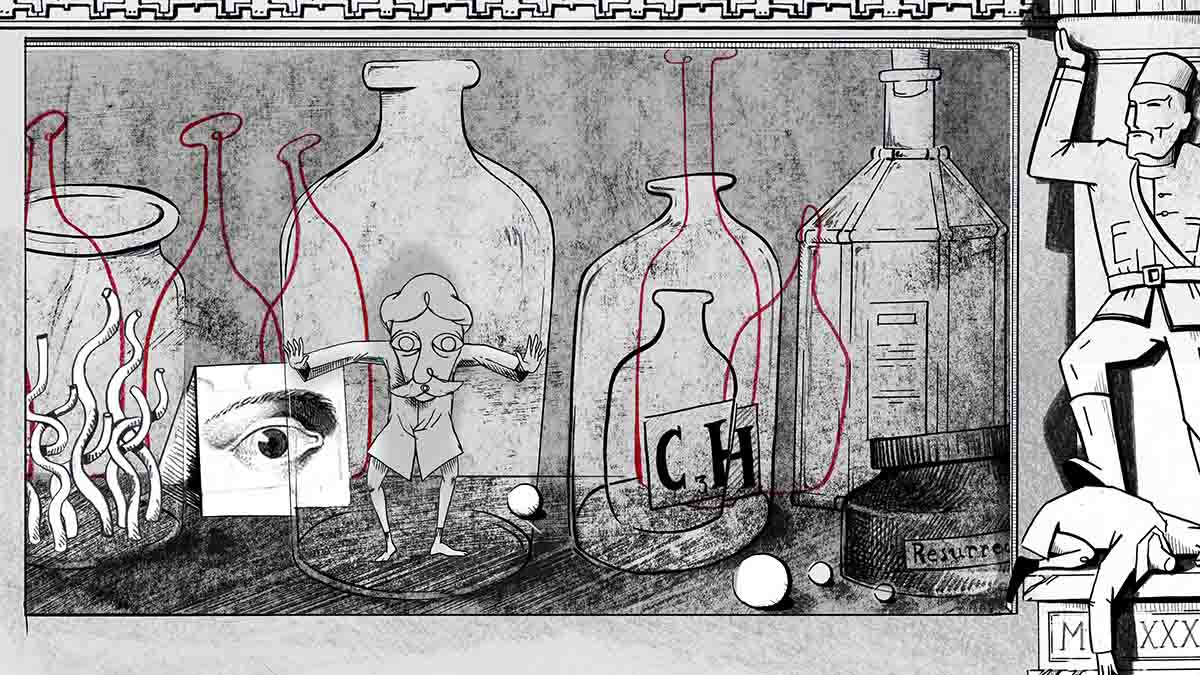
Lucia Malerba and Niccolò Manzolini (La Mangoosta) visualized the universe of Raymond Roussel in their latest animation short film production, 'The Angst And The Bliss', in an attempt to decipher the surreal world left behind by the great French artist.
The Mangoosta team has been hosted before at Zippy Frames with their 'Flocks' animation short. They talk to Viktor Smolkin and Zippy Frames about the new film, now released online.
ZF: You mention in the film the "door" Raymond Roussel left for us that leads to his art. Was his last text an inspiration for the creation of the short film about him, or was it something else?
Mangoosta: The film's narrator is the real voice of the French philosopher and historian Michel Foucault, a great admirer of Roussel, in a 1960s radio recording. Like us and many others, he too tried to solve the enigma left by Roussel, without success.
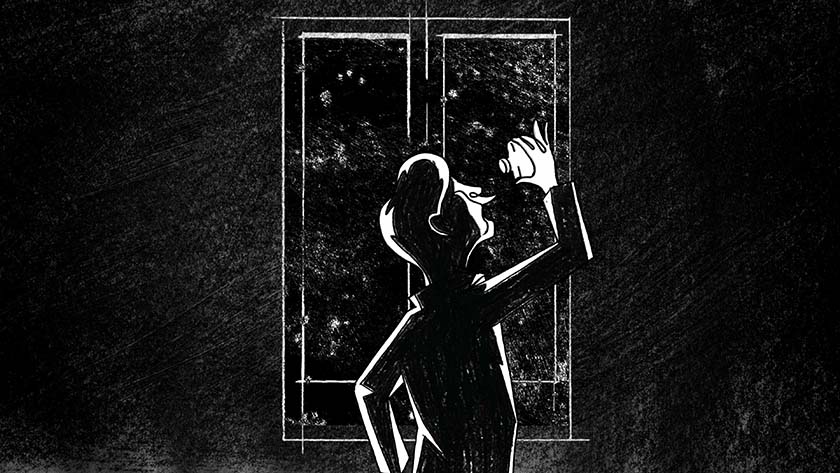
The door he refers to is both the physical door of the room at the Hotel des Palmes, in Palermo, where Roussel locked himself to perform the ritual (which we see several times in the film) that led to his death, and the metaphorical door that separates reality from imagination. A threshold that the writer tried to cross his whole life.
The imaginary, rather than being another dimension, is a state of mind that we too seek to achieve in our artistic and daily exploration: an ideal territory where animation can be practised, allowing every transformation, and where utopia can be offered as a response to the inert banality of reality.
ZF: Music is a major part of the film—could you tell us more about how it relates to the images and to Roussel? Also, there is a boy band that reappears in the film: Who are they? And why are they present?
Roussel had little success during his life, but he left behind a large following of admirers. The first ones were the Surrealists: Dalí, Ernst, Duchamp, Breton, and others recognised him as the father of Surrealism. The boy band is, in fact, the “surrealist band” with the faces of some of them!
Among Roussel's many hidden admirers, who continue to this day, is also the composer of the film's soundtrack, Pierre Bastien, a French composer with a long and rich career.
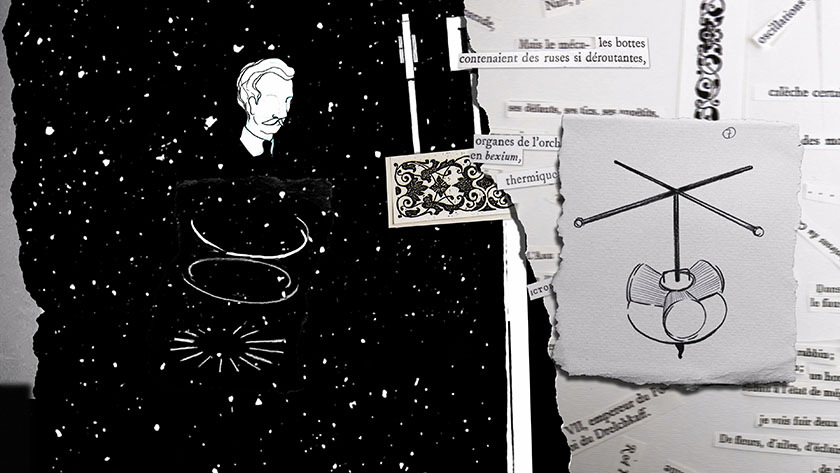
Roussel populated his books with imaginary machines, many of them musical. It was from one of these (the thermodynamic orchestra of the chemist Bex, described in Impressions of Africa) that Pierre Bastien drew the inspiration that shaped his career, developing a unique compositional technique based on musical machines he invented and built with Meccano pieces.
'The Angst And The Bliss'
ZF: From a practical point of view, how did you work with the composer? Were you present while he worked, or did he compose without seeing the film?
Mangoosta: When we first contacted Pierre, we didn't know that he was one of Roussel's many hidden fans. We liked his music and thought it was perfect for the film. When Pierre told us about his Rousselian inspiration, with his characteristic generosity, it was easy to start a fruitful exchange that still goes on today.
When the production began, we went to Rotterdam, where Pierre lives, and spent a few days in his studio, a wonderful wunderkammer halfway between a musician's studio and an inventor's laboratory. Pierre showed us the machine he would use to compose the music for the film, and we filmed it. You can see it in the film, in action, faithfully redrawn.
During those days, we worked together, exchanging ideas and defining the shared basis for the work. Then Pierre composed the music on his own, on a non-definitive (but almost) version of the film, working on a single score rather than individual pieces. When he sent us his composition, we exchanged a couple of emails to change a few accents, but the score was already right for the film.
ZF: July 14th is the Feast of Santa Rosalia in Palermo. What did you find in this parallel between his death day and this holiday? Was it something intimate to you?
Mangoosta: Saint Rosalia, patron of Palermo, was a 12th-century Sicilian noblewoman who retreated into a cave in solitude until her death. Roussel also came from a noble family and chose to live a secluded life, unable to find a satisfying place in the world. They both rejected a suffocating reality.
We discovered the story of Raymond Roussel thanks to a Sicilian writer, Leonardo Sciascia, who in 1971 published ‘Atti relativi alla morte di Raymond Roussel’ (Documents relating to the death of Raymond Roussel), a book in which he seeks to reveal and at the same time increase the mystery of his death. The book describes the night Roussel died, June 14, 1933: that night in Palermo, various events overlapped in a sort of dizzying astrological climax. While Roussel died of a barbiturate overdose, beneath his window converged the traditional celebrations for Santa Rosalia and the fascist celebrations for Italo Balbo's first transatlantic flight.
This is why the film repeatedly features the musical motif of a religious fanfare, the effigy of the saint, and the silhouettes of the fascists.
'The Angst And The Bliss'
ZF: Your film is built upon mirroring, repetition, and the mechanical aspect of art. Did you try to visualize Roussel's texts in this way as a hommage? Also, how did the 1930s (Surrealism, Dada, experimental animation) affect your aesthetics (visual design and animation techniques) -if at all?
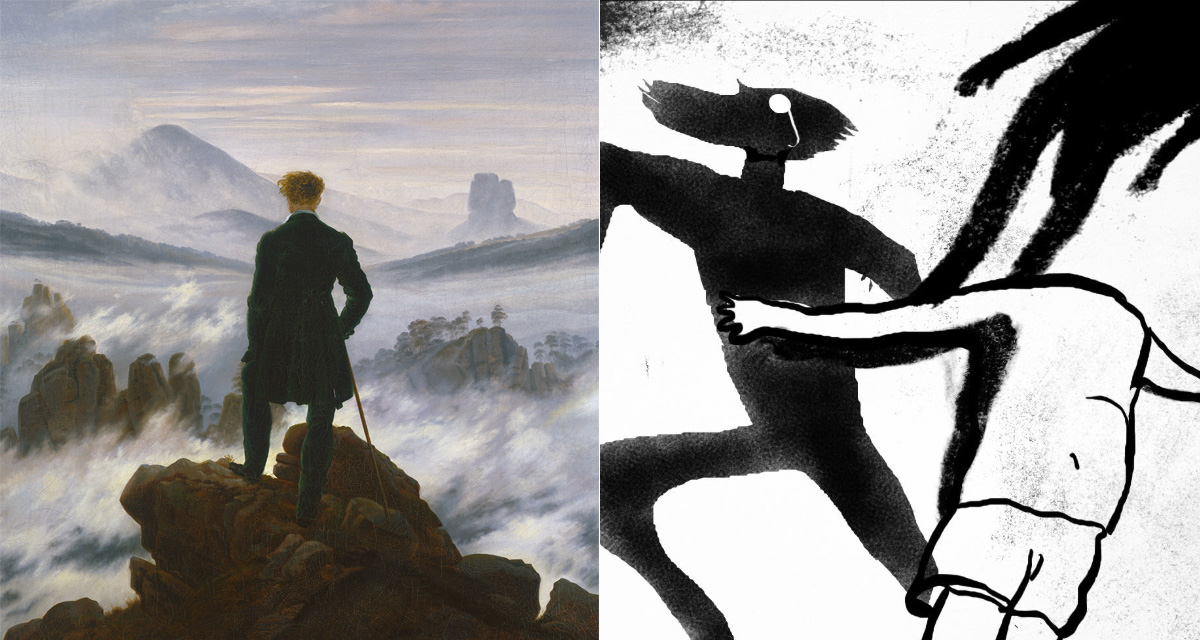
Mangoosta: Of course! The film is a great tribute to surrealism, of which we consider ourselves illegitimate children. We have scattered the film with references, from the architecture of De Chirico to the collages of Max Ernst.
We have tried to visually represent what Roussel called his “procédé,” one of the first examples of automatic writing in literature, which greatly influenced the work of the surrealists. So we wrote the film thinking of a kind of spiral in which the actions that Roussel performed before his death are repeated five times, each time bringing with them new elements that make up the multifaceted image of this artist: bipolar, chess player, inventor, drug addict, traveler, esotericist...
Our writing process was a ping-pong, one of the great things about working in pairs, where each of us rewrote what the other had written and redrew what the other had drawn, almost like a musical improvisation.
ZF: For a film treating a surrealist subject, you use few colors. In handling the passage from reality to imagination, how did you use black and white versus color?
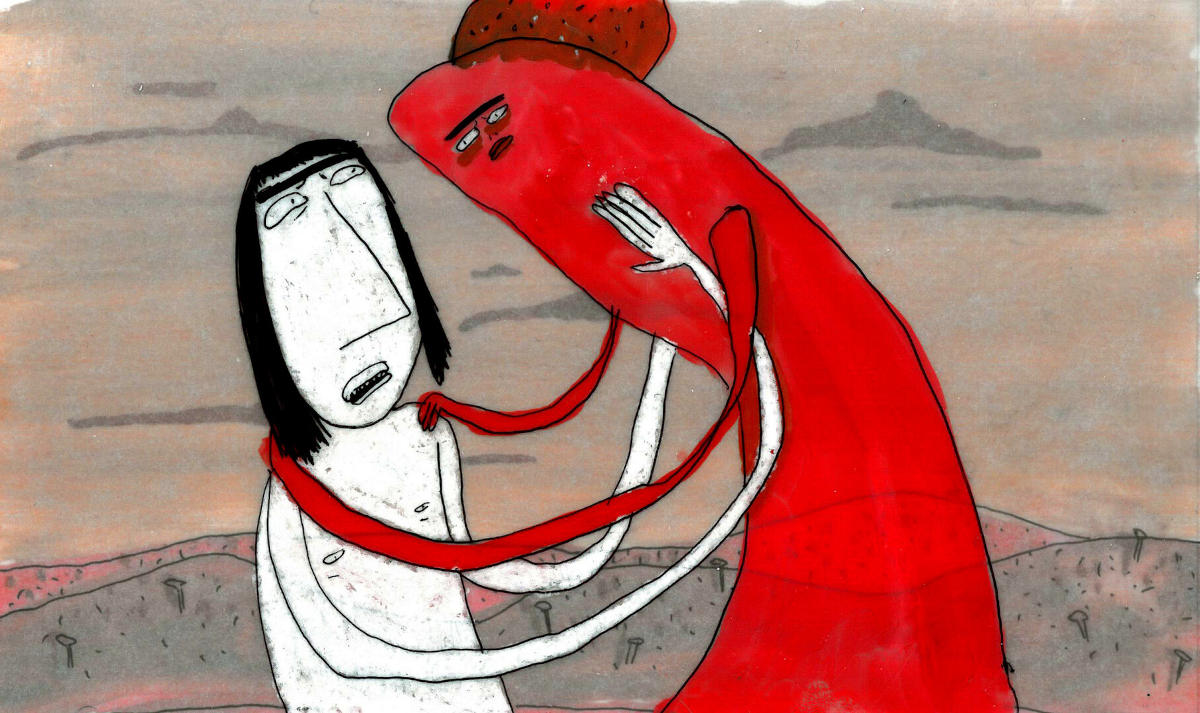
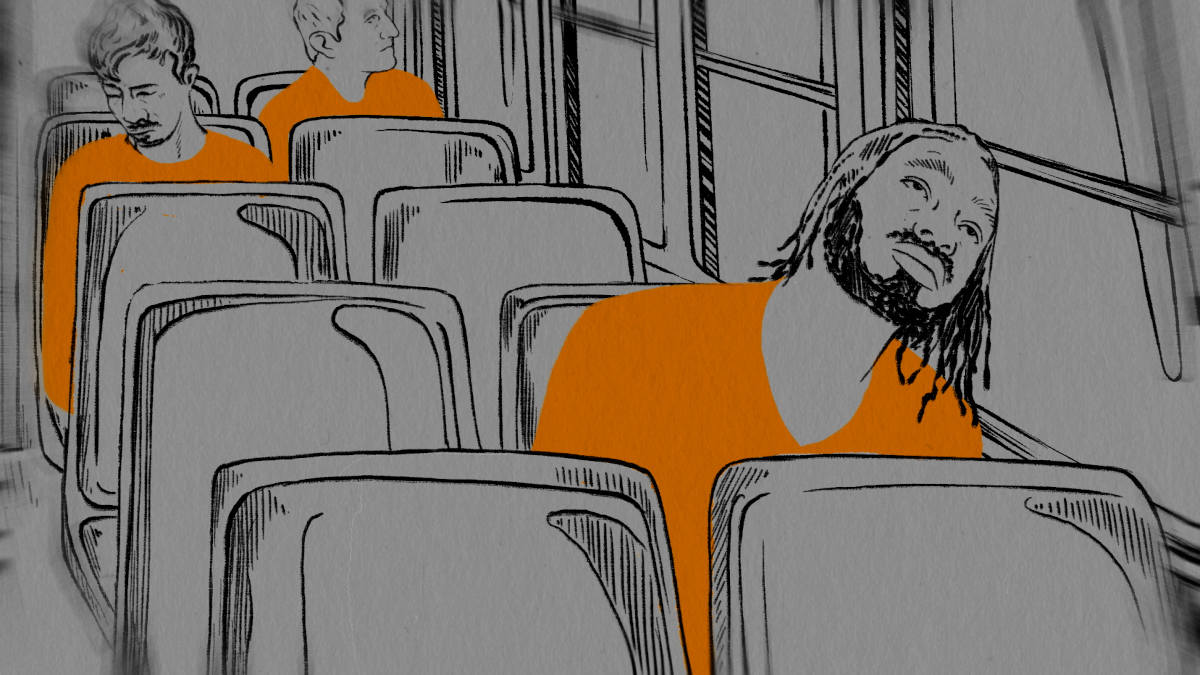
Mangoosta: Year after year, we are abandoning digital media to return to an almost entirely analog way of working, to save ourselves from standardization and rediscover the pleasure of using our hands to work. We use graphite, ink, paint, chalk, and gouache, but rarely more than one color, often red (which is the color of margin notes and spelling mistakes).
We are passionate about late modern graphics, lithography, and xilography, so the contrast between black and white, between full and empty spaces, has become a structural element of our way of drawing.
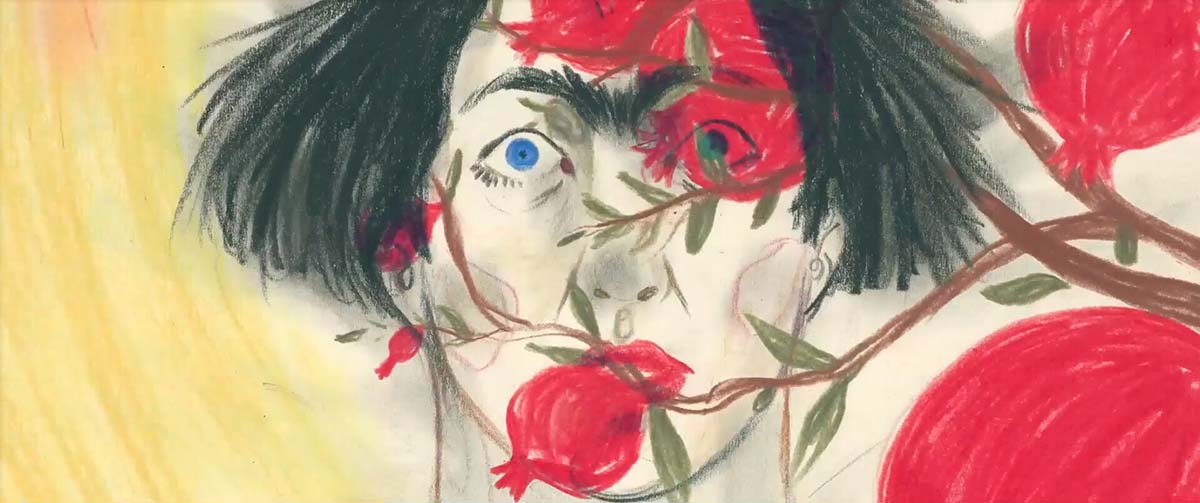
In this case, black and white also represent the two polarities between which Roussel oscillated, the angst and bliss of the title, an entanglement of light and shadow that is common to all our lives. Color bursts in at the end to represent the overcoming of this dualism, a kind of rebirth. Even for us, who are learning to color again, with more than two colors at a time, finally...
ZF: You are planning on expanding the film into an interactive virtual reality piece. Could you explain how it will bring us closer to the world of Raymond Roussel?
Mangoosta: Roussel, a fan of Jules Verne, described fantastic places in his books, dotted with absurd machines and detailed yet unimaginable memorabilia. It’s easy to imagine him as a precursor of the fantastic worlds of virtual reality.
The virtual experience is called 'Roussel Music Box' and is produced by Studio Geppetto by Amaury Campion, a young French producer with extensive experience in animation and XR, in collaboration with IRCAM, the sound research center founded by Pierre Boulez in Paris.
It will be inspired by the short film's stylistic universe, and we will collaborate with Pierre Bastien. The idea is to immerse the users in Roussel's universe, giving them an active role and inviting them to seek the solution to Roussel's enigma, guided by Raymond Roussel himself, tracing not only a visual experience, but also a sound, tactile, and proxemic one.
Something that has to do with theater, sound performance, and the attractions of amusement parks, which Roussel loved.
Watch 'The Angst And The Bliss'
About the Authors
Lucia Malerba and Niccolò Manzolini met in 2014 and together they founded La Mangoosta, looking for another dimension to refound reality on the basis of the imaginary. Working between France and Italy, they deal with freehand drawing, visual art, and traditional animation. They have produced two short films ('Flocks', 2020, and 'The Angst and The Bliss', 2022) and several covers, comics, and illustrations. They are currently developing a multimedia project, 'Green as Hell', and a virtual experience, 'Roussel's Music Box'.
Want to read more free articles like this?

Keep this professional animation journalism effort relevant and updated. Become our patron