
Shorts 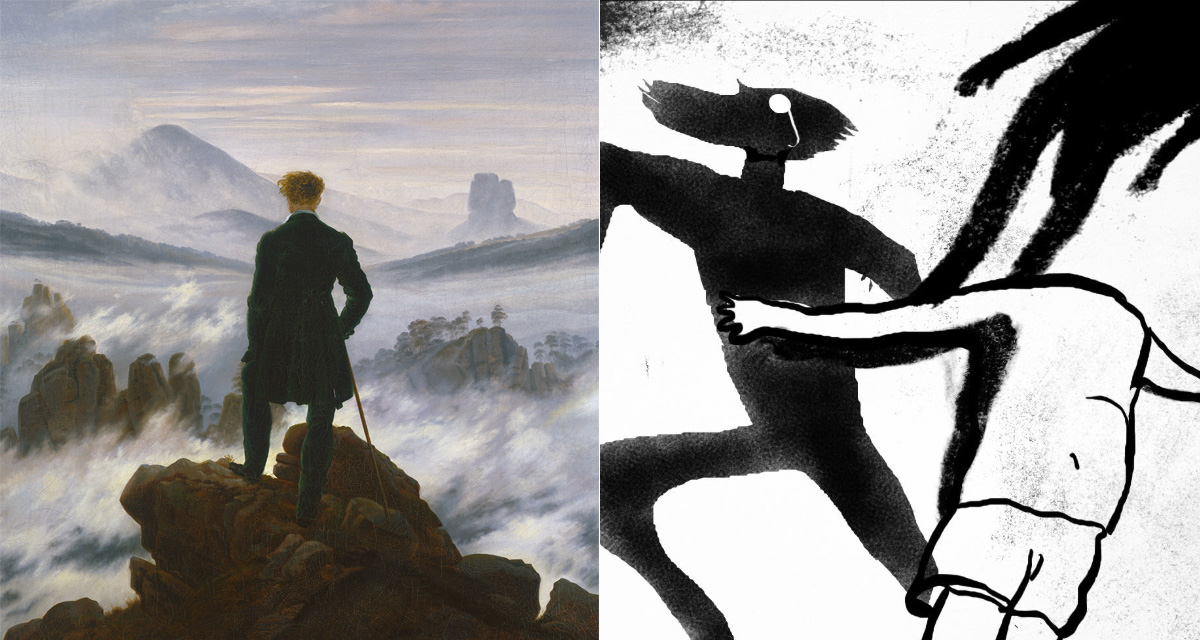
‘Floating’ Animation Short by Jelena Milunović (2025): Between Fabulation and Memory
Amanda Barbour
Co-produced with Set Sail Films (Serbia), Adriatic Animation (Croatia), and Filmuniversität Babelsberg Konrad Wolf (Germany), the hand-drawn seven-minute short 'Floating’ by Jelena Milunović has had a good run on the festival circuit. After stops at Annecy, Animafest and Dok Leipzig (among others), Milunović’s 2D animation has been awarded Best Student Short at Anifilm:
“In only seven minutes, this film manages to show empathy, imagination, and tenderness about mental illness, while avoiding stereotypical thinking about this subject. The director transforms her painful personal experience into an intimate universe.” - Festival Jury.
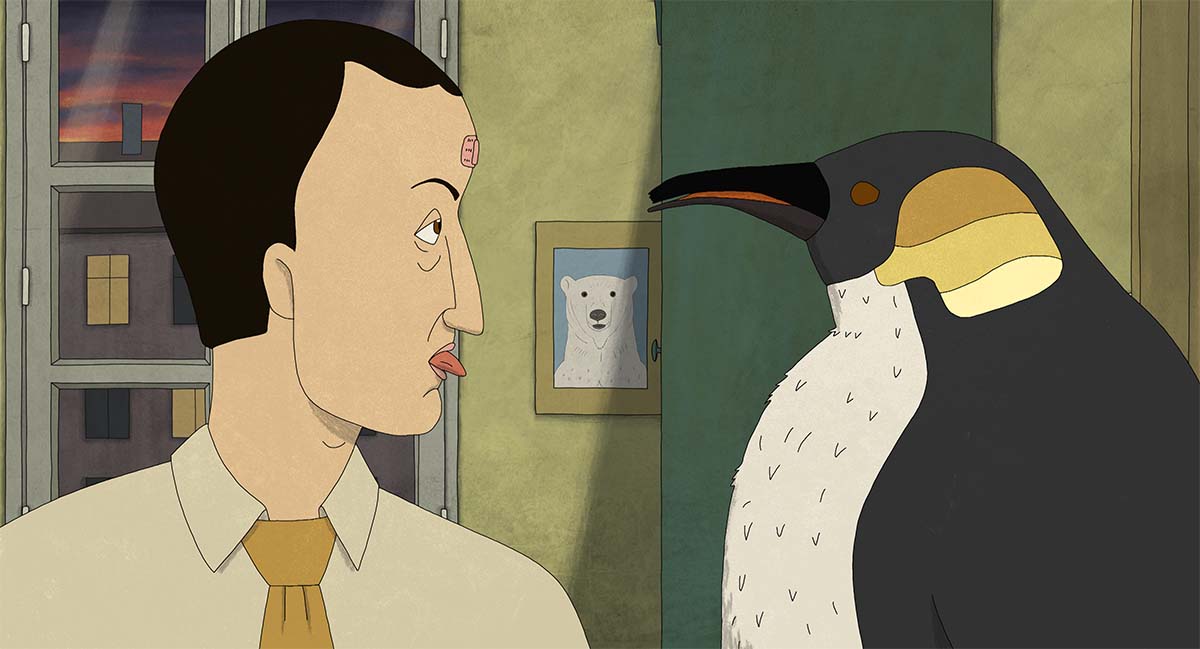
Animation speaks the same language as psychoanalysis. In being divorced from our physical world, the medium is well placed to illustrate how something feels in lieu of how it looked to someone else. ‘Floating’ (Jelena Milunović, 2025) is an elegant and eloquent short about a father’s journey with mental illness, shot largely from the perspective of his daughter.
Milunović positions the camera behind the daughter's head for most of the film. We watch her watch the action unfold around her, without seeing her reaction or facial expressions. Framing the scenario in this way recalls Caspar David Friedrich’s 'Wanderer above the Sea of Fog' (1818).
Friedrich’s painting is ambiguous; it contemplates man's place in nature. Is the Wanderer a conqueror, or lost? Is he dominating, or being dominated by the terrain before him? Friedrich explained that, “The painter shall not paint what he sees in front of him, but what he sees inside himself. The artist’s emotion is his law.”
Creating distance between the daughter and the audience’s vantage point mirrors the space between her story and her cinema. While the animation draws from personal experience, it's not a documentary. Retaining an element of fabulation makes sense in a story where reality becomes contested.
In 'Violence' (2008), Slavoj Žižek writes about how traumatic events cannot be approached directly. They need to be observed awry, with a sidelong glance. An indexical relationship to reality doesn’t necessarily yield truth, because trauma dissolves coherent narrative. Fragmentation, inaccuracy, and confusion are often reliable indicators of veracity.
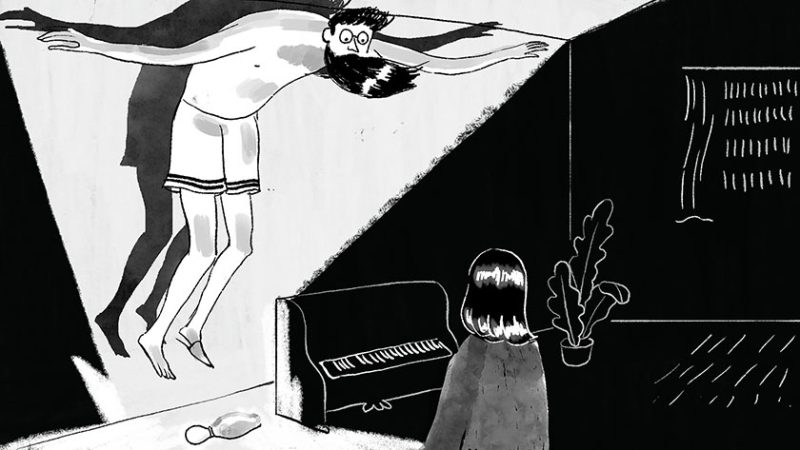
As “realism” fails in the face of trauma, Milunović oscillates between breaking and upholding the laws of physics. The father floats, his shadow splits into multiple personalities. The daughter tries to reach him, but the stairs become higher and stickier. In the absence of dialogue, the animation’s exposition is anchored in character design, choreography, and the schematization of space.
Floating
Most of the pain in the world is concentrated in places where people are dear to each other. We see family members distance themselves from the father, while the daughter tries to bring him back down to earth. Eventually, she makes the call, and hospital attendants shoot him down.
There’s a long history of mental illness on both sides of my family. I’m aware that people in the midst of a psychotic episode often don’t know that they’re unwell. People who care about them often don’t have a lot of good options. The sick resist treatment and feel betrayed by forced hospital admissions. The people around them hold their good intentions with feelings of complicity in that betrayal. Milunović’s cinematic treatment of this comes from a very real place. It’s not sensationalized or overly sentimental, just sad.
Post-medical intervention, we see the father shrink, and the daughter carries him on her shoulder. He then grows taller again, as he begins to heal. This signals the evolving relationships between parents and their children. As we grow up and they grow old, the dynamic between carer and cared for evolves.
A string tethers the father to his daughter, keeping him from floating away. They dance, and these gestures towards the hope for healing and celebrate the love between them.
A happy ending to a sad story packs an emotional punch. Mental illness comes and goes in waves, and any audience familiar with the terrain knows that this journey is not linear. As with Friedrich’s Wanderer, where we are and where we go from here isn’t clear.
I included the bit about my family because objectivity in journalism is a fallacy. All authors come to a story with their own experiences and opinions that shape how they read and interpret what’s in front of them. I’m grateful that Milunović made this film. As Kurt Vonnegut Jr writes, “Many people need desperately to receive this message: 'I feel and think much as you do, care about many of the things you care about, although most people do not care about them. You are not alone.”
The award-winning animation is available to watch now on Arte.
Contributed by: Amanda Barbour
Amanda Barbour is an award-winning film critic and president of Australia’s oldest online film journal, Senses of Cinema.
Read More About:
Related Articles
Have an animated short film?
Get it featured on Zippy Frames. We present, interview and cover independent animation shorts of every animation technique.

Zippy Frames is the premier online animation journal promoting European and Independent Animation since 2011
Zippy Frames
Quick Links