Flight of Escape in Stop-Motion: 'Winter in March' Animation Short by Natalia Mirzoyan
Mikhail Gurevich
Who is the author behind the Cannes-premiered, and now Oscar-qualifying stop-motion puppet film 'Winter in March’? Natalia Mirzoyan was born in Yerevan, Armenia, to a Jewish/Armenian family; she moved to St. Petersburg, Russia, at the age of 22, to study art, eventually landing at studio Peterburg, known for long-running and quite popular series for younger kids 'Kikoriki', and over the years, made a good number of episodes.
In parallel, she started doing personal films, to a warm reception and recognition from the start. The latest in line, 'Five Minutes to Sea' (2018), had just enchanted both festival juries and audiences around the world. Happily married, with two kids. Solid career and life path.
Times change, however. And at times – change abruptly and in a rough way.
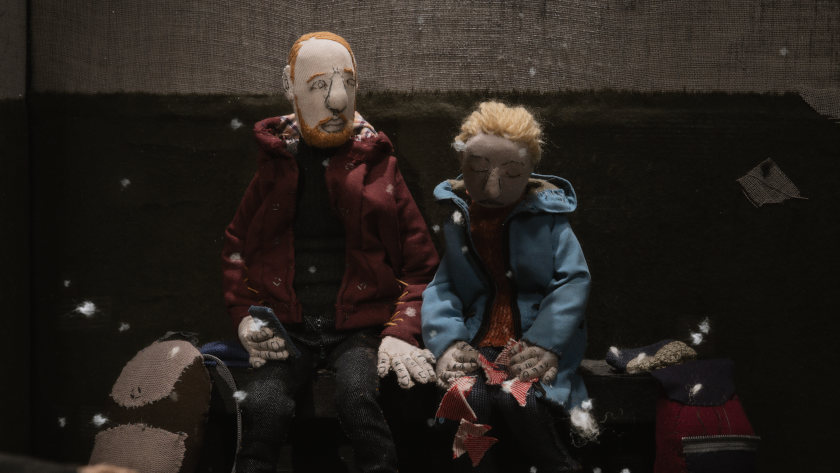
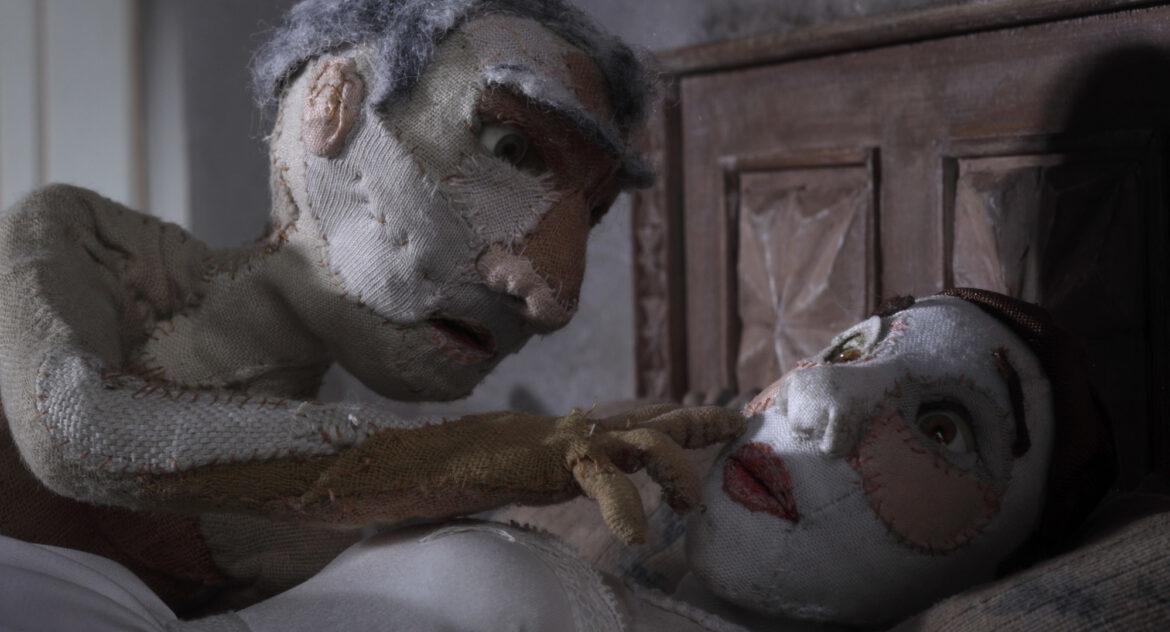
…A couple sleeps peacefully in bed. Man wakes up, reaches for his phone – and newsfeed turns nightmarish. Images of planes dropping bombs, tanks, and alike crawl from the screen right onto his body, to finally envelope him completely… Then would come the visions of buildings being crushed right before the eyes, imaginary or for real, boundaries blur; amidst the snow engulfing road and soul, all the desperate way out – to the borders and beyond.
The story of Russians who fled the country due to their inability to influence the situation (as well as fear of arrest and mobilization) resonated with the director, especially the story of Kirill and Dasha, whom she interviewed. As she states, "their narrative was full of striking visual imagery and echoed many of my own feelings. It became the foundation of the film 'Winter in March'.
Genre-wise, Mirzoyan defines her new film, a 4-country co-production (Estonia, Armenia, France, and Belgium), as a cross between documentary and road movie. But it inevitably rhymes with the real-life odyssey – speaking of genres – of her own. In 2021, she had to spend a few months in Yerevan on hard family matters; and having settled with prior life there, returned to St. Petersburg for good, supposedly, right in early February of 2022 – only to face in very short while the inevitably to flee back, with family in tow and the same suitcases in hands; and then to move further on to Tallinn, to continue professional training in EKA (Estonian Academy of Arts), as she had planned long before
ZF: Do you consider your film an animation documentary, an animadoc proper? In what sense or to what extent?
NM: It is an animadoc, based on 4 hours of interviews with Kirill and Dasha. Almost everything was like that in real life, but the most important part is the inner feelings, which I totally share with my characters. Sometimes it is dreamy, there is a lot of surrealism, but actually, the reality then was so changed for me that I felt constantly as if on a bad trip from some heavy drugs in March 2022. I think almost everyone among my friends felt the same, and it is what we talked about in the interviews. Actually, war is the most surreal thing in this world, and dictatorship is as well. So yes, it is totally a documentary film.
MG comments: Natalia Mirzoyan also struggled with the very issue of voiceover in animadoc, characters’ direct speech commenting on the story, to finally use only the woman character’s voice alone and limit her text to about 4 minutes out of 16 minutes of film length.
ZF: (Auto)biographical/personal connection – does it help here or make things more difficult? And the fact that your characters are from the same professional-social milieu – how does it affect the message or the scope of address?
NM: Well, I always lived in a bubble of animators and artists, so Kirill is my old friend. He is an animator, and Dasha is a children's theatre director. They are both typical Petersburg ‘intelligentsia’ artists. Went to protests, supported Navalny [the most prominent opposition leader, brought to death in a prison camp – ZF]. So did I. Outside of this bubble, Russian society is the opposite. So, I felt it was important, with this film, to talk with people who feel the same.
ZF: You’ve been asked this repeatedly, and still cannot avoid it: why puppets? And this particular kind of puppets? Is it really suited for animadoc at all? And – what exactly allows or opens up anew here? Or – what are the (hidden) contradictions in this path/choice?
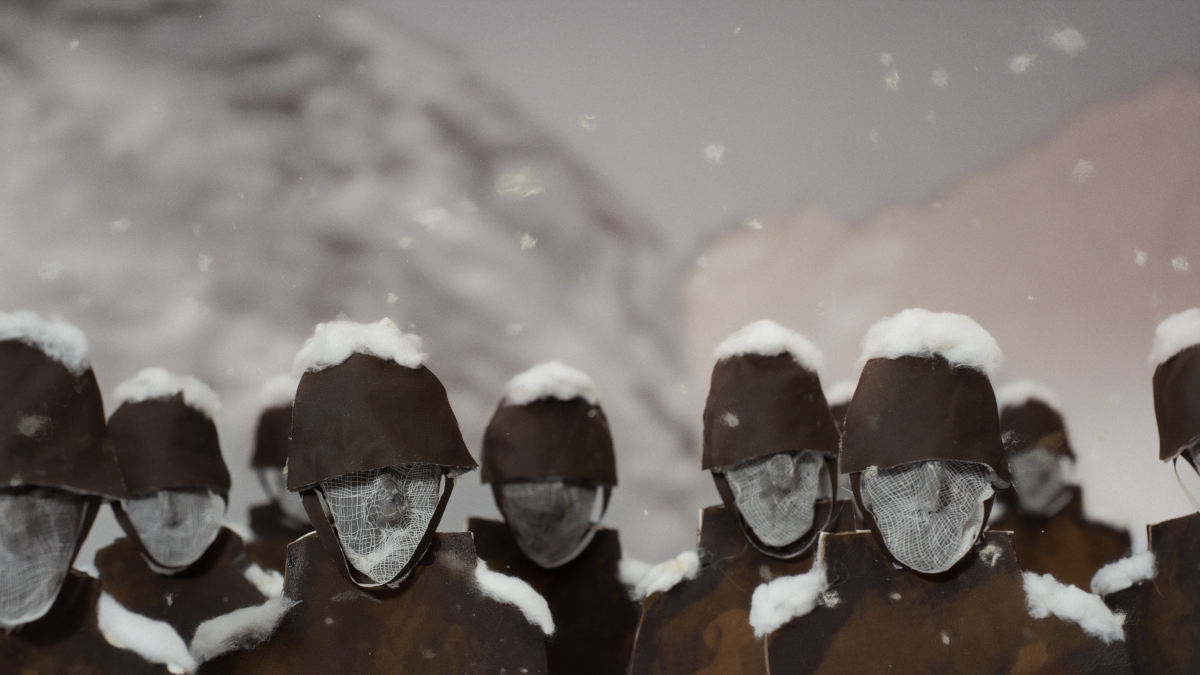
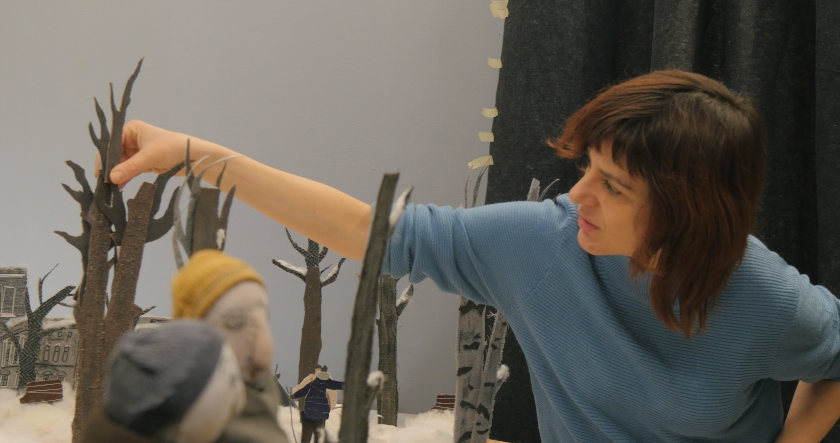
NM: Using puppets was probably the most non-obvious choice for this story. It is a road movie with a lot of sets and characters. Initially, I came to EKA because I wanted to make puppet films guided by Anu Laura Tuttelberg. At the same time, in 2022, all the feelings about which I speak in my film were so fresh (we had just escaped from Russia), that I felt that there were no other topics about which it was possible to talk. Actually, I was so depressed that if not for my master's studies, I would never have made a film. And all the decisions at that time were made in a bit of a changed state of mind. So now it seems crazy. But as soon as I decided on the material for the puppets and the world — textile and threads — it worked together so well and helped me tell the story and express my feelings.
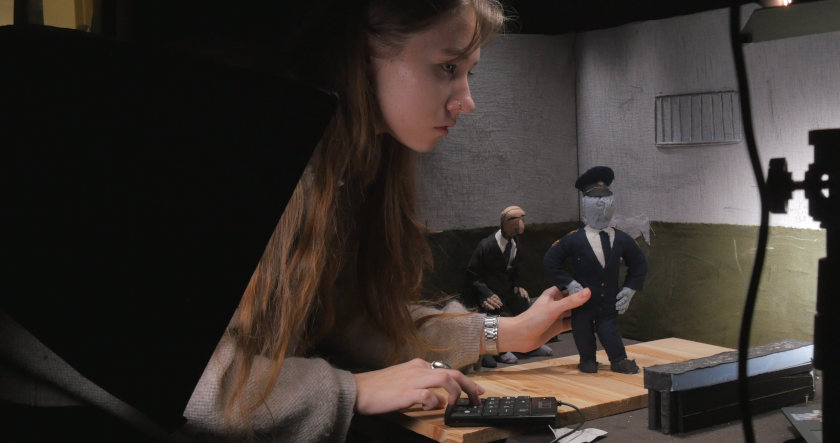
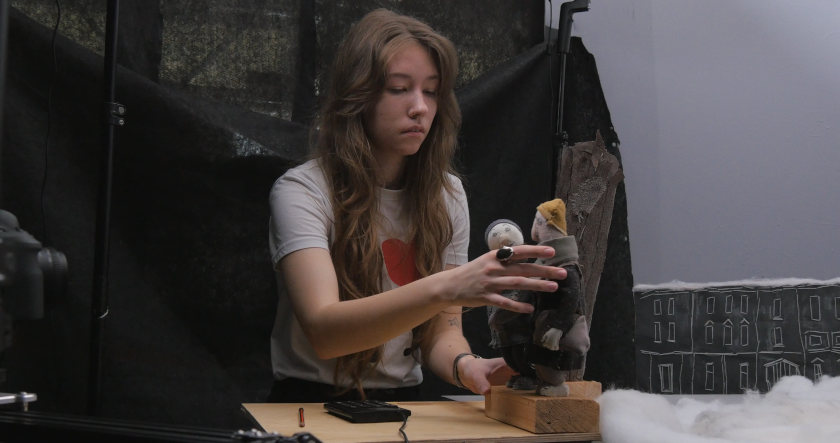
Natalia Mirzoyan and crew during the making of 'Winter in March'
MG comments: I’d add, the technique as such here might surely feel somewhat therapeutic in a broader sense –through its estranging capacity of ‘material metaphorizing’, so to speak, when sheer technical, it seems, moves can as if immediately sublime into meaning – perhaps, the most precious quality and true sign of auteur animation, in my belief. How the rough threads are being unknotted, opening up the fabric bodies to all the winds of elements and history… actually, it speaks also of body image-ideology, on a more general plane. Or the ‘cotton snow’ – main, throughout leitmotif here, as Mirzoyan conceived from the very initial impulse – is in artistic sense fruitfully paradoxical (as are other facets-devices, to my mind): yes, it stands-works for metaphor but still doesn’t give up its plainly material nature – it’s just cotton, after all, touch-feel it! – thus properly grounding the stream of thought and feeling, I’d argue.
ZF: Generally, what were the challenges – or probably special benefits – in switching from drawing and/or cutouts to this technique/variety of animation? NM: It was a great challenge, because I felt a lack of freedom in transformations and using animation metaphors. But thanks to my film partner, Sander Põldsaar, who was making sets and a cameraman, I could make a lot of transformations and also make camera movements, which I liked to use in my drawn animation. But of course, it is a lot of fighting with the material world. The process is much more difficult and longer, but also much more interesting.
ZF: On technique, more pointedly: you’ve clearly developed certain tricks in dealing with ‘real’ puppet sets, maybe to overcome some limitations/difficulties – can you reveal those trade secrets a bit?
NM: Well, we used some flat puppets, some three-dimensional, also camera movements helped a lot. But Sander was really making very tricky things, like changing the room side, for example - still, it doesn’t grow to the size I wanted…
MG comments: Surely, they were trying hard, getting inventive within the limited resources, with perhaps about one-third of the regular budget for such a project, as Natalia notes. Yet, there are certain other laborious techniques in play, like embroidery, real-physical or digitalized: those haunting screenshots that travel from the phone or monitor onto the bodies and surroundings can be misread as paper cuts, but in fact are roughly-exquisitely embroidered, sometimes put on a cardboard base. And more..
ZF: In the beginning, you put some sequences of protests, with very specific imagery – maybe referencing somehow the antiwar animated shorts which had appeared at the time (and continue to be developed up to now)? What’s the connection of the film in general to this genre/movement? – if at all.
NM: I searched for video references for many things. With the protests, I wanted it to look like it was filmed on a phone. But actually, protest scenes are not harsh enough; unfortunately, it was too difficult to make it.
ZF: Despite feeling reluctant to make/distribute your film at all in these trying times, you nevertheless did it, and to significant acclaim already; hence, your message is getting through. What does it actually mean in today’s public discourse (on this war and/or beyond) – in your understanding or feeling?
NM: When I started the film, it was too horrible to imagine the war going on for so long. But also, the dictatorship in Russia grew much more (and not only in Russia). And overall, we don’t know what to expect tomorrow, especially living in Estonia, at the border with Russia. So, my producer, Kadriann Kibus (Rebel Frame), insisted that we should release it now. I now agree with her decision - I see that the film is important not only to Russians but to many people around the globe. I am receiving many warm words from very unexpected places. Iran or Sudan, for example. Also, even if my film is focused on Russian immigrants, it still has a Ukrainian theme, and now every talk about Russian crimes in Ukraine is important.
MG comments:Natalia Mirzoyan daringly ventures into different artistic territory, switching from drawing, or occasional cutouts, to full-blown puppets. And not only that: from light to heavy breathing, if you will. It would’ve been hard to imagine, after so gentle and lighthearted, as if aquarelle-translucent and effortlessly elegant 'Five Minutes to Sea', to follow the same artist-director into sets of rough fabric and cardboard, to almost awkward figures and movements – deliberately so, no doubt – and to find with her fresh, uneasy but powerful expressiveness there, as means to untangle the pain knots in human condition of the day.
Watch the trailer for 'Winter in March'
'Winter in March' animation short has won a number of prizes after its Cannes Festival CINEF premiere, including the Heart of Sarajevo for Best Short Film (Sarajevo Film Festival 2025), a special mention at the recent Cinanima Festival, and a Grand Prix at the Feinaki Beijing Animation Week 2025; apart from its Academy Award qualification, it has been qualified (via Uppsala Short Film Festival) for the 2027 European Film Awards short film category.
Replies were edited for brevity purposes. Interview and comments contributed by: Mikhail Gurevich
Want to read more free articles like this?
Keep this professional animation journalism effort relevant and updated. Become our patron