
Interviews


Helping Others to Speak Up: A Conversation with Zero Impunity team
Olga Bobrowska
Zero Impunity is an artistic animated documentary that is so gentle when it empowers the victims of sexual violence that happened during the armed conflicts to speak up, and so rigid, concrete and powerful when it comes to analyses of the international (in)justice system that mercilessly silences them down. Picturesque resort of Annecy, with its historical architecture and sky-high prices of accommodation, meals, and services, is a place where the “first-world privileged” may, in fact, overlook every global catastrophe without any effort.
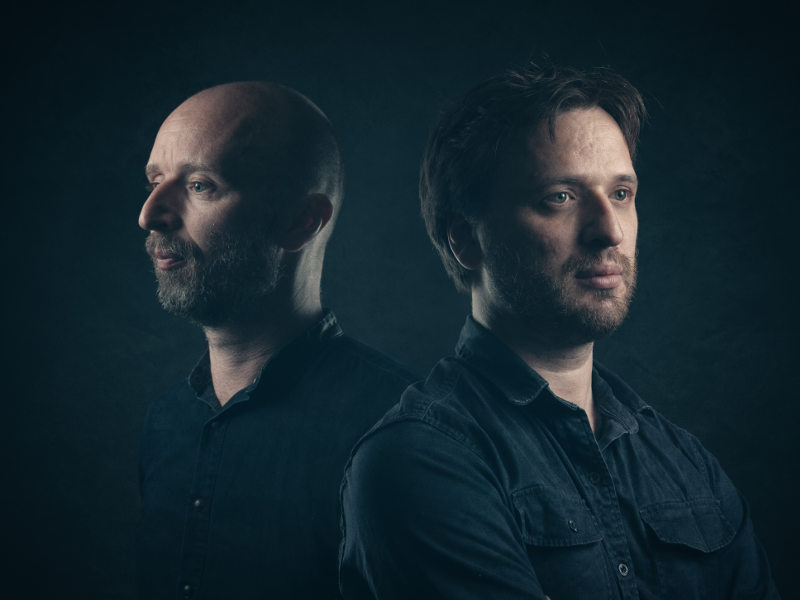
It is indeed exciting to talk to brothers and directors Nicolas Blies and Stephane Hueber-Blies, Marion Guth (an executive producer) and Denis Lambert (co-director for animation) who dare to highlight some drastic issues that democratic powers rather sweep under the carpet, a team who does it successfully, even in this perfectly bourgeois, self-satisfied and capitalist-driven surroundings. Find more about the film and the movement here.
ZF: First of all, let me say that your film is an excellent example of journalism in animation and a very unique work that successfully conveys both intimate stories about individual sufferings as well as meticulous analyses of structures that increase personal and collective traumas instead of seeking constructive, legal solutions to arrive at justice. You call this work a “citizen performance”. What do you mean by this?
SHB: The core of the film is the global transmedia that we used as a kind of pacifist weapon. We started this project with six investigations in Syria, Ukraine, Central Africa, etc., the outcome of which you watch in the film. They were conducted by twelve women investigative journalists from the Youpress collective. In the beginning, it was supposed to be an animation only but...
NB: … but after we published the reports from these investigations in the form of long texts and pictures in social media...
SHB: … we received a lot of bad comments, people were saying that none of these is true, Bashar al-Assad's military was not responsible for raping the children, we lied about Guantanamo, we are pro-Putin and pro-Trump, anti-UN, everything and nothing at the same time. That happened during the writing process, so together with Nicolas and Denis, we decided to limit the animation part, instead going back to Jordan, Syria, Ukraine, and the USA with a camera in order to meet people and try to discuss with them these comments. We went back to all these places with Olivier Crouzel, a video artist, and everywhere we created sort of artistic installations through which we showed citizens' commitment on various subjects that our film deals with. Only then did the film become a mix of 50% animation and 50% live-action.
At that time, we integrated film, investigations, and concrete social actions conducted especially in Ukraine and France. In order to organize them, we formed a partnership with various NGOs, and 400,000 people supported us on them by signing petitions. This was particularly important in Ukraine, where so far the sexual violence occurring on the front lines was not specifically criminalized; only last week, an adequate law was passed through the parliament (learn more on the subject here). In France, we're still working on finding ways with the Ministry of Defense and the French Parliament to highlight our cause. Now this citizens' performance embraces three kinds of activities: journalistic investigations, animated film, and concrete social actions.
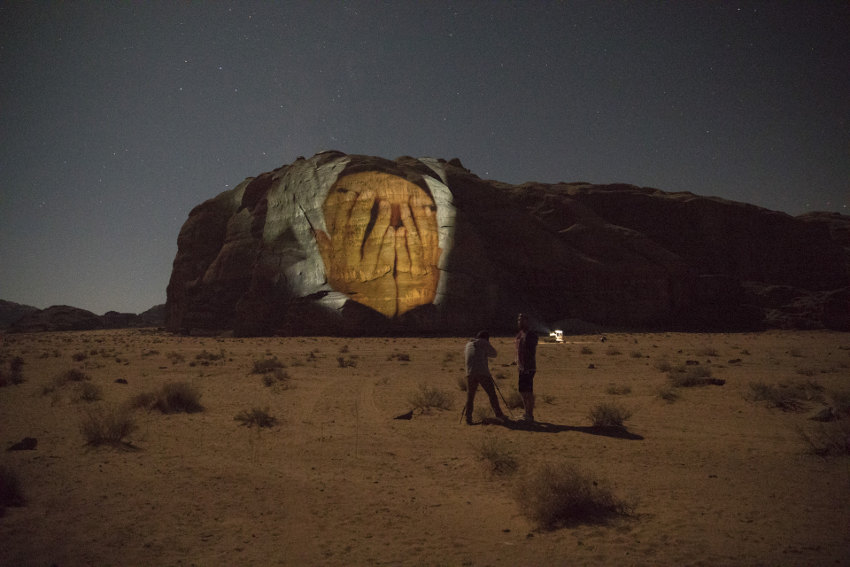
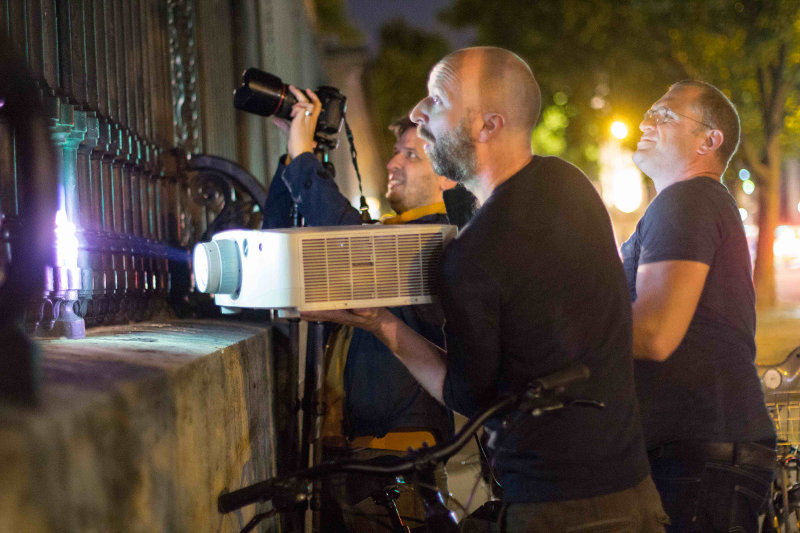
NB: For the videos projected on the walls in various cities across the world, we recorded the citizens who perform a specific gesture of uncovering their faces. This is a message to the survivors: “I'm hearing your voice, your voice exists, because of that other voices can rise up”. This is central for Zero Impunity: ok, we are neither doctors nor NGO workers, we're just citizens watching a film, reading a report – and what can we do? We can say to others: “I'm listening to you,” so activism is the process and a manner of behavior that helps others to speak up.
ZF: I'm wondering about the way you interacted with the citizens. Was it difficult to engage people in the refugee camps, urban streets etc, to perform this gesture? Furthermore, how do you interpret reactions of people confronted with the projected videos – sometimes, especially when you recorded European streets – we see people who completely do not care...
SHB: In Jordan, Paris, wherever we went, we were projecting faces on buildings and waiting for interactions with passers-by. To be honest, it was disappointing that not many people cared to talk. And there were some other obstacles. For instance, when we tried this in Amman, Jordan, we were followed by the secret service, and they forbade us from doing the installation in the city's streets. Even more, our fixer was arrested a day before we were scheduled for projections, and interrogated about us, our aims, goals etc. So within the team, we decided to go to the desert and project the faces on the mountains. I think this act is also telling.
NB: Whenever we managed to engage the citizens in discussions on the streets, our approach was that we were not trying to convince them to anything. We only wanted to hear what they wanted to say. Some people would favour torture, but some were really supportive. As for people whose faces we recorded and projected – they didn't have to be convinced, they wanted to do it.
MG: I remember that you also asked the video artist, Olivier Crouzel, about that. He said it was not necessarily about the topic of sexual violence itself or for the fact that this act was so symbolic and universal. He said that if this had happened fifteen years ago, people most likely would have gathered around in surprise and started asking questions, but today, because of the multitude of projections, billboards, advertisements, and lights in the urban streets, such performances become more and more invisible.
ZF: Medium cancels the message?
NB: Yes, and since the event didn't work powerfully, we realized what kind of power we actually have when we published the videos on social networks. In the film you see the performance we did on the buildings of the French Ministry of Defense. We published this material just a few months before finishing the film, and thanks to the outreach, we got meetings with the Ministry of Defense. At the time of the projections, we didn't have people around us, but after it was published online, they gathered around the networks and started supporting the action.
Zero Impunity creators: hacktivism
ZF: Let's speak about animated parts of the film. It was planned as fully animated, but in the course of production, you all in the team decided to animate only 50% of the story – how to approach such a radical change of plans in terms of the form?
DL: I thought it made sense: to have concrete, live-action imagery echoing animation. We used animation mainly for the parts of the testimonies, whenever real witnesses speak about the crimes. But average viewers have a problem trusting animated images, and so real live-action completes the subject.
ZF: Your animation style is realistic; you don't use it as an “audience-friendly” tool that might possibly ease a little bit the impact of the painful message of the film.
DL: The purpose was to focus on words, not on graphic style. That's why we chose realism; it helps to concentrate on narrative. It was also a logical and quick choice, as first we did investigations, a lot of research, and also a graphic research.
NB: It's realistic but also minimalistic. Minimalism also gives a distance that you need to focus on words.
ZF: Six investigations gave you the source material; the stories we can read on the project's website are much longer and complex than the summaries presented in the film. What was the method of deciding what's staying in the film, and what has to be cut out from the original story that is based on facts?
NB: It was impossible to present all that came from these huge investigations. For each investigation, we decided to focus on one or two individual situations and testimonies so the audience would understand the essence of the problem. And so they would see the structure of the global system that links these situations.
SHB: Our goal was not to speak very specifically about geopolitics in Ukraine or Syria, but we wanted to speak about the global system of impunity that recurs in wars around the globe, which results from patriarchy.
NB: System of impunity also demonstrates how diverse the category of sexual violence really is...
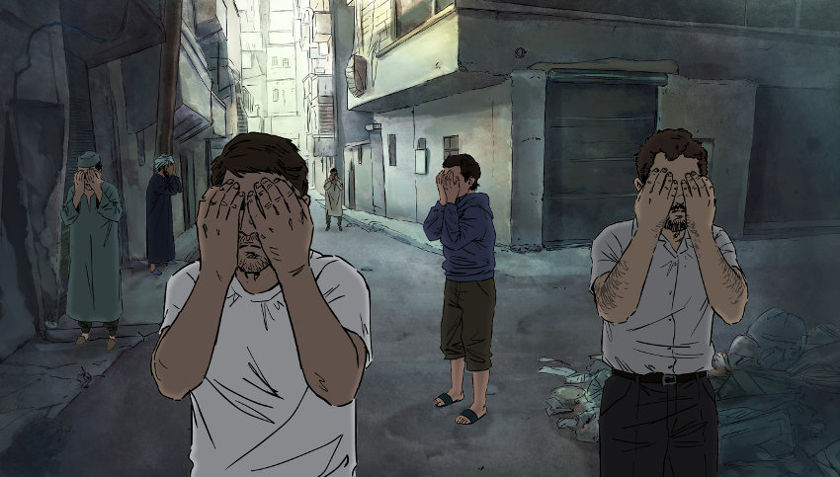
SHB: … for example: surviving prostitution, rape, child rape, torture, rectal feedings, medical torture... Considering all these gives a global point of view on what sexual violence is. It is not easy to understand that, for a lot of people, prostitution in the war zone is not sexual violence, but we consider it this way.
NB: And then we tried to explain why there is silence around these subjects, why victims are afraid to speak. When you understand why it's difficult for them to speak up, you will also understand how brave they are when they do so. And then you have further responsibility.
ZF: I'd guess it was difficult to produce such a daring documentary film in various countries with unstable governments or organized under authoritarian regimes. How did you research or scout for locations in these places?
MG: The basic investigation was done by twelve women journalists. Their collective knows how to get the credentials and authorization, they work in a network, etc. Among other reasons, this is why we've worked with them; we knew they could do something really in-depth. Furthermore, from the very beginning, Nicolas and Stephane wanted to work with women journalists who were capable of providing so many testimonies. And then, Nicolas and Stephane know how to work by themselves; in this sense, the production was easy! From the very first moment, financially everything was in place, animation was on the side of Denis and Melusine Productions. We had a great team of people engaged in this topic.
NB: We were a very small, confident but also experienced team, and from the very beginning, we wanted to be independent. That's why we didn't pitch the project at any TV channel or anything like that. We have been deciding on our own what we're talking about and where. In this sense, it was free.
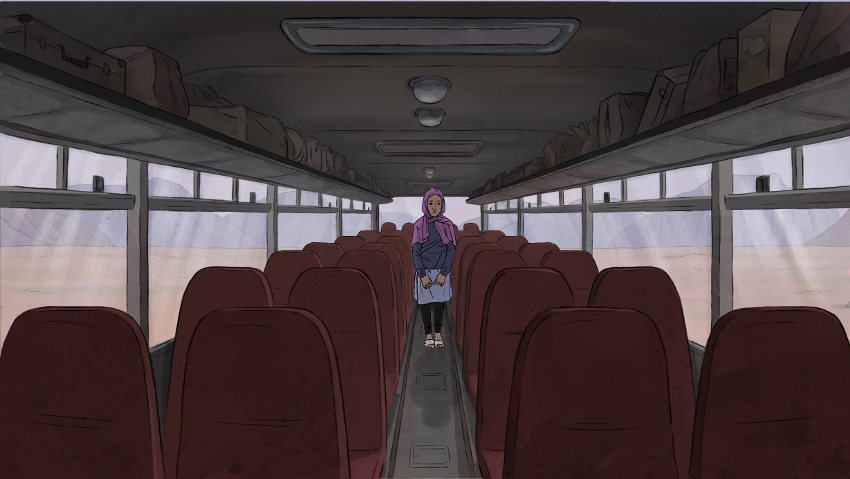
MG: A producer's perspective: on each stage – writing, character design, etc – we wanted everybody in the film to have dignity, and we wanted their portrayals to be truthful to the investigations. In terms of the material, we've been primarily working with audio recordings, but in another sense, we had to work on our own bias as well; we had to explore where we are strong and where we have to remain cautious.
SHB: We also had to deal with political pressure, especially from the side of the UN. In one place, we were forbidden to visit women from one of the refugee camps. Also, some festivals withdrew our film because of pressure from the US or French military. But even during the writing phase, we had to deal with these kinds of issues.
NB: But the production of video projections used in the live-action part of the film was really easy. There were just three of us; we had no authorization for projecting on the walls (except for governmental buildings). Well, we told you about problems in Jordan, but we did this without any obstacles in Kyiv or Odessa.
SHB: A funny situation happened while we were projecting on the walls of the Ministry of Defense in France. Well, they have this huge warning sign that forbids recording and photographing. We came with our projector, filmed the videos, and at some point, the police car arrived. So we put the projector back in the bag and started going away, I said to our assistant: “Take the memory card out and replace it with anything”. And of course, a policeman approached us and asked us to hand the card over. Well, they received some whatever images, but us – in two days' time we put our video material on social networks and it made a buzz.
MG: Because of all these, it is important to understand that at the institutional level, it is easier to support such a political film at an early stage. We approached the film fund in Luxembourg and the funds in France when the investigations were still going on, but we didn't yet have the script. Intuitively, we knew that once the reports were on the table, it might be more difficult for them because of the politics. This kind of production requires the involvement of people who want to level up.
Olga Bobrowska, Annecy Festival 14.06.2019
Want to read more free articles like this?
Keep this professional animation journalism effort relevant and updated. Become our patron