
The Development Doesn't Move on Its Own: It Is Pushed by People
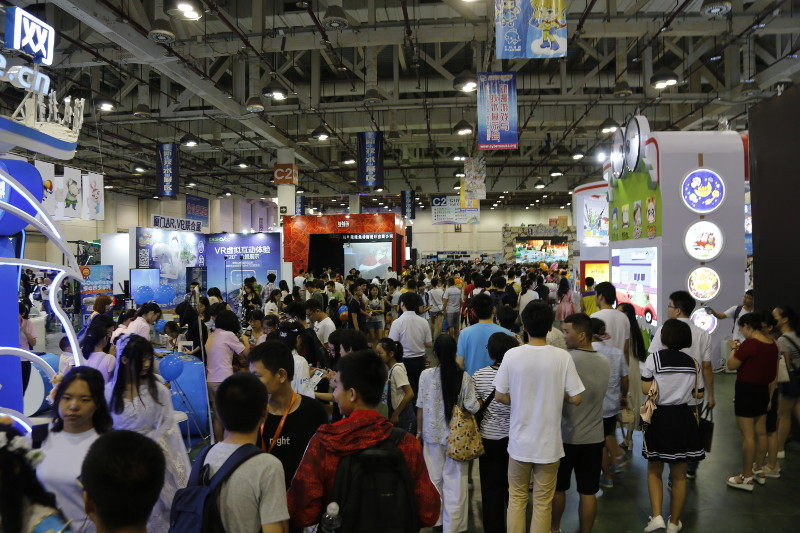
In Xiamen, Fujian province, the city famous for pearls, seafood and nature sites, we talked to Mr. Zhang Chi from ASIFA-China, attempting to map Chinese animated film's walking patterns in regard to the size of industry, Belt-Road Initiative and a particular situation of Liu Jian's Have a Nice Day – or as one should name it accordingly to its new title, The Big World...
At the end of 2018, China celebrated the 40th anniversary of the introduction of the reforms and opening up strategy that enabled the country's transition into a global superpower in terms of geopolitics, economy, industry, and technology development. Contemporary China's influence on globalized cultural production has become more and more recognized by the traditionally self-oriented Western audiences of professionals and enthusiasts.
Still, the status and significance of animated films and content production in China tend to be underestimated in the mainstream. Unjustly, the Chinese producers and official bodies have already invested a lot – and keep doing so – in this form of intercultural communication, while the independent artists master their art and craft, and elaborate their messages in the utmost sophisticated, witty, and skillful manner. Let us take a look at the conditions of an “animation production with Chinese characteristics” from the perspective of the well-established and industry-driven festival in Xiamen.
11th Xiamen International Animation Festival (CyberSousa) ended on November 18th. The Festival, organized by ASIFA China in cooperation with the local municipality and business partners, grants large financial awards (a total of 1.93 mln RMB) to the winners and laureates of the five categories (4 national and 1 international) in the Animation Competition and Comics Competition.
It is also one of the most significant and recognized Chinese events devoted to animated film. Organization of the Festival's timeline may evoke certain confusion among Western professionals: in fact the Festival starts in October; in two weeks sequences the organizers bring another groups of Chinese and foreign experts to evaluate works on the basis on pre-, mid- and final selection, while the actual Audiences attend only several screenings in the very end (the Interviewer participated in pre-selection).
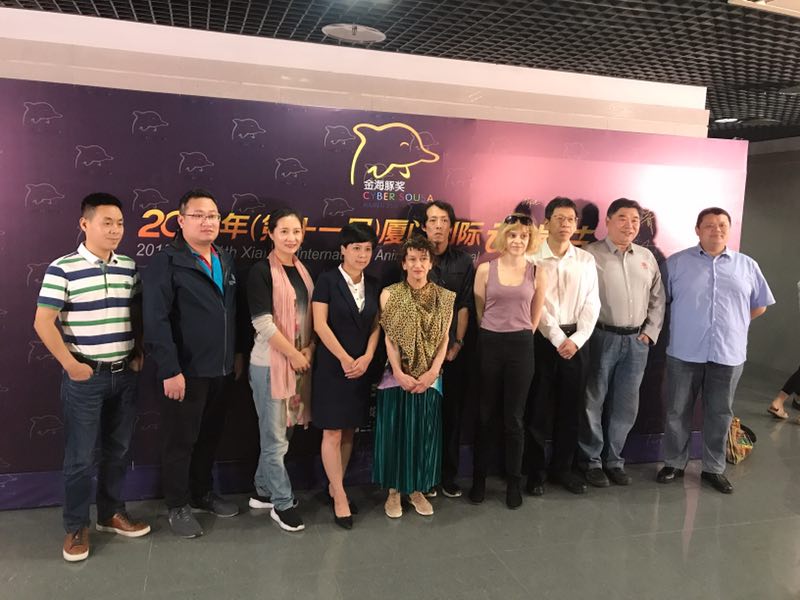
Xiamen 2018 Pre-Selection Jury
Almost simultaneously to the grand finale of CyberSousa, the Chinese Independent Animation Film Forum is annually held in Beijing, an event that appears to follow the art-house animation festival formula as developed in the European circuit. The diverse approaches taken by the organizers of both XIAFF and CIAFF manifest an apparent tendency in contemporary Chinese animation that can be described as a paraphrase of Zhou Enlai's famous stand on cultural production: Chinese animation walks on two legs of arts and industry, both of them only naturally compelled to learn and interact with the international scene, at the same time curiously pursuing uniquely Chinese ways of expression and industry models.
In Xiamen, Fujian province, the city famous for pearls, seafood and nature sites, we talked to Mr. Zhang Chi from ASIFA-China, attempting to map Chinese animated film's walking patterns in regard to the size of industry, Belt-Road Initiative and a particular situation of Liu Jian's Have a Nice Day – or as one should name it accordingly to its new title, The Big World...
Olga Bobrowska: While thinking about Chinese animation, we should realize its size. Let's try to present it with the numbers.
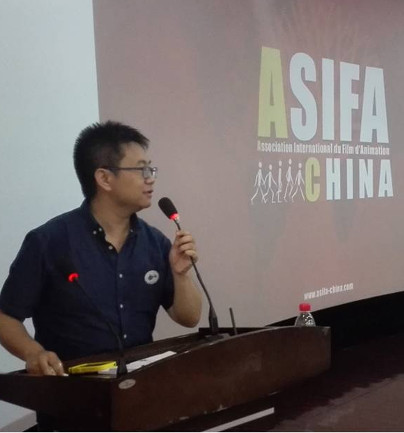 Mr. Zhang Chi: Since 2011 the domestic animation production exceeds 200.000 minutes. Despite the fact that TV animation production has decreased in the past two years, the overall animation production has grown since the internet animation production has increased rapidly, and the feature animation films keep developing. The minutes as a measurement for the animation content are not important anymore, as it is very hard to calculate all the animation works; for example, animation made by students or graduates from schools is in huge amounts, but it is very hard to calculate the minutes.
O.B.: We meet in Xiamen. I'm wondering what the production in Xiamen looks like in comparison to Beijing?
Z.C.: There are not many animation studios in Xiamen. The reason why the festival is held here is that the three biggest providers of mobile animation content are based in Xiamen. Mobile animation is very important right now. Animation content for mobile is first sent and tested in Xiamen by these three providers: China Unicom, China Mobile, and China Telecom.
O.B.: There are plenty of animation departments, film and animation schools all around China – how does this scene look in numbers?
Z.C: According to the reports we have, more than 1,000 colleges, vocational schools, and universities offer an animation major. According to the reports, we have more than 300,000 students. The animation industry began developing very fast in the 2000s, and many universities set a major focus on animation after the year 2000. It's a short time, and judging the quality of students, their skills, and their professionalism is already challenging. There are not enough teachers.
O.B.: These problems we learned from Xue Yanping's film Silence within Noise. An Account of Chinese Animation in the 21st Century. He had a very harsh opinion on the level of education, and he was very critical about the level of awareness of the artists. There are moments in the film that show animation education as a factory. First of all, would you agree with his depiction? Secondly, do you think there are some traces of change or transformation?
Z.C: Xue Yanping was my teacher, and I partially agree with Mr. Xue's opinions. I think that the development of the animation industry in the 21st century is very short. There is not enough time for animation to develop in a normal way. The development doesn't move on its own.
It is pushed by people. It moves in the right direction even if there are some detours. For example, in other countries, the governments are more likely to give money for artistic productions, but in China, the production system works differently. The studios focus on persuading TV stations to broadcast their series, a basic criterion for governmental subsidiaries, rather than on improving the quality of their works. The policy for subsidiaries for animation works that were broadcast on TV has been abolished, making the studios pay attention to the issue of winning the market.
O.B.: The interest of European selectors and curators is based on recent festival successes; therefore, we follow artistic achievements from schools like Hangzhou Academy of Arts or the Communication University of China in Beijing. What are the schools that you think are overlooked in the international circuit?
Z.C: You should also mention Beijing Film Academy. Interesting works also come out from the Xi'an Academy of Fine Arts, which is very good at 2D animation. And the China Academy of Art.
O.B.: What about the school in Jilin?
Z.C: Jilin Animation Institute is very big. It has many students and it is famous. This school invested a lot of money in communication. Mr. Johnchill Lee, the general secretary of ASIFA CHINA, is actually one of the founders of the Jilin Institute. It’s a big institute with many students, and they produce a lot of works each year. Some of the students' work is good. However, compared to its size, their production could be better.
O.B.: The other factor that European organizers take into account is the festival circulation. How many recommended animation festivals are going on in China right now?
 Z.C: There are two major festivals: one is China International Cartoon & Animation Festival (CICAF) held in Hangzhou every year, and one is the Xiamen International Animation Festival (XIAF). There were many others – over 100 festivals in China, but most of them lasted for 1 or 2 editions, and then they disappeared. Xiamen and Hangzhou are the ones that have sustained for a long time. Xiamen is held for the 11th time, and the festival in Hangzhou started in 2005; Mr. Johnchill Lee, the general secretary of ASIFA CHINA, was also one of the founding members of this festival. The first animation festival in Shanghai started in 1988, but it was held only for two years.
O.B.: What is ASIFA-China and XIAF's view on the definition of Chinese independent animation? How do you see the role of the independent artists within the industry?
Z.C: Independent animation is a very important base for animation development. Independent animation inspires people in terms of techniques, storytelling, and expression methods. Other than telling stories, animation can also be used as a way to express ourselves, to convey emotions, knowledge, and to establish connections among people. And compared to live-action, it has fewer limits when it comes to telling the stories and expressing ourselves. Sometimes it might be awkward to express your ideas by using the actors but there is no such feeling in animation.
O.B.: Can you formulate today's goals for ASIFA-China and the XIAF?
Z.C.: The mission of ASIFA-China is to establish connections between Chinese animators and between Chinese animators and foreign animators on the basis of people-to-people, films-to-films, and industry-to-industry. We want Chinese animators and students to learn more about the animation industry in China and other countries in the aspects of commerce and arts. We have held many seminars at the universities around the country. We also hold the AWG (The Animation Workshop Groups) for the teenagers, to teach them how to surprise themselves and how to do animation. We co-host the Xiamen festival. We want the Chinese animation to be watched by more people and judged by a fair jury. We also help Chinese animators to visit festivals in other countries.
O.B.: So you are – so to say – a center of affairs. What is the animation sector's role in the Belt-Road Initiative? I think that Europeans believe it is more of a trade deal than a cultural exchange campaign.
Z.C.: We don't forget about the culture. China always wanted the Chinese animated film and culture to go outside. For a long time, we have felt that the Europeans have been misunderstanding us. We wish that people in European countries would learn more about our culture and how our animation works, but it's not an easy thing to do. The animation industry is important for the Belt-Road Initiative. We want our culture to be well-known and widely understood, but we still study the process of implementation. Economic and financial communication – these are much easier than cultural communication. Let's think about one example of the Belt-Road Initiative and animation: since the 1980s, the series The Mole [original: Krteček] is very famous in China. Now the Chinese officials communicate with the producers in the Czech Republic to combine the efforts, and to combine the mole with a panda.
O.B.: I like this idea, the mole is a hero of my childhood. Foreign successes or problems in international distribution may have repercussions on the domestic industry. In Europe, Liu Jian's film Have a Nice Day became very popular after the situation in Annecy in 2017 [O.B.: The film was withdrawn from the competition due to official requests of the Chinese partners ], and it was reported it had problems with distribution in China.
O.B. But some time ago, I realized that Have a Nice Day's title – Hao jile/ 好极了– has been changed into The Big World – Da shije/ 大世界– and currently it is recognized by the Chinese film critics as a part of „Big Four New Tendencies in Chinese Animation” (zhongguo donghua de da fangxiang) along with Monkey King: Hero Is Back (Da sheng guilai), Big Fish and Begonia (Da yu haitang), and The Grand Protector (Da hufa). How did this change occur?
Z.C.: So you want to know why Hao Jile/ Da Shijie was not very popular in the beginning, but with some time it became a popular film... Well, it premiered abroad – in Berlin and Zagreb. Then it was supposed to be screened in Annecy, but this didn't happen. After that, the film's title was changed.
O.B.: Because of Annecy?
Z.C.: The situation in Annecy might have been one of the reasons. But I think that the main reason is related to the actual story of the film. “Hao jile” means “great,” but the film is actually about a not-so-great mob. It's a very dark story, while this specific title shows a certain attitude of the director that didn't seem right for the officials from the perspective of protecting the minors. The title Da shije (The Big World) is neutral; it doesn't show any attitude. The ups and downs in Annecy had shown some attention for the film – when people thought that nobody could watch it anymore, the film came back, and the audience was interested in it. Another reason for its popularity is that the film won an important award in Taiwan – The Golden Horse – and so more people found out about it. It was very prestigious since the award for the feature animation film had not been granted to any film for a few years.
O.B.: What was the reception of this arthouse animated feature?
Z.C.: The box office wasn't really high (about 2.6 million). As you know, most of the popular films have a happy ending, and everybody likes family-friendly Disney films. But Hao jile/ Da shijie is not the film that you would enjoy with your family because of its black humor. But it was appreciated by the animators and the professionals who paid attention to the ways of the director's expression. Another reason for its lack of success at the box office is that the cinema hall managers didn't give the film sufficient opportunity to be screened. This is the problem with arthouse animation.
(Olga Bobrowska kindly thanks Ms. Yujie Hua for the translation and all the help)
contributed by: Olga Bobrowska
Want to read more free articles like this?

Keep this professional animation journalism effort relevant and updated. Become our patron