
Pierre-Luc Granjon’s Masterclass at Animateka 2025: the Joy of Creativity (GoCritic! review)
ZF Team
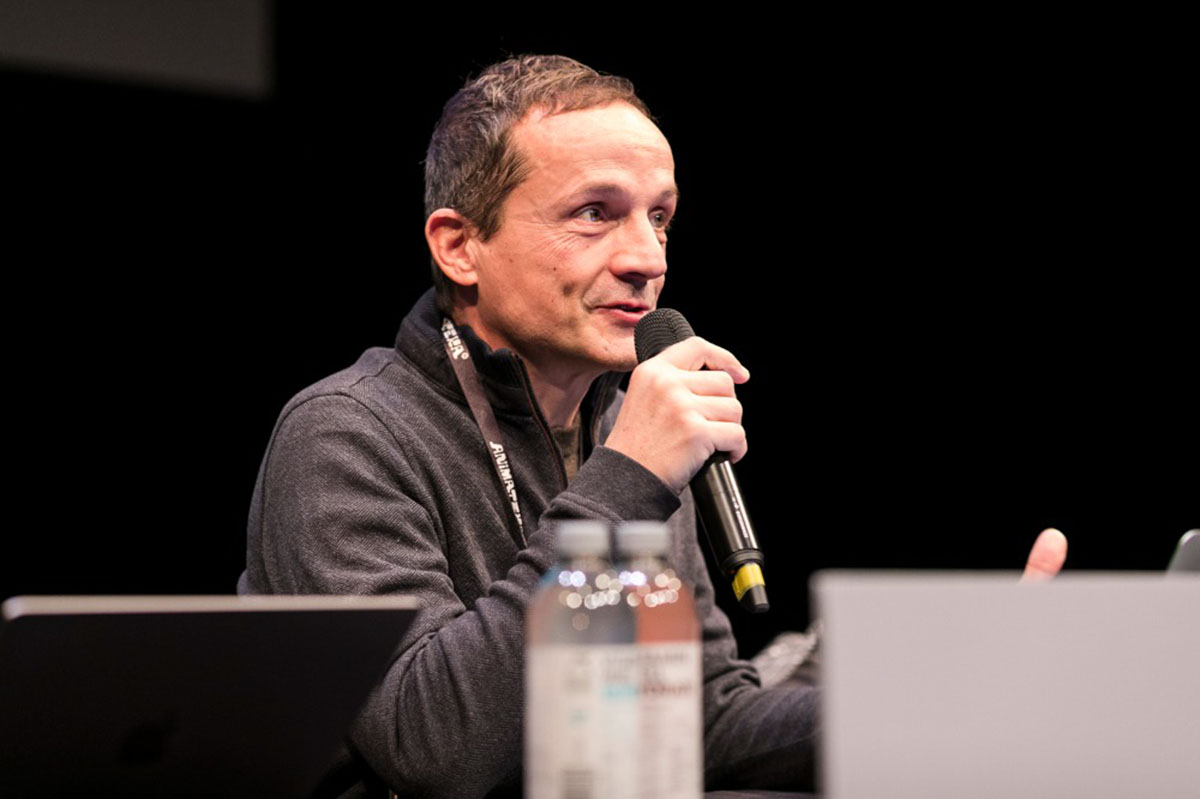
“Making a happy movie is a political act.” At first glance, describing French animation filmmaker Pierre-Luc Granjon’s works as “happy” — as he did at the masterclass held during Animateka in Ljubljana on December 2 — might seem odd. Often exploring dark themes amid dark environments, Granjon’s visuals can appear melancholic and slightly eerie. The filmmaker himself evidently perceives his oeuvre differently...
When describing his 2002 debut short 'A Little Adventure' (Petite Escapade), Granjon, now 52, recalls as inspiration his own childhood. He spent much time venturing in the murky forests around his native town, Annemasse (on the Franco-Swiss border): “the forest was a kind of big playground, not scary at all. It was like a home for me.”
Granjon was omnipresent at Animateka this year as the festival artist-in-residence. He designed the poster; a small exhibition dedicated to his career adorned the corridors of the festival’s main venue, Kinodvor; he served on the Main Competition jury, and a selection of his work was screened in the “Jurilicious” programme.
Granjon's career began after graduating from the École d'Art Appliqués in Lyon; he then worked for the Folimage production company as a model-maker, mainly on the 1999 claymation TV show 'Hilltop Hospital'. During the masterclass, held in the industrial surroundings of the Slovenian capital's former electrical power station, he cites as major inspirations two French animated shorts from that pre-millennial era: 'L'homme aux bras ballants' (1997) by Laurent Gorgiard and 'La bouche cousue' (1999) by Cathérine Buffat and Jean-Luc Gréco.
Granjon himself recognises a parallel to La bouche cousue in his second short, 'The Other Kids’ Castle' (Le chateau des autres, 2004), as both feature the interior of a bus as a key location. Granjon, while maintaining a “joyful” approach, has always implemented in his films decidedly engagé themes. 'The White Wolf' (Le loup blanc, 2006), is his reaction to the alienation caused by mass-consumerism: “supermarkets do everything they can to make us forget that the meat we buy once came from a living animal,” he muses.
While The White Wolf tackles vegetarianism with an almost cruel (and shocking) honesty, he considers 'The Big Beast' (La grosse bête, 2013) as his most directly political film. “I wanted to make a more political movie,” he recalls. “I was surprised by the election results in small French villages where there is no immigration at all, and many people voted for the far-right.” In Granjon’s stop-motion film, a small town is shocked and then incited by news and hearsay about the presence of a dangerous beast.
The highlight in Granjon’s masterclass is not as much the contents of his films but the creativity of his approach. While his early stop-motion films implemented mainly 3D chicken-wire and papier-maché figurines, Granjon explains that he has been continuously open to experimental impulses. “I really enjoy discovering things that are new for me,” he says. “I really have the feeling of joy in discovering new things.”
| Related: Our review of The Night Boots |
For The White Wolf, he describes welding together a multi-layered frame with glass panels to provide a sense of depth to the 2D animation of the film: not something seen before, exactly, but a technique that Granjon himself learned through trial and error with his team.
In other cases, he learned new techniques from other prominent filmmakers. In an emotional moment of the masterclass, Granjon is deeply moved as he thanks his fellow Animateka juror Michèle Lemieux (present in the room at the time), for her guidance in teaching him pinscreen animation. Granjon attended Lemieux's three-day masterclass at Annecy on this venerable animation style, invented in the 1920s by Alexander Alexeieff and Claire Parker, and the focus of Animateka's exhaustive retrospective this year.
Pinscreen, as Granjon explains in great detail, employs microscopic pins inserted into a 50cm x 70cm metal frame. Each pin casts a shadow that can be darker or lighter, depending on how it is inserted, allowing for the creation of very detailed monochrome images. The animator applied this technique in his most recent film, The Night Boots (Les bottes de la nuit, 2024), winner of both the Cristal Annecy prize for Best Animated Short and the Audience Award at the French festival earlier this year.
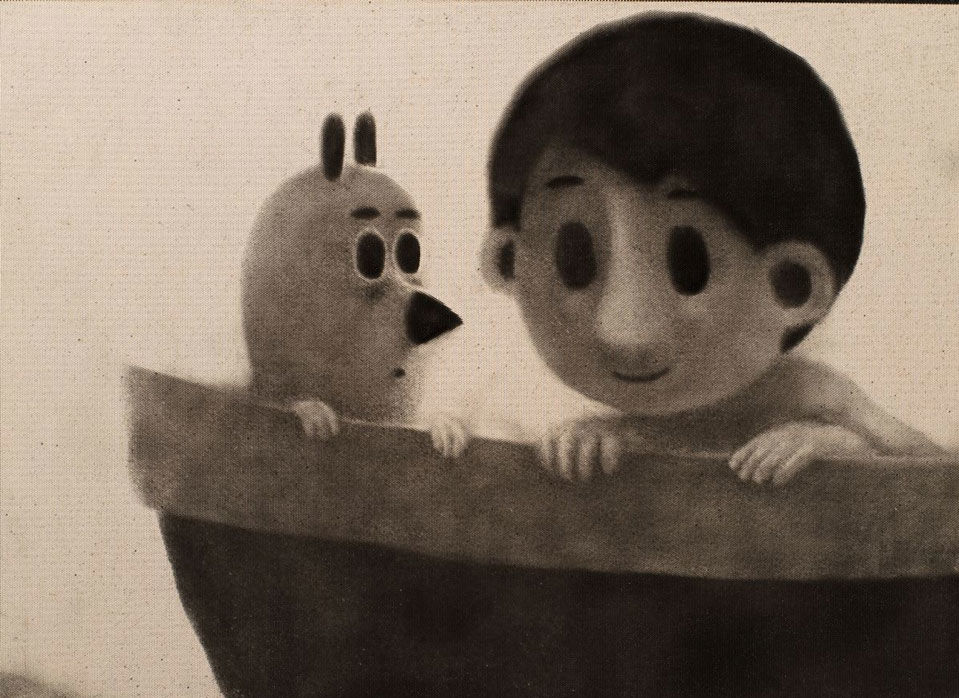
'The Night Boots' by Pierre-Luc Granjon
His current interest, however, points more towards the use of a technique he developed for '36,000 Years Later: Je ne fais que passer' (2015). His very brief short, made as part of a multi-director project with 14 other animators from Folimage, is inspired by the paintings in the Chauvet cave, one of the oldest painted caves in the world.
In the masterclass, Granjon describes the method he deployed on this project. A thick plasterboard is stretched out, and the animated characters are engraved. As the animation progresses, the layer gets thinner, providing an additional “fading” effect. The director teases that his next film, still in development, will be using this procedure once again.
Granjon has also co-directed some feature-length stop-motion films, such as 'The Inventor' (2023, with Jim Capobianco), but this area is barely touched upon during his presentation — he perhaps sees his short films as a higher expression of his creativity. Nonetheless, asked about his feature-length experiences, he emphasises, once again, the importance of joy: “I tried to make sure that everyone felt comfortable and happy to come to work... The main thing is that, even if you’re stressed, you have to keep smiling at your team.”
The masterclass indicated that Pierre-Luc Granjon can be summed up in this balance: between a positive mindset and a creative fervour, he is always open to novelty, and approaches animation with joie de vivre in his heart.
contributed by: Viktor Tóth
Want to read more free articles like this?

Keep this professional animation journalism effort relevant and updated. Become our patron

Read More About:
Related Articles
FIND THE RIGHT FESTIVAL