StopTrik Festival 2026 Report: Living with Dead Media
Amanda Barbour
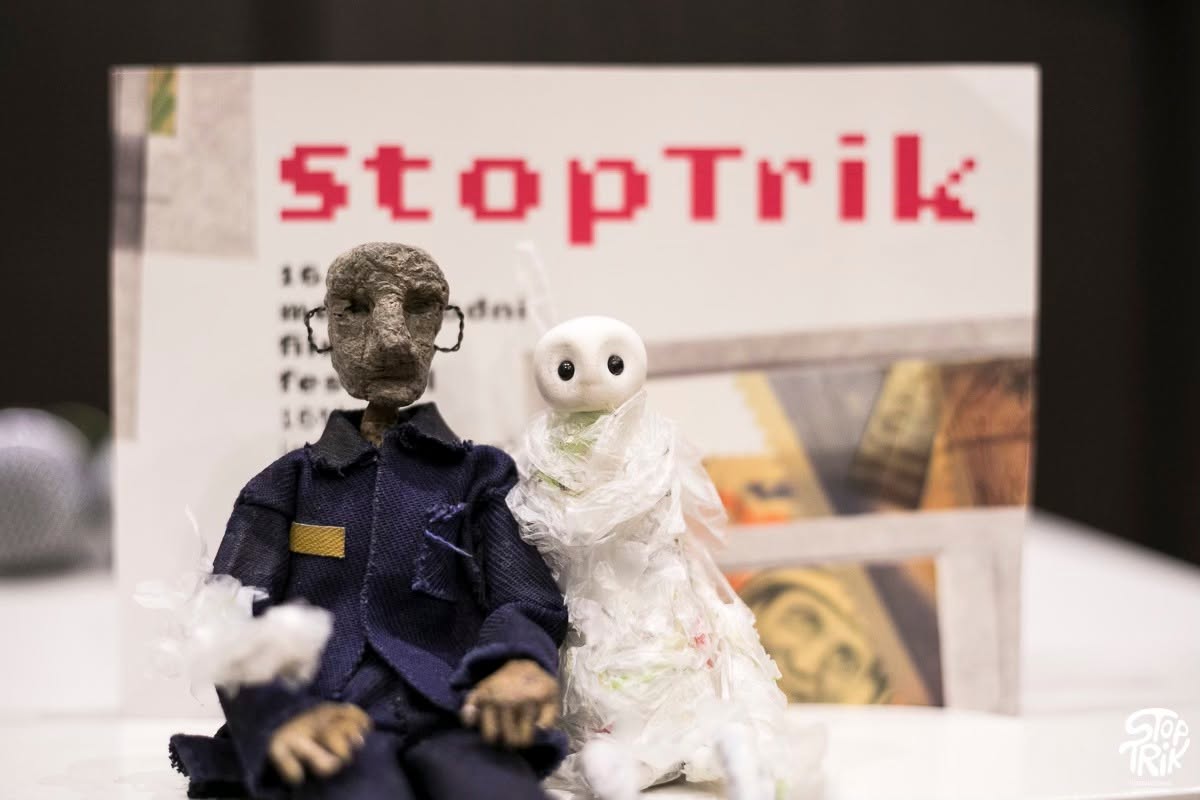
Slovenia’s StopTrik International Film Festival (2026: 23-27 September in Maribor), which recently completed its 16th edition, is Europe’s oldest (and much-acclaimed) stop-motion film festival. As a medium-specific celebration of cinema, it attracts audiences who are interested in how a film is made, not just the final cut we see on screen. This then informs debate on the symbiotic relationship between form and meaning, and gives useful context for the 2026 theme: Dead Media. This is “media that didn't make it, martyred media” that became obsolete with the passage of time. The festival's 16th edition was thus an exercise in media archaeology: an excavation of the various technologies that propelled static images into motion. What emerged across the films, panels, workshops and lectures was how a film’s making shapes its meaning. Or, as Marshall McLuhan would have it, "The medium is the message."
The “Trik” in the festival’s title is relevant here. “Trick films” were short, silent films featuring innovative special effects in the late 19th and early 20th century. Georges Méliès’ ‘Le voyage dans la lune’ (1902) and Segundo de Chomón’s ‘Hôtel électrique’ (1908) are good examples of this. Techniques like stop-motion, substitution splicing, and superimposition were part of filmmakers’ arsenal to “trick” audiences. StopTrik’s 16th edition pulled back the curtain to see how the experience of watching a film changes when you know the tactics behind the tricks.
Vintage media in Animation Practice
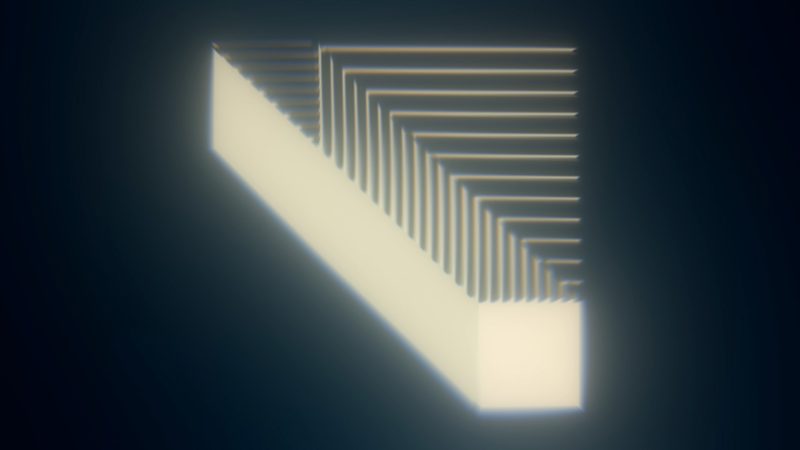
Films in the ‘Dead Media: Fleeting Matters’ retrospective were preceded by title cards explaining the technical aspects of the subsequent film. Watching Norman McLaren and Evelyn Lambart’s ‘Mosaic’ (1965), audiences were thus aware that this was made by engraving straight lines on black leader, creating a Morse-code-like percussion. Optical sound asks what sound looks like. Hong Kong-based artist, animator, and researcher Max Hattler, featured in the ‘Imagining the Authors' screening-and-talk event, gestures towards this tradition in ‘O/S’ (2023). Here, “Abstract motion becomes sound. What you hear is what you see.” Hattler explained that he “was not corrupted by the 12 principles of animation,” because he wasn’t taught them at school. This results in a more musical mode of filmmaking, where music gives his work structure. The 12 principles mimic realism to create The Illusion of Life. Deviating from this frees us from the shackles of logic: to yield new ways of seeing, hearing and understanding the world.
O/S by Max Hattler
Another notable entry in ‘Fleeting Matters’ was Lei Lei and Thomas Sauvin’s ‘Recycled’ (2013). Images salvaged from 35mm negatives, en route to a recycling plant on the outskirts of Beijing, become this film’s reel. The ensemble of what looks like family photos alludes to the dying art of printed family albums. The transition from analogue to digital has come with a shift in audience and form: a family album’s materiality means it can only be seen by people in close physical (and likely emotional) proximity to you. An online audience is much more unpredictable, and comes with quantitative metrics (like “likes” and algorithms) that incentivise certain kinds of images. The cost of developing film results in a more economical approach to what gets photographed, while digital images are abundant. On average, we hold over a thousand images on our phone. Only 2% make it to print. This has implications for how familial history is captured, curated and ultimately remembered.
Vuk Jevremović's exhibition, ‘Human Gestures’, showcased how time-intensive labour becomes visible on canvas through the textures of oil painting. It featured two paintings, ‘The Cathedral’(1988) and ‘The Machine’ (1999), coupled with a selection of handcrafted frames from ‘ThePanther’ (1998), ‘11’ (2022), and ‘Moral Support’ (2024). StopTrik Program Director Michał Bobrowski’s remarks are worth repeating, as these images “offer a meditation on disappearance and persistence - on what it means to continue working with tools and processes that the present no longer requires, yet still needs.” Jevremović's craft rebels against a capitalism that prioritizes speed over substance. It poses “unresolved questions about what it means to make images by hand in a world that has largely stopped asking.”
Contemporary Animation programs
StopTrik’s anti-establishment inclinations are reflected in how they structure competitive programs and bestow accolades. Beyond having a standard ‘International Competition’, ‘Borderlands’ is also a part of their regular programming and creates space for more experimental, hybrid approaches to stop-motion. This refuses hard borders around what does and doesn’t count as stop-motion. Instead of international expert juries, the festival empowers audiences to decide on the winner of the Grand Prix. This insistence on democratic process is emblematic of the broader festival ethos.
After taking home the Cristal Award for a Graduation Film at Annecy, Montréal-based artist and animator Laurence Thérien’s ‘Ball Face’ (2026) won the Maribor Audience Grand Prix. Claymation is well suited to the film's slapstick comedy, as a young girl navigates the perils of elementary school under the tutelage of an attempted cop-turned-PE teacher. Thérien is attuned to what clay can do; it’s a form of play that goes out of fashion as kids grow up, while its elasticity can exaggerate sports injuries for comedic effect.
The Catalan-language ‘La veritat et gira l'esquena, Cornelius’ (‘The Truth Rejects You, Cornelius,’ Khris Cembe, Marc Torices, 2026) was a worthy recipient of the ‘Borderlands’ Audience Grand Prix. Cornelius the labrador consults his psychologist, a chain-smoking shrimp. Therapy is rendered in puppet stop-motion, while Cornelius’s increasingly chaotic memories are relayed in 2D animation. The latter aesthetic shifts (from children's book to something akin to ‘Fear and Loathing in Las Vegas’(Terry Gilliam, 1998)) with every version of the same story Cornelius tells. This dialogue between different film languages expands common connotations of what stop-motion is, or can be.
An action-packed program meant that I didn’t have time to catch the Stop Motion Animation for Children’s programs. However, it’s worth noting that the young crowd became three jury cohorts disaggregated by age: 6 - 8, 9 - 11 and 12 - 14. Treating young people as intelligent, with opinions worth elevating, is a notable departure in a world controlled by adults (who often make questionable decisions anyway). Empowering young people, who often don’t get a vote, contributes to the anti-establishment inclinations mentioned earlier.
When animation contests who writes the historical record, and how
The festivals’ politically active programming emphasizes how media history is also a history of society and culture. To show ‘Solidarity with Sudan,’ StopTrik screened the hybrid feature-length documentary ‘Khartoum’ (Anas Saeed, Rawia Alhag, Ibrahim Snoopy, Timea M. Ahmed, Phil Cox, 2025). It’s a love letter to the titular city that profiles five locals from different social strata, before and after civil war broke out. The film's use of green screen demonstrates what animation can articulate that newsreels struggle to capture: people's dreams. Their memories of a city before war tore it apart and their hopes for the future.
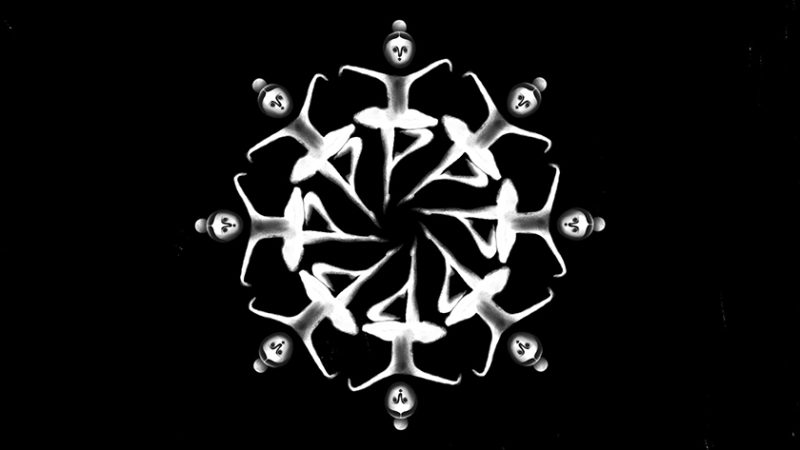
Looking further north, Nicolas Fattouh (founder of Beirut Animation Nights and director of the critically acclaimed How My Grandmother Became a Chair (2020) curated and presented the Arab Animation showcase. It highlighted the breadth and vitality of contemporary Arab animation, opening a window into how animators from Lebanon, Jordan, Morocco, and Syria see, interpret, and imagine the world inside and around them. Thinking about how this complements the festival theme, Rona Fayad’s ‘Downfall’ (2021) gave an interesting nod to stroboscopic discs. Austrian animator Thomas Renoldner explored these discs in more detail on the 'Dead Media Spirit in Audio/Visual Culture' panel, then provided additional context to ZippyFrames.
Downfall by Rona Fayad
The festival concluded with ‘Dead Media: In and Out Misinformation Society’ screening programme. These 10 short films examine how truth is constructed, and can be deconstructed, when animation interrogates the press. Veronika Schubert’s ‘In erster Linie’ (‘First andforemost’, 2016) creates cloud formations that look like cartography. Borders morph and merge over 3,000 engraved pieces of glass, recorded in time-lapse. The audio replays soundbites of politicians talking about the 2015 refugee crisis. Their words are formulaic and deliberately obtuse. In their repetition, they become devoid of all meaning. When language becomes rhetoric and borders become unstable, the guise of certainty reveals itself as an illusion. A similar dynamic was discussed on the panel, ‘Mainstream Media in the Era of Genocide’. This put journalists Kristina Božič and Boris Vasev in dialogue with the historian Assal Rad. Vasev noted how journalists are at risk of repeating scripts they didn’t write, like “when the EU talks about ‘enhancing security on their outer borders’. It’s not security, it’s control.” For Božič, the words “Benjamin Netanyahu” should be preceded by “Indicted war criminal”. Rad has gained a significant online following for sharing edited headlines of articles about the Middle East. Rad’s edits reveal how the news isn’t neutral; it transmits ideology through what’s explicit and what’s obscured. It shows how narrative can be used to “trick” readers.
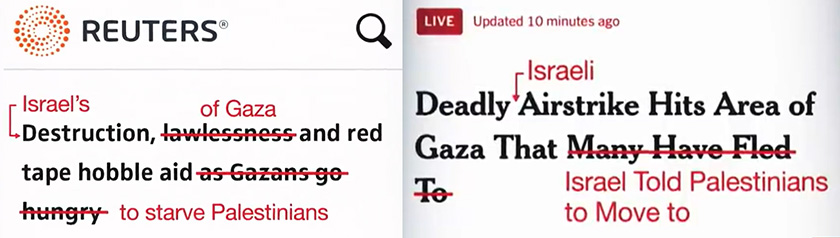
Examples of Rad’s edited headlines
When asked why it’s important to create space for panels like this at a stop-motion animation film festival, StopTrik Executive Producer Urška Breznik answered that “we’re involved in critical literacy. We want to dissect the media, and how the media is shaping the society that we’re living in(..); there must not be a cultural event that is not addressing something political at the same time.” Rad added, “All of what we're discussing is part of a larger narrative ecosystem. That narrative ecosystem includes popular culture, media, film, television. Every medium that you can think of repeats these tropes.”
StopTrik’s exhibition of diverse media formats shows how our tools of expression inform what we’re able to say. From what’s handmade to hardware and software, these technologies co-constitute and express the cultural values that gave rise to them. Resurrecting dead media thus enables us to interrogate the current moment, to question how we come to know and imagine the world. Learning to live with dead media is an act of resistance against passive media consumption. It cultivates a form of literacy and political consciousness that’s aware of how perception and experience take shape.
StopTrik Festival 2026 Awards
Maribor Audience Grand Prix Stop Motion Animation - award given by the Audience.
'Ball Face', dir. Laurence Thérien, prod. Royal College of Art, 2026, UK, Canada
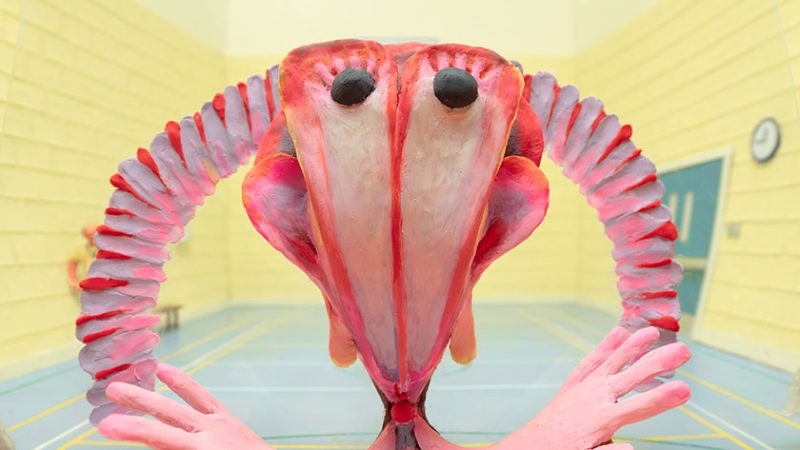
Ball Face
Maribor Audience Grand Prix Borderlands - Award given by the Audience.
'The Truth Rejects You, Cornelius' / 'La veritat et gira l'esquena, Cornelius', dir. Khris Cembe, Marc Torices, prod. Hampa Studio, Mr. Miyagi, Ruibarbo, TPO, 2026, Spain’
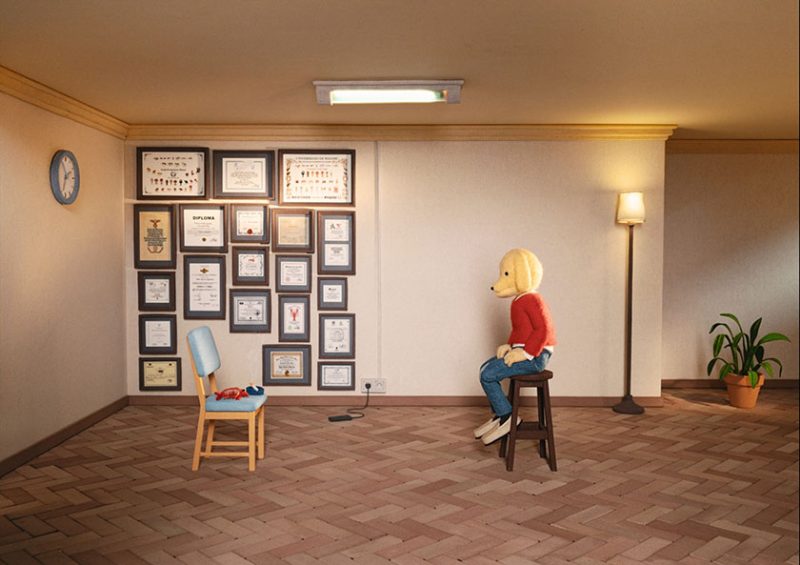
The Truth Rejects You, Cornelius / La veritat et gira l'esquena, Cornelius
Maribor Student Jury Stop Motion Animation Award
Maribor Student Jury: Melani Kumin, Gloria Džankić, Jan Svenšek
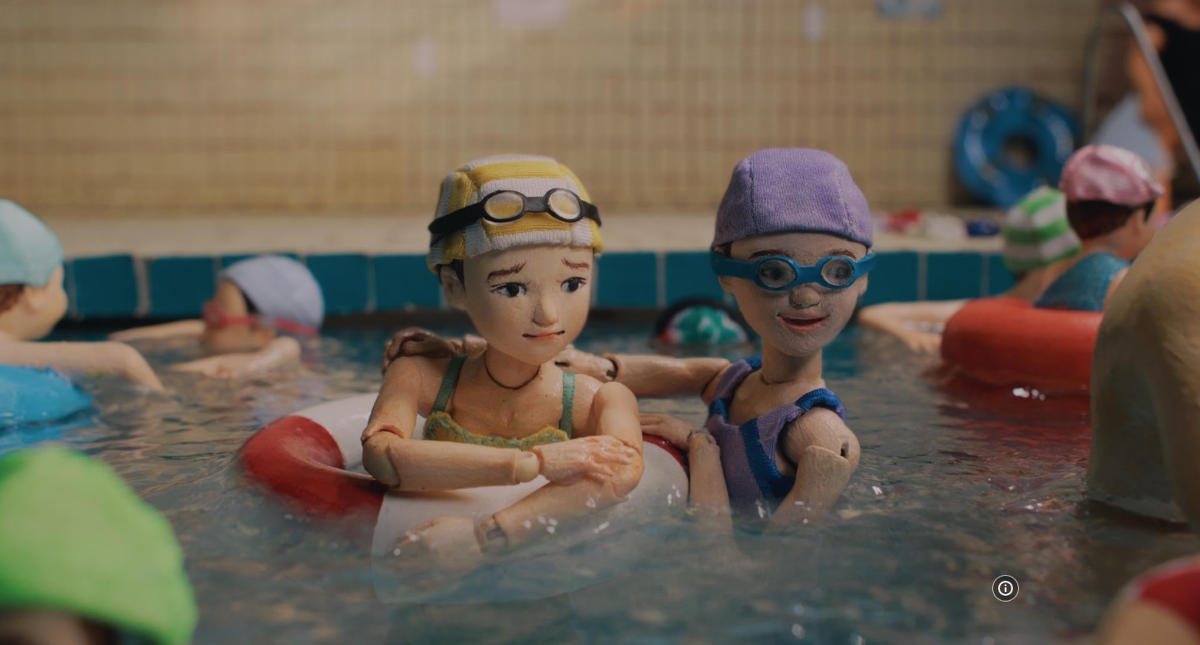
'Pembe & Eflatun', dir. Alix Bortoli, Dal Park, prod. Minem Sezgin de Boer, 2025, The Netherlands
Jury Statement: The film, with its monochromatic imagery and the second most common material on Earth, sand, warns of a future in which society is dictated by capital, which produces constant wars and climate catastrophe, and where the needs of communities are neglected. These conditions have displaced a large part of the population, who, in hope, seek refuge, which they find in an old prison. The prison, a state-owned space of repression where the story also takes place, here represents a space for building a community according to the principles of "bottom-up". The space is reformed to raise a new generation.
Maribor Student Jury Stop Motion Animation Special Mention
'Making It Fit', dir. Mariana Leal, prod. Animate Projects, 2025, UK
Jury Statement: The film's box projection technique deals with the niche topic of the queer community. Oppression accompanies them even in death, as the opinions of those around them and those close to them are projected back onto them. This social issue does not protect the marginalized, not even at the legal level.
Maribor Study Jury Award Borderlands
'Banana Soup' / 'Labouyi Bannann', dir. Geena Gasser, prod. Schattenkabinett, 2025, Switzerland
Jury Statement: The subject animation humorously exposes colonialism in everyday and self-evident goods. Due to globalization and the extended food chain, not only small farmers suffer, but also the fruit itself, as its biodiversity is disappearing. The animation mixes elements of ethnic music and visualization, authentically presenting the region.
Maribor Student Jury Borderlands Special Mention
'Fly Train' / 《褪色的透明列車》(Tuise de touming lieche), dir. & prod. Ria Riwen Zhang, 2025, Hong Kong
Jury Statement: An introspective passenger ride that takes the viewer into a dreamy black and white experience through the unique technique of object animation and shadow play.
Stop Motion Animation for Children (group age: 6-8 years old) - award given by the Audience.
'Piccolo Piccolo', dir. Marta Gennari, prod. Folimage, Nadasdy Film, 2025, France, Switzerland
Stop Motion Animation for Children (group age: 9-11 years old) - award given by the Audience.
'Cell Buddies' / 'Celmaatjes', dir. Melle Windig, Hidde Alberts, Jurgen de Smit, Arjen van der Plas, Miguel Reyes, prod. Sint Joost School of Art & Design, 2025, The Netherlands
Stop Motion Animation for Children (group age: 12-14 years old) - award given by the Audience.
'PAI PAI - EP06: Typhoon’s Coming' /《我是陳派派》第六集:我要放颱風假!(《Wo shi Chen Paipai》diliuji: Wo yao fang taifeng jia!), dir. Hugo Huang, prod. TurnRhino Original Design Studio, 2025, Taiwan
Our Comprehensive Coverage of StopTrik Festival
16th StopTrik International Film Festival took place in Maribor, Slovenia, on September 23 - 27, 2026.
contributed by Amanda Barbour
Read More About:
Related Articles

Submitting your film to festivals? Get a festival roadmap for your animated short: the right festivals and pitching events, matched to your film. Festival consultancy →
Zippy Frames is the premier online animation journal promoting European and Independent Animation animation since 2011
Zippy Frames
Quick Links