
Thomas Renoldner on ‘Stampfer Dreams’ and Stroboscopic Discs (Interview: StopTrik Festival 2026)
Amanda Barbour
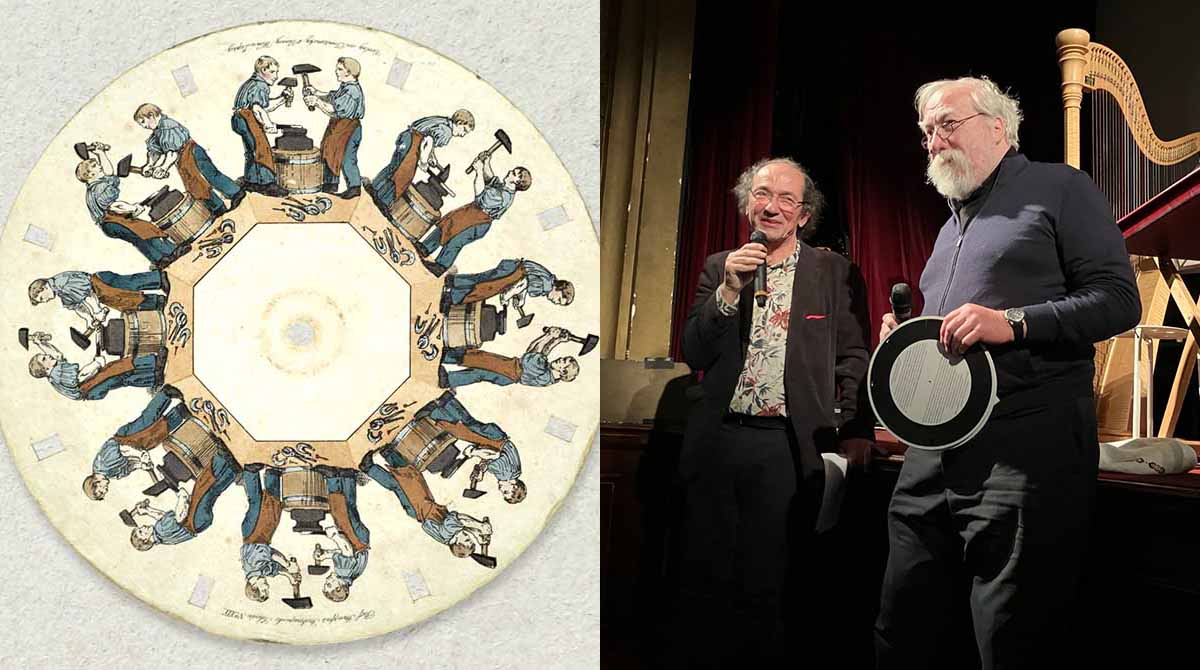
Austrian animator and experimental filmmaker Thomas Renoldner (known for ‘Stampfer Dreams’ (2024), ‘Don't Know What’ (2019) and ‘Sunny Afternoon’ (2012), amongst others) is one of the usual suspects at festivals featuring experimental films. The 16th edition of StopTrik revolved around the notion of Dead Media, “media that have died on the barbed wire of technological advance.” Here, Renoldner presented the research that gave rise to ‘Stampfer Dreams’ on the Dead Media Spirit in Audio/Visual Culture panel. ‘Stampfer Dreams’ is both an animation and a book that chronicles 19th-century scientist Simon von Stampfer and his development of the stroboscopic disc: a circular disc with a series of images that create the illusion of movement as the disc rotates. This treatise on kinetic art premiered at the 2024 Ottawa International Animation Festival and was more recently nominated for Best Short Film at the Austrian Film Awards. Renoldner sat down with Zippy Frames to discuss the entanglements between industrial mechanics and the evolution of media technology.
Renoldner notes that “Information about Stampfer’s contribution to the development of stroboscopic discs is often missing from publications and exhibitions about the history of animation or cinema. They often only mention Joseph Antoine Ferdinand Plateau’s phenakistoscope, but I knew about Stampfer from previous research. It’s not that I was originally strongly interested in pre-cinematographic devices; I was more interested in Stampfer’s biography. I thought that it’s not fair to forget him.”
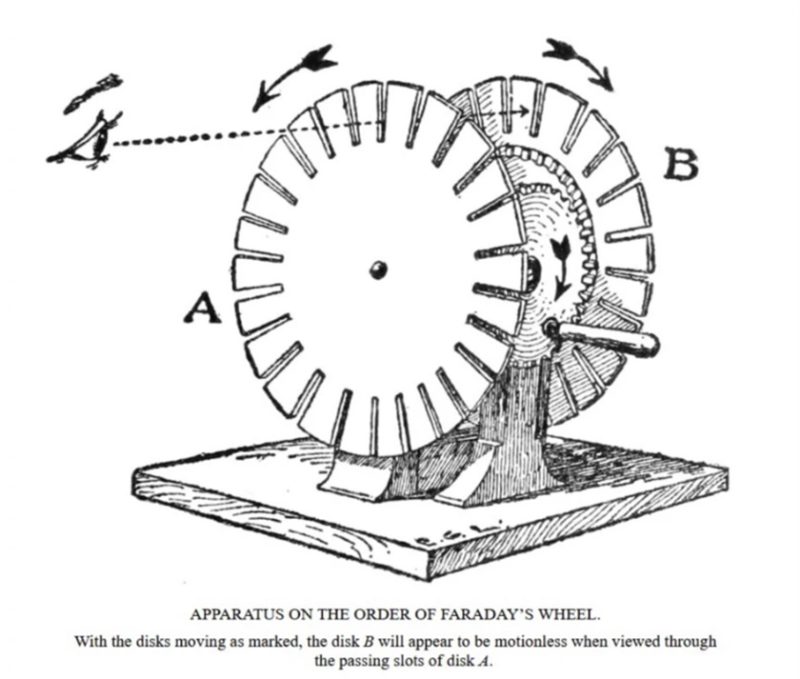
He further explains: “The early 19th century was a time when various scientists took an interest in the study of optical phenomena, related to human perception, with mathematics and geometry playing a significant role.” The antecedent for Stampfer’s stroboscopic disc was Michael Faraday’s Cog Wheel Machine (1831): two parallel discs that create optical illusions when rotating in opposite directions. Faraday noticed this visual phenomenon in a factory while watching gears rotate at different speeds, in different directions. Renoldner was “curious and impressed by the experiments Faraday was executing, which Stampfer describes quite precisely (..). Faraday was exploring how we perceive phenomena, optical illusions, and the laws of physics that made this possible. I’m fascinated by how inventive they were, to build all of these machines to understand more about the human. About ourselves. Working with these machines is a kind of self-reflection.” Anna Vasof built a replica of Faraday’s Cog Wheel Machine that was on display in the StopTrik exhibition space.
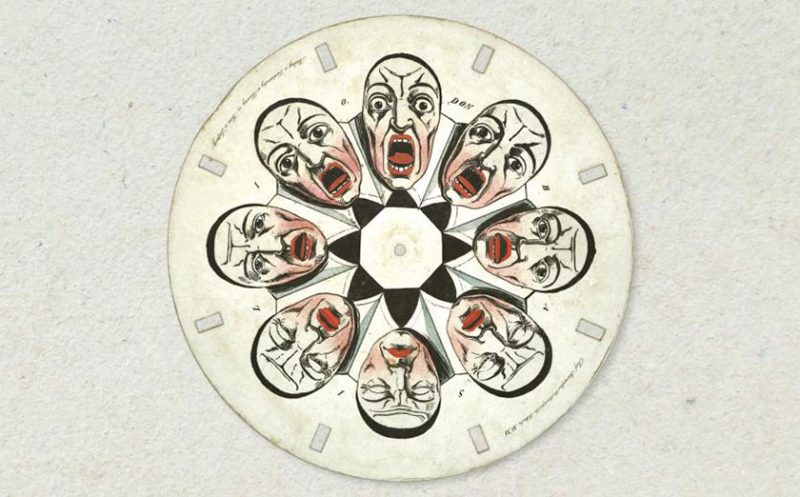
After Stampfer showcased his stroboscopic discs in 1833, replicas flooded the market almost immediately as optical toys with more sensationalised images. This new form of “mass media” was a bit ironic, as Faraday made his initial observation at the lead mills of Messrs. Maltby. Renoldner draws attention to the social conditions of the Industrial Revolution, where “child labour was widespread, working and living conditions were simply catastrophic.” What started as an observation in a factory likely powered by child labour became entertainment for infants of the upper class. This reveals how even in its nascent forms, pre-cinema technologies were tethered to the entertainment industry and the Industrial Revolution.
‘Stampfer Dreams’ opens with a dedication to the scientist Simon von Stampfer, and ends with a credit to Benedictine monk Father Amand Kraml. This is because Kremsmünster Abbey acquired Stampfer’s stroboscopic discs in the 1830s, and Father Kraml effectively became a steward of them at the Kremsmünster Observatory in the 21st century. When asked why monks and a monastery took an interest in Stampfer’s discs, Renoldner explains that, “Monks can be scientists, put simply. I think their intention, and the intention of the Church, is to promote the richness of God's creation."
Renoldner used images from Stampfer’s discs, “as a kind of found footage, to compose my own film.” The images and animations these discs create become plot points in ‘Stampfer Dreams’, but the film is about the world around these discs, as much as the discs themselves. For example, the weather chamber at Kremsmünster Observatory has been a meteorological observation station for over 250 years. Father Kraml was responsible for collecting data several times a day and transmitting it to GeoSphere Austria. Renoldner signals this legacy of bearing witness to a changing climate in the opening sequence of his animation, but it’s a subtle reference, as he “hoped the audience might discover the message on their own.”
This convergence of scientific observation and environmental change enters the frame with panning shots of Thomas Ender’s ‘The Grossglockner Mountain with the Pasterze Glacier’. The1832 oil painting of Austria’s biggest glacier coincided with the release of Stampfer’s discs. An image of the young Stampfer is put on the painting, accompanied by a somber soundtrack. The melancholy suggests that both Stampfer’s childhood and the glacier will eventually disappear.
Experimental filmmakers are a bit like scientists, insofar as their films are often audiovisual experiments. When asked if he was testing a hypothesis in ‘Stampfer Dreams’, Renoldner replied that he was testing the boundaries of genre. “Every genre has this conservatism, in a way. If experimental films repeat the same formula hundreds of times, it’s boring.” The film blends narrative and non-narrative, historical and experimental film forms.
Stampfer descends from the Alps, reflecting Renoldner’s biographical research that indicated he was “born as a poor boy in the alpine region and had to work in the woods and as a shepherd.” The initial exposition has an aesthetic akin to children's movies, but the expectation for a classical narrative to follow is then disrupted by avant-garde dream sequences. Stampfer begins to dream (or hallucinate) when he crosses paths with a water mill. The images that follow recall Faraday’s Cog Wheel Machine and the later illustrations on Stampfer’s stroboscopic discs. The film becomes more explicitly experimental upon Stampfer’s arrival at a circus, then closes with shots of the stroboscopic discs, revealing the found footage source material.
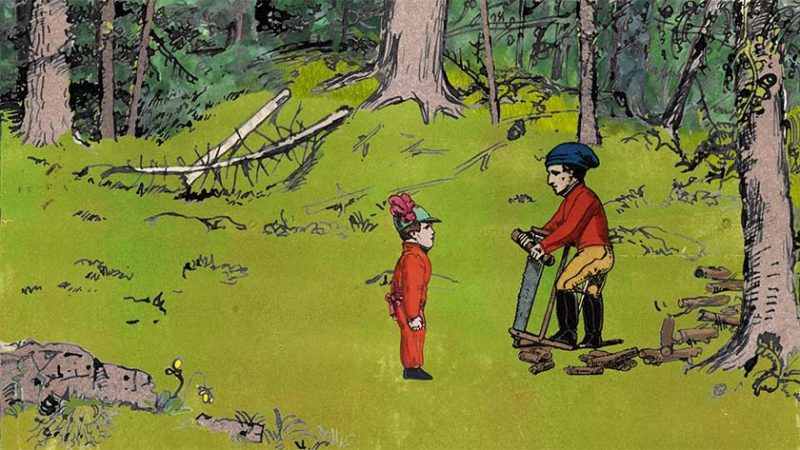
Stampfer dreams
Renoldner is not necessarily nostalgic for old technologies, or a purist when it comes to working with obsolete media. ‘Stampfer Dreams’ is the first time the animation director and artist has worked with historical materials, and digital animation enabled the crew to control the frame rates while preserving the visual integrity of the discs. The book accompanying the film similarly refuses any simple opposition between old and new: augmented-reality encoding animates its images when viewed through a smartphone. Renoldner’s initial encounter with Stampfer was itself mediated by comparatively new technology. Father Kraml “was one of the earliest users of the internet to distribute knowledge. This is how I actually discovered Stampfer’s discs.” Kraml started sharing information about them online in 2001. “After I found that link, he sent me a CD-ROM with the animated loops."
StopTrik’s exercise in media archaeology is less about establishing a binary between vintage and modern technologies; it’s more about how these are mutually co-constitutive. Stampfer was a pioneer, and his experiments in proto-cinema anticipated future forms of filmmaking. Phonovideo and turntables likewise gesture towards the past and their technological predecessors. Our means of expression shape how we come to know and imagine the world. Beyond spectacle and optical illusion, Renoldner’s work reveals what it really means to see.
The interview with Thomas Renoldner was conducted during the 2026 StopTrik Festival.
Read More About:
Related Articles




Zippy Frames is the premier online animation journal promoting European and Independent Animation animation since 2011
Zippy Frames
Quick Links