

Dinner for Few: Interview with Nassos Vakalis
Vassilis Kroustallis
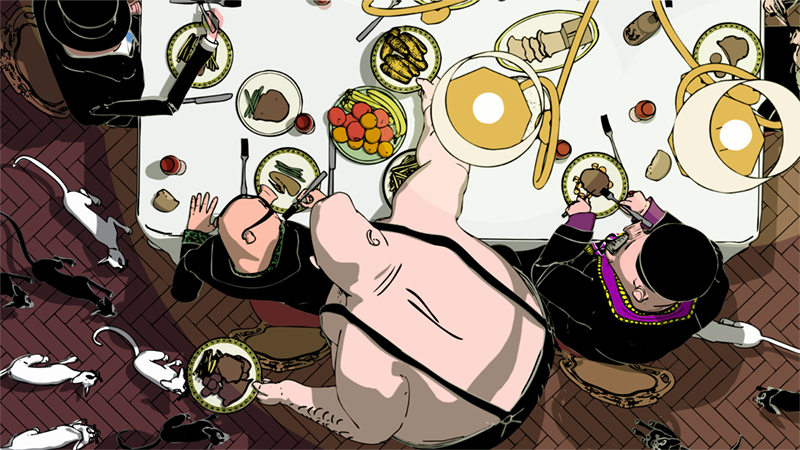
The Emmy Award-winning DreamWorks animation artist Nassos Vakalis directs a 10-minute animation film that is far from his studio credentials (storyboard and animation for Spirit: Stallion of Cimarron, Monsters VS Aliens, Puss in Boots, Turbo, and Bee Movie)
Dinner For Few depicts a sociopolitical allegory of our society. During Dinner, the system is working like a well-oiled machine. It constantly feeds the few who foolishly consume all the resources, while the rest survive on what little falls off the table. Inevitably, when the supply is depleted, the struggle for what's left leads to violent, catastrophic change. Sadly, the offspring of this profound transition turns out to be not a sign of hope but the spitting image of the parents.
Watch Dinner for Few
The film has garnered 70 international awards in the festival circuit, including ReAnimania Festival (ReA)'s Best Short Film Award, and a special mention at Interfilm Festival.
ZF: Nassos, thanks for talking to Zippy Frames. Dinner for Few is a strong political parable, inspired by the South European economic recession. Tell us what motivated you to make this horror politics story.
 Nassos Vakalis: Well, I considered it more like a socio-political allegory or a metaphor. There are many elements in the film that are borrowed from the current events and from other stories like the Animal farm for example but that came later.
Initially it was not even an idea for a film. I was actually talking to a friend on the phone a few years ago and we were both reminiscing of the old Greek tavernas and the cats circling the tables waiting for something to drop.
I remembered how at the end of the night when you have not fed some of the cats enough, the more brave of the cats choose to jump on the table (the moment you were not looking) and eat almost out of your own plates or steal something and run off. Soon a parable between the cats and the people in the current economic crisis came into play.
My friend suggested I could do a comic strip with the idea and send it to one of the Greek newspapers. I felt the idea had legs and I thought I could further develop it. This led me to the core of my story, which eventually became what you see.
ZF: How long did it take you to complete the film, from idea to post-production, and what about funding?
NV: It took me 2 and a half years to finish all the visuals and another 3 or 4 months to complete the sound and music. The storyboard and story development part was only one month long. I like to humor how it felt like the story pieces fell into place like magic. Pretty much after I wrote the treatment, I started boarding on it.
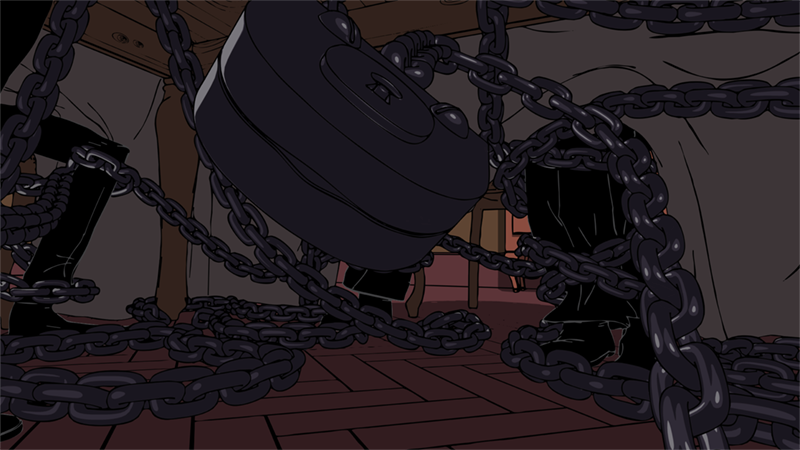
There was one idea that changed because I felt what I had written visually looked funny, and it should not be like that. This is the part below the table. Initially, it was a maze of hands and legs all tangled together, but I could not see how I could visualize that and not make the characters look cartoony. It only took me a day to come up with the chains and the chain snake idea, which I felt was a much better concept.
One other interesting thing that happened was that about 2 to 3 months into production, Eva Vomhoff joined the production and together we decided to start all over with a more advanced software. So she rigged everything on the new package, and we started animation. I did some style tests and renderings at that point, but the bulk of the rendering and compositing work was done after we finished all the animation.
I funded everything myself, with most of the money going for a new computer, software, the music, and the live orchestra performance. I was lucky enough to get a very talented artist, Eva Vomhoff, to volunteer her talents, and she did a lot of the more technical work, as well as some of the most interesting animation: the tiger and the cats. Besides her, there was no other artist who did any big chunk of work. I credited some people who sold me or gave me some furniture models or did some plug-in development, but that was as far as we went for having a full crew. If you want to put a number on the budget it was around 14K dollars.
ZF: Dinner for Few is very different in storytelling and style from studio output and your own previous shorts. How is it different working for a big US studio like Dreamworks and making your own film? What are the benefits and the pitfalls of having creative control over a complete film?
NV: I have been working for years in more children-oriented themes or stories that deal with character or follow a character's development through comedy, adventure, or even drama. This is what Hollywood likes to do, wherever it is a comedy or a drama, usually has a happy ending and everyone is fine and everyone learned his or hers lesson. More or less, Hollywood animation follows the hero's journey kind of storytelling.
This is definitely a film outside this mainstream studio mentality. It deals with subjects the main studios, and particularly the Hollywood studios, do not like to touch. The story itself is an adult story; it has no protagonist, it has violence, it has blood, it is highly political, it deals with the allocation of wealth, the system, and the ways people revolt to get, at least momentarily, what they feel belongs to them or deserve.
I'm not sure but I believe Hollywood thinks there is no real audience for such subjects, at least not an animation audience. For my part, I have done so much of the traditional animation storytelling that it was about time for something different, and the only avenue to achieve that was a personal short film.
Having the creative control is kind of unusual for my training. People might not know this, but directors do not have unlimited creative control in Hollywood. Well, some may have more than others, but there is always the studio behind to guide them to an outcome that will secure financial success. So doing my own thing and having nobody, except my wife, to bounce the ideas around was a very welcome freedom.
It opens new avenues for expression, whether stylistic or thematic. Now that the film is done, obviously I do question many of the choices I made, but at least I know I made them on my own and not under pressure.
ZF: The visual style of Dinner For Few is attractively nightmarish; its graphic colors and shadows make the 3D computer animation look like a stylized 2D animation, especially the tiger scenes. Let us know more about this. Did you come to this decision from the start?
NV: DINNER FOR FEW is a 95% 3d film, and I'm saying 95% because the remaining 5% is animation and effects done in After Effects. But character-movement-wise I would say it is a completely 3d movie. It was conceived as a 3D film and executed as one, even though early on I was reluctant to go photorealistic with the rendering style. Maybe I was feeling that I was not up there with the technology on hand, or maybe I was tired of looking at such photorealistic renderings, but I felt that going that way I would have been subtracting from my story rather than adding to it.
My intention was to find something that would be the natural manifestation of my story as a visual experience. I could leave all the cutting-edge technical stuff to the ones who can afford it and can push it further while I can find or invent a style appropriate for my own story. I decided to go back to the basics and look at my story again and see how someone could have it approached if it was a graphic novel.

Immediately, it was clear that approach would require a flatter, more stylistic rendering. I would need outlines and colors within, tones and hard shadows. Could that style be possible with the technology I had on hand, or at least what was available commercially?
I knew of a flat color technique which is called toon shading, and it was used in the past to simulate a more 2d cartoony style. Even though that had a problem. I always felt that the lines generated by the computer were like wires, and there was an artistic flair missing from the strokes. It looked very mechanical. That said, I had an Idea for how to fix it in post via a series of Photoshop manipulations that I stumbled across a few years ago while working with a graphic designer. I ended up writing some Photoshop actions to streamline and automate the process and run a few tests.
The tests were pretty much successful, though I did notice some limitations. For example, small-sized characters or objects seemed to lose their shape, and during camera moves there was a noticeable flickering of the lines, but overall I felt this was the way to go.
This newly achieved method lead to more changes. It forced me to push my character designs to a more stylistic nature. I revisited my designs and started pushing the shapes to a more cartoony look, yet maintaining or even pushing the grotesque elements of the characters' look and personality. I eliminated a lot of detail, stylized their clothes and features, and started thinking of them as graphic elements, moving shapes and lines within a canvas of more intricate textures. Finally, I felt I had the style down.
ZF: There are many animation works in the previous and last decade that deal with the political. Ari Folman's Waltz with Bashir, Satrapi's Persepolis, the 2014, Annecy-awarded Rio 2096: A Story of Love and Fury. Do you think that animation needs to become more relevant to everyday social and political issues, and can US studio animation achieve that or do we need to resort to independent output?
NV: As said earlier, I can't see Hollywood doing anything like that with animation. At least not a feature film. Europe has shown some really nice examples that do find an audience in the States but not the audience the studios hope to attract. Hollywood movies are, in a way, watered down to appeal to a greater audience. The cost of producing these films, whether the films are live action or animation, requires a healthy return.
Political views tend to appeal only to small parties, or at least to the party whose ideas they support, so by definition are limited. Even storytelling itself in a non-political form but still dealing with other issues of social nature, like some of the Miyazaki films for example, finds a smaller audience and less ticket sales. This is why I think most films follow a formula thematically, down to the gender of the star, that guarantees results with today's American audience. This is how broad they look.
For my taste, I wish I could see more stuff done with some kind of different thematic approaches, not necessarily political but definitely going away from the formula. I want to go and see a movie where I can't predict the outcome from the first five minutes.
ZF: Where do you go from here? There's a lot to be done regarding promoting Dinner for Few (festival submissions, etc.), but is there a different project or studio work you'd like to talk to us about?
NV: Well, as you said, there are the festival rounds. It looks like I will need to work hard for this one since the subject is a bit controversial and, as said, not very appealing to the US audience. I hope to perform well in Europe, as well as in South America and Asia.
As far as other projects, I do have something in the back of my head. Since it is an animated feature film idea, its story follows the hero's journey storytelling formula, but I'm trying to give it a twist so it becomes different and hopefully fresh. I plan to have a script written for this one, but this sounds like too far into the future since right now the focus is on promoting Dinner For Few.
Film Review (Vassilis Kroustallis)
This highly symbolic but visceral short is a captivating horror take on political greed and heartlessness. The Brechtian motto "Those who eat their fill speak to the hungry of the wonderful times to come" doesn't suggest any kind of distanced treatment; it only serves as a reminder of what follows. With their feet in chains, church priests, bank officials, politicians, the press, and judges are strong enough pigs to eat what can be processed from a hotel room in ruins. Leftovers (and sometimes mechanical mice) are given to angular-shaped cats, a more horrifying version of the Siamese cats in Lady and the Tramp (1955). Set in purplish hues, Dinner for Few swiftly evolves into a red-bloodied arena, when a tiger acts as the nemesis for both tormentors and their cat lackeys. Yet, there is always a way to get rid of the danger and do "business as usual", especially when the underdogs are the ones to provide their support to the New Order.
The terrifying and nightmarish look of the film owes a lot to its fluid animation style, which is made as if CG suddenly went wild, but captivating nevertheless. Bird's-eye view shots give the necessary distance from the decadent atmosphere, yet the ending confirms that political and social corruption is a predicament, not just another episode in the ruined, rain-soaked hotel room.
CREDITS:
Dinner for Few, 2014 (10')
Director-writer: Nassos Vakalis. Producers: Nassos Vakalis, Katerina Stergiopoulou
Music: Kostas Christides (performed by: the Bratislava Symphonic Orchestra)
Technical and artistic collaboration: Eva Vomhoff
Read More About:
Related Articles

Zippy Frames is the premier online animation journal promoting European and Independent Animation since 2011
Zippy Frames
Quick Links
