
A Talk with Fraser MacLean (Guest Article)
ZF Team
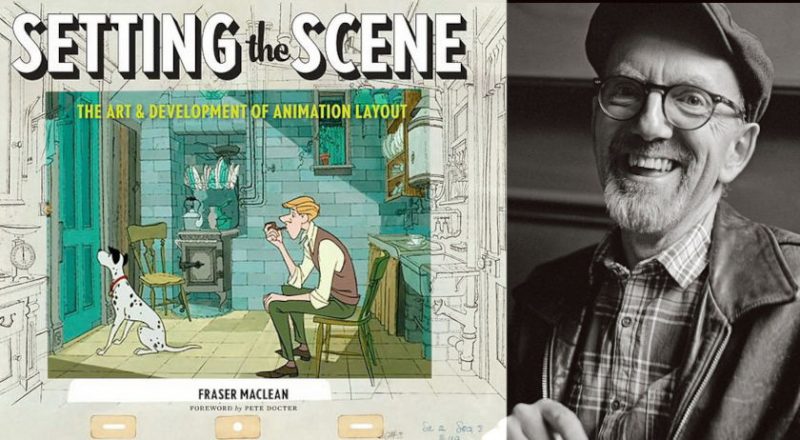
I met Fraser Mac Lean several years ago at Annecy Festival for the first time, and since then, we have kept in touch, and he has kept inspiring me throughout the past years. Fraser is the author of the book ‘Setting the Scene,’ and he has a long history in the animation field. He has worked on productions such as 'Who Framed Roger Rabbit?', Disney’s 'Tarzan', and 'Space Jam', as well as teaching animation in many different locations. He is currently living in Guadalajara as a teacher. Every time I feel a lack of inspiration, he is the greatest person to have a call with. After the call, I feel like I am bursting with inspiration again. Here is our last conversation.
Fraser explained to me how he started his career in the animation industry. He described being a young Scottish lad and not getting the opportunity to learn how to be a director, yet having the flame and passion for drawing and filmmaking. This led him into the field through Disney, who was looking for people to work on Who Framed Roger Rabbit, and that’s how it all started for him.
We talked about animation ten years ago versus today, and how different it looks. Ten years ago, it was considered an entertainment tool, yet today it is something we interact with every moment in our lives, even just by holding our cell phones.
Animation is not a matter of life or death! Sorry, you are wrong! We talked about how animation is not only limited to the entertainment industry; its purpose is not just for fun, but it is an important tool in the development of humanity. It is scientific. It is not all about Disney’s princess franchise.
At some point, I asked him if the industry of animation can be very brutal and if it sometimes can lead people to think pessimistically, or even do anything. Fraser’s answer was pretty reassuring: “Most of the things that are easy are not worth much.” He inspired me a lot with his words, because indeed, if we really learn how to appreciate the difficulty of it, it will be that much more rewarding to work on something. Things that are easy to achieve do not necessarily end up well anyway.
He also acknowledged that animators are not supposed to be martyrs either; we don’t have to sacrifice everything and work 18 hours a day, but need to find a balance in between.
“Don’t expect to find happiness at work, bring happiness with you to the work you do.” This was also a strong point I agreed upon with Fraser. From my previous perspective, I also thought the biggest achievement would be to work in a big studio, but earlier this year, I realized that overall, I should be enjoying what I am doing rather than expecting what new work could bring to me. I should think more about what I could add to them. Hearing this from Fraser made me feel more confident and, in a way, confirmed that I am on the right track. “It is not all about being an animator, usually people who made an impression in this field are the ones who are not all about animation, they have broad interests, they like to read and go to the theaters, and their world is not limited to animation, “ he said, and I couldn’t have agreed more with him.
If you don’t have anything to tell, what does it matter to be able to make all those beautiful drawings, or shape the most beautiful 3D sculptures anyway? “It is ok to be part of a team, it is not all about being a new Picasso, on the team of Roger Rabbit, there were hundreds of people working and I was just one of those hundreds!” In a way, I really appreciated this statement. Sometimes we are so obsessed with being one unique thing and seeing ourselves as special that we forget we can still be special and work on a team. I personally like the idea of working on my own projects as well. That’s probably because of being a student at KASK and thinking more individualistically, but I totally understand what Fraser means by this. It is not all about you being something special.
“Be the party where everybody wants to get invited!” We talked about the highest place to reach today, getting a prize in the Oscars, for example, and how people see it as the most incredible thing to reach, but in reality, yes, even though it is something, it is not everything. Rather than focusing on wanting to achieve such heights, why not try to start something small on your own?
We don’t know how lucky we are. Wake up and smell the coffee. We are already way more privileged in comparison to many people in the rest of the world. We have to learn how to be more grateful for the things we already have and be happy.
The conversation continued, and I would have liked to write more of my talk with Fraser, but it is almost the end of the page. At the end of our talk, I remembered once again what a great inspiration he is to me, and I appreciate having him as both a friend and a mentor.
contributed by: Hasan Pastaci
Read More About:
Related Articles


Zippy Frames is the premier online animation journal promoting European and Independent Animation since 2011
Zippy Frames
Quick Links