
Shorts
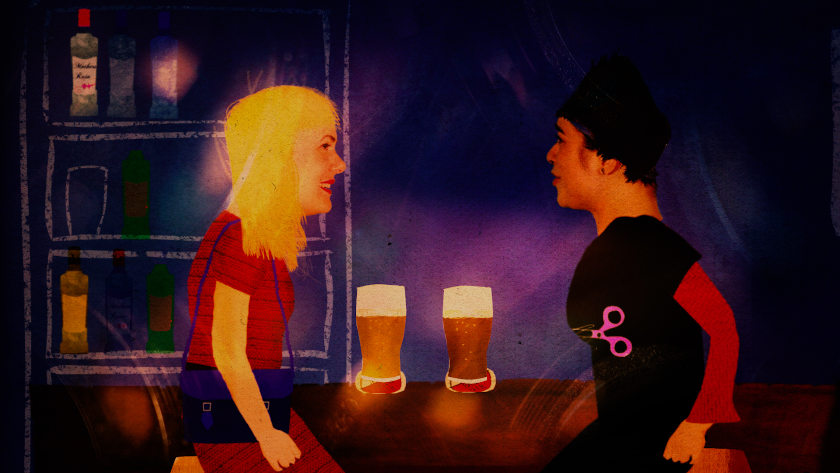


Queerer Than Thou by Kate Jessop
Olga Bobrowska
The pandemic made it difficult to celebrate Pride Month. If you're missing the excitement and glamour of the parades and parties, Kate Jessop's Queerer Than Thou comes right in time, reinforced with glitter, rainbow guns, and a feather boa. This raw-style animated punch offers a good laugh, but it also opens up a quite vast space for the critique of contemporary Western culture: diverse and emancipated on the outside, filled with patriarchal privileges on the inside. We're talking with Kate Jessop about her approach towards comedy and critique, queer animation as a trend in world animated film, the reality of pitching to 50+ white males, and the cancelling culture as an answer to “LGBT free zones” in Eastern Europe.
Watch Queerer Than Thou by Kate Jessop:
OB: Queerer Than Thou is a new episode from Tales from Pussy Willow. Can you outline your motivations behind this project?
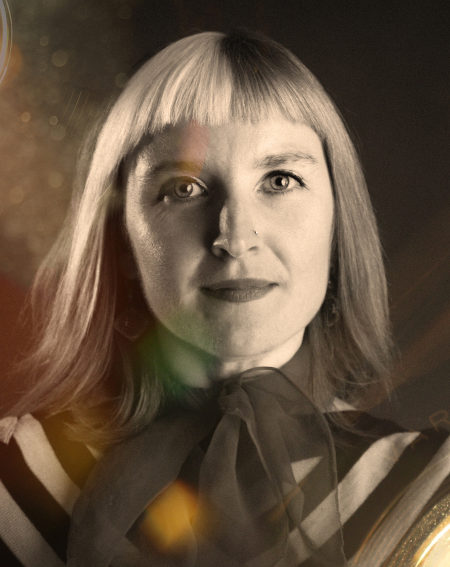 KJ: I started writing comedy a few years ago. I work with satire as cultural commentary, and I'd say it's a critique of society as a whole. Obviously, I grew up in Britain, so it's a bit of a critique of British society. There are some things that are quite British, e.g., in the episode Coming into the Station, a woman is trying to have an orgasm whilst having Skype sex. She climaxes on the train, and everybody is silent afterwards. I think that's just very British in regards to being polite. But a lot of the issues that I address are actually quite universal.
In the episodes Smile or The Astronaut there are problems such as misogyny, cat-calling, and the way women are objectified in the media, regardless of their achievements. And then there are queer themes that I'm addressing as well. 'Queerer Than Thou' addresses biphobia, coming out, and interfighting that can happen in queer culture. And again, I think it happens everywhere. The series is quite popular in the USA and Canada. It was selected for Berlinale Talents Lab, so the Germans and other Europeans found it funny as well. But it was a bit of a test regarding whether it reaches audiences that have English as a second language.
OB: I really like Smile. You present the universal problem of women being cat-called, but you replace this act by making these men utter perfect, insightful, and respectful comments on a woman who passes by.
KJ: It's a subversion. These are all the things that you would like to have said to you, and also a lot of the things that happen to women that go on unrecognized, like being a single mom, setting up your own business, dealing with abusive partners... things that are never really addressed, but a lot of women get through. The idea was to juxtapose the characters of the builders so they could be insightful and perceptive feminist allies. I was working with the idea of what if men actually saw women for who they really are, realized the inner beauty and struggle, instead of just objectifying them.
OB: Do you think that your series plays some part in a wider feminist movement?
KJ: It straddles and intersects with lots of different genres: feminist film, queer film, adult animation, and sketch comedy. I'd like to think that, to a certain extent, my writing is activism in regards to perspective shifting. But I do that through comedy. If you can make somebody laugh, you're resonating with them. I feel that traditionally feminist film might be a bit preachy, or perhaps some people think that feminism isn't for them. But if you can make people laugh, then it reaches another part of them and it can be quite perspective-shifting in that way.
OB: I think comedy is quite a difficult genre for animation artists. How do you find yourself in the environment of a stylish art-house that frequently excludes a comic approach?
KJ: That's a good point, but it all goes back to the intersection of different genres. Animation is just one of them. The raw and rough style is appropriate for the quite blunt kind of message. But at the same time, it is something that I'd like to progress and work on further. For example, the first seven episodes I did in one summer, and it's kind of really rushed. I knew that I wanted to have live action and animation combined.
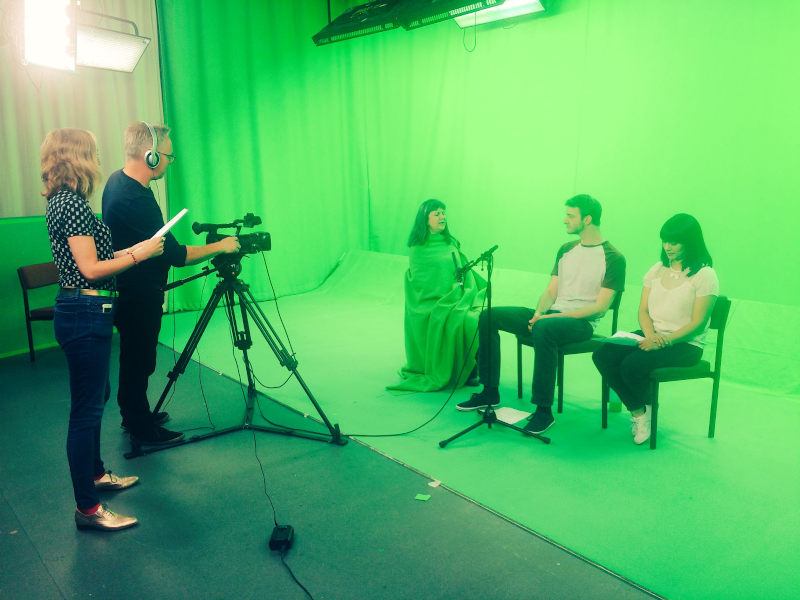
The shooting of Tales From Pussy Willow
And then Leo Crane came to work on the series as an animator, as he fell in love with it. We worked together on the second series, but we still did it super quick. Back then, we didn't have any budget for two seasons of the digital series. We had funds only by the time of Queerer Than Thou. Now I want to spend more time on making the animation look more beautiful, more compelling.
OB: Do you mean it in a camp sense?
KJ: Do you mean camp in a Susan Sontag sense?
OB: In a broad way, yes... I refer to aesthetics, but I believe that in a subversive manner, Queerer Than Thou tells a lot about the queer culture with its symbols, but also clichés. You don't really present a sublime image of the queer culture...
KJ: I don't know... What I'm doing with Queerer Than Thou is I'm critiquing queer culture. There is a dark side to it, people can get super competitive, there can be a lot of fighting, and judgments. I've also realized that non queer audiences may have to investigate what some of the terms mean. The episode is addressing privilege as well. And there's a lot of privilege in being able to come out when you're “in the womb”. A lot of people don't come from cultures where it's easy. When I moved to London, I found myself going on lots of dates with posh lesbians, and I'm from a working-class community, so it took me longer to come out because it just wouldn't have been safe for me.
I think that in the UK, in lots of parts of the country, there are still places where it's quite difficult to come out. In places like London or the southeast, the middle class lives in a bubble, whereas people from different cultures, with various religious backgrounds, have it hard to navigate their own religion, sexuality, and class. I work with absurdity. And I push it to the extremes. It's very heightened in order to make people think about what I'm saying. It is ridiculous that the characters are fighting with a pink feather boa, etc. But I'm using queer symbolism that everybody will understand (like rainbow guns, vogueing karate) and pushing it to the most absurd extent. In a way, I'm presenting the culture back to queer people to say, this is how ridiculous we are.
OB: Recently, On LGBTQ2S+ Animation was published by Quickdraw Animation Society, and your work is highlighted within this publication. Tales from Pussy Willow is mentioned in the chapter under the title 'future of queer animation'? Do you agree with the authors that at this moment we can start speaking about queer animation as a trend in world animation?
KJ: I'd like to think so. Animation has been a bit lagging behind. I feel like 'Pussy Willow' was taken on board by queer film festivals much more than by animation festivals. That's been quite disappointing for me, but I would like to think that things are changing. My early successes with Little Elephant and Chariot Riders, which got into over 100 festivals and quite a lot of academic conferences, gave me confidence.
They were accessible and, in a way, groundbreaking. But I do feel that only recently it's been starting to be addressed. I was really happy that Quickdraw decided to put together that book. It's the first book on queer animation ever, and I'm honored to appear in it twice.
OB: Do you observe this cultural change occurring within the indie animation scene? Would you call it a safe and creative space for the LGBT community?
KJ: Animation is perfect as an awareness-raising medium, especially animated documentary. But this refers back to my point about comedy. I feel like sometimes animated documentaries can be a bit of a downer. That's why I think comedy can be quite inspiring. But I'm not sure if it quite got there yet. Also, those who go for animation screenings at the festivals are not mainstream, so what we really need to be doing is breaking out into the mainstream. In regards to mainstream representation, we're starting to see that little tiny bits are coming through. Currently, the most interesting stuff regarding adult animation is actually coming out of America. In terms of cultural commentary, there are really intelligent examples, such as BoJack Horseman and Tuca & Bertie. They tackle quite difficult topics: feminism, gun crime, sexual harassment within the workplace, but again, they do it with humor. When it comes to the European broadcasters... My project might be a bit ahead of its time. Well, I'm still pitching to white, 50+ men who don't get it. I know that we need to wait for the industry to change first. And to be honest, I feel like the UK is taking a step backwards. In the 1990s, we had a hilarious Channel Four show called Smack The Pony, all written and performed by women.
There was also The Fast Show, co-written by Caroline Aherne, who has passed away unfortunately (watch Aherne's stand-up). And the last ever British animated series that was written and directed by a woman is Crapston Villas, produced by Channel Four, some 20-30 years ago... So that's all in terms of women-directed content for television. At this point, my producer touts the series as “Fleabag meets South Park", just because Fleabag is the only female-led British comedy that anybody knows, but my work is nothing like Fleabag!
As for the indie scene, it's time to be earnest. That's why, again, I think comedy is quite refreshing. Is it a safe space for LGBT content? Yes and no... I don't think Eastern Europe is a safe space anymore because of worrying about “LGBT free zones”. I've stopped submitting to festivals in Poland or Russia. Maybe it is cancel culture, but in general, I don't feel it's a safe place now. Disappointingly, I’ve also noticed that since I’ve started doing queer animation, East European festivals that used to programme me, now don't. The films are successful elsewhere, and I somehow can't think why else I'm not at these festivals in Eastern Europe, where I used to be. And I love Polish, Czech, and Hungarian animation, that's why this is breaking my heart a bit.
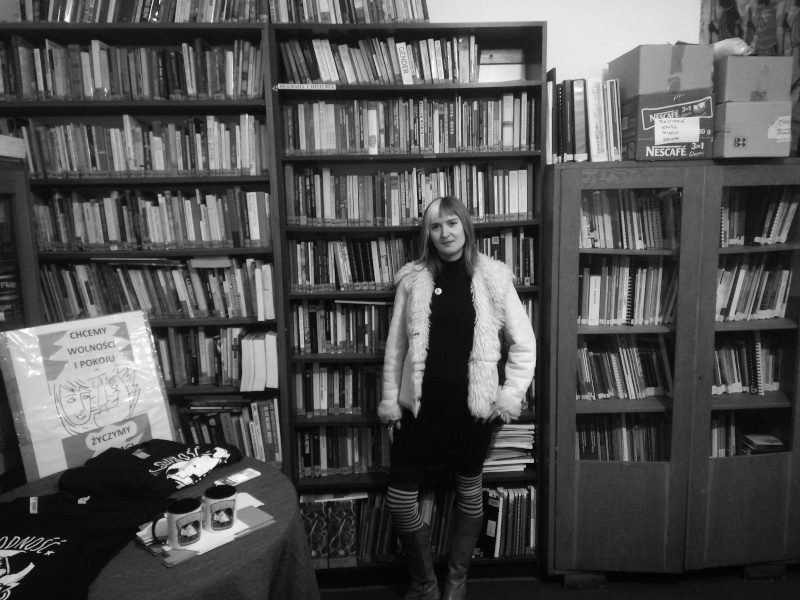
Kate Jessop at Manifa Women's March in Krakow, Poland 2018
OB: I understand your point. Yet I think that LGBT communities, e.g., from Poland, would appreciate support even if it's just submitting your films to the festivals here. Eventually, let me ask you about a current and universal problem: how is the pandemic situation influencing our production?
KJ: I've got some distribution deals, and we have a really good viewership already. My producer believes that pitching a pure animation to broadcasters might be easier now. But my instinct is that making it all an animation is going to take away what it is. We use a hybrid style mixing animation with live-action. But actually, in terms of my production methods, we can all maintain social distancing: there's one DoP, a sound person, one actor against a green screen, and me, and we shoot it all at once. Then I just take it away, edit, and composite it with the animation. I don't think that COVID will impact us that much. I think it's probably a perfect production to make during COVID, so I'm hoping to make the next episodes now.
Film Review (Olga Bobrowska):
I'm so queer I shit glitter, says one of the characters from the newest episode of a web series, Tales from Pussy Willow, and somehow this line perfectly exposes Kate Jessop's caustic approach towards comedy writing and culture critique. A witty and accelerating dialogue, together with a raw style of hybrid animation, enables sharp but empathic criticism of social absurdity. Two seasons focused mostly on women experiencing harassment, mansplaining, or diminishment, while the queer, ethnic, or racial diversity themes remained in the background. This time Jessop scrutinizes queer culture. Importantly, she does so with a huge support of the fans who joined the crowdfunding campaign and provided the filmmakers with a necessary budget, hence empowering them to push forward satirical critique. Those familiar with Jessop's work realize that her social commentary is not judgmental or moralizing. She knows how to accurately puncture the sweet-little-nice bubble of the middle class in order to make certain ambiguities come to light.
Artistic hybridity works here on several levels. Above all the whole series consequently combines live-action footage with cut-out animation. Jessop's aesthetics are based on realism of background and character design (the latter based on cut-out faces of the actors) but the complementary props and distinctive features of the characters' appearances (such as beard or hair-cut) seem sketchy and even intentionally unrefined. By all means, 'Queerer Than Thou' falls into the category of 'queer animation'. Along with Kate Jessop's previous works, it clearly shows that the cathartic resolution built upon humour is powerful and engaging. It is a punch rather than a sermon that perfectly corresponds with animation's intrinsic, transgressive qualities.
CREDITS
Queerer Than Thou by Kate Jessop
Written and directed by Kate Jessop | Starring Anna Maguire and Peyvand Sadeghian | Animated by Leo Crane and Kate Jessop | Camera and sound: Jeremy Clancy | Made by Animation GirlBand | (Hipster Films)
About Kate Jessop:
Kate Jessop is a multi-award-winning animation filmmaker who has had hundreds of international exhibits and has 5 international distribution deals, including Shorts International and Amazon Prime. She represented the UK in the Best of Women in Film and TV and was selected for the Berlinale Talent Lab, both with her portfolio as a director and with her comedy series, Tales From Pussy Willow, chosen for development in the Project Lab. She enjoyed her first retrospective at the Gilbert Baker Film festival in USA 2019. She has worked across narrative film, comedy, illustration, live visuals, music video, and motion design and utilises 2D animation, stop motion, and live action in her work.
- Instagram @katejessopfilm
- Kate Jessop Webpage
- Tales from Pussy Willow Webpage
- Tales from Pussy Willow Facebook page

Want to read more free articles like this?
Keep this professional animation journalism effort relevant and updated. Become our patron
Read More About:
Related Articles
Vassilis Kroustallis