
Festivals
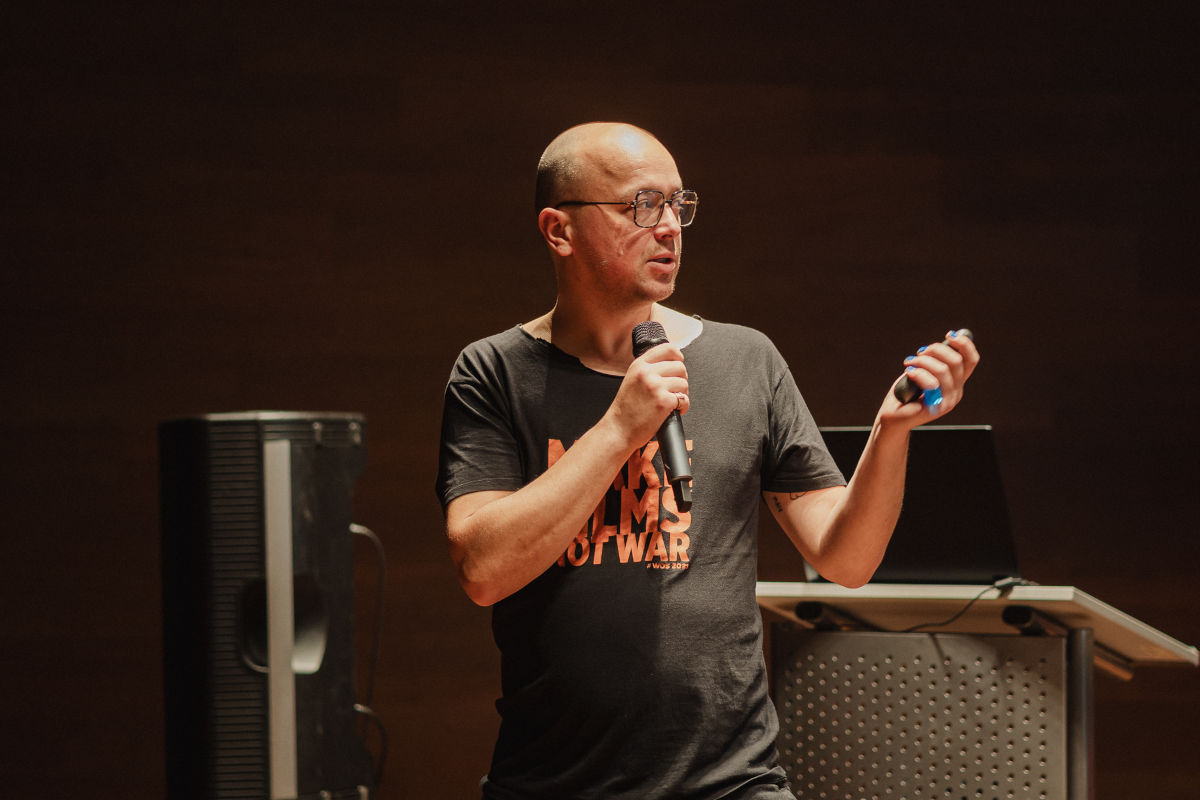
Bastien Dubois at the 2025 Animest Festival (photo: Larisa Baltă)


Faces from Places: Bastien Dubois’ Masterclass at Animest 2025 (GoCritic! Review)
ZF Team
“When I arrived in Madagascar, I only had a laptop, 10 kilos of paint, and a camera”, said French animator Bastien Dubois about his first independent film. His talk was part of the twentieth edition of the Animest International Animation Film Festival in Bucharest, Romania.
To celebrate this milestone, this year’s festival was constructed around the theme of traveling, a common subject in Dubois’ oeuvre. During his presentation, he took the audience through the places around the world that marked his career. He also charted the evolution of his artistic process and reflected on how the passing of time helped to recontextualize his early work.
Ever since he was a child, Dubois was pushed to travel. He reminisced about how his family would tease him about drinking tea with them instead of seeing the world, as a proper young person should. From his hometown of Lille, he took a long route to Istanbul, even while questioning if he really wanted to travel at all. Yet he ended up creating an animated travelog of 120 drawings in ink, watercolor, pencil, and gouache. The idea of turning these sketches into a book occurred to him, but his journey ultimately led him to work in 3D animation. “I used it to give volume to the sketches”, he said about this early work. This weighty style of animation made its presence felt even more in the short film ‘Madagascar, a Journey Diary’, a piece about his year on the island country, which he brought to life through animation. The film was nominated for an Academy Award in 2011.
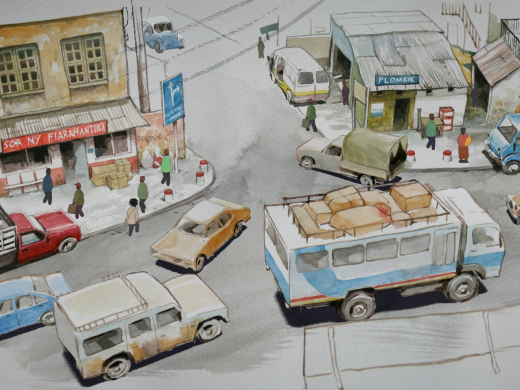
Without a very well-defined script, he structured ‘Madagascar’ around capturing the ancient funerary tradition of Famadihana. During the ceremony, locals bring the bodies of their ancestors out from the family crypts, rewrap the corpses in cloth, and rewrite their names on the gravestones so they will always be remembered. The ceremony culminates with live music as the bodies are returned to the tombs. After showing the attendees the film in its entirety, Dubois explained that the production developed very spontaneously, while acknowledging that sticking to the idea of capturing the ceremony helped him stay focused. Laid back and encouraging, he revealed that conversations with locals inspired him to push along with the production, pointing out to a smiling young audience that “a lot can be achieved by going to the bar”.
He gave himself a greater degree of freedom stylistically by using a combination of 2D and 3D animation, along with rotoscopy and camera mapping. He even used hand-made embroidery by a local artisan. She was thrilled to see her work animated. He also involved the children he came to know at the orphanage where he was staying. As they were playing with cars made of tin cans, he got the idea to animate the stop-motion scenes of chaotic traffic in the film. With a mischievous grin, he told the audience the children wanted to enact way more crash scenes than were necessary. After spending a year in Madagascar, he worked for another year on completing the film back in France, acknowledging that he started animating before defining the animatic.
After making ‘Madagascar’, he was approached by ARTE France to direct ‘Portraits de Voyages / Faces from Places’, an animated series in which each episode features a person who came to France from another country. They speak about their culture and history in a deeply personal way. The shorts mix motion-capture and hand-painting, continuing the travel diary aesthetic he developed from the beginning. The series, which included stories from Lithuania, Mexico, Pakistan, and seventeen other countries, was first broadcast in March 2013 for French television audiences.
After screening one of the three-minute episodes, he acknowledged that during production, he felt they were rushing to finish the series. Twenty distinct episodes were completed in just eight months. One of the biggest challenges was making the interviewees, who were not actors, comfortable with stop-motion technology. According to Dubois, the crew would often clap the film slate, and “then we would ask them to tell us about some other stories, and they would be more relaxed”. This openness and flexibility in accommodating the participants led to changes in the narratives. Wanting to depict one of Dubois’s own experiences from Louisiana, they searched for a person of Cajun heritage who was living in France, since they were only using people who were already living in the country. After making the right casting choices, he realized he wanted to tell their stories instead, saying, “I found the people more interesting than [stories about] my own travels”.
Dubois shared that as his career advanced, he started to develop a deeper understanding of the colonialist aspects of his work. By the time he directed ‘Cargo Cult’, a short from 2013 dealing with the effects of the Pacific War on Indigenous Papuan tribes, he tended to look at the Madagascar travel diary differently, realizing that his age and inexperience at the time drove him to focus on his personal journey alone.
In ‘Souvenir, souvenir’, his 2020 short film, he directly tackles the repercussions of colonialism, crafting a story from his relationship with his grandfather, a soldier during the Algerian War of Independence.
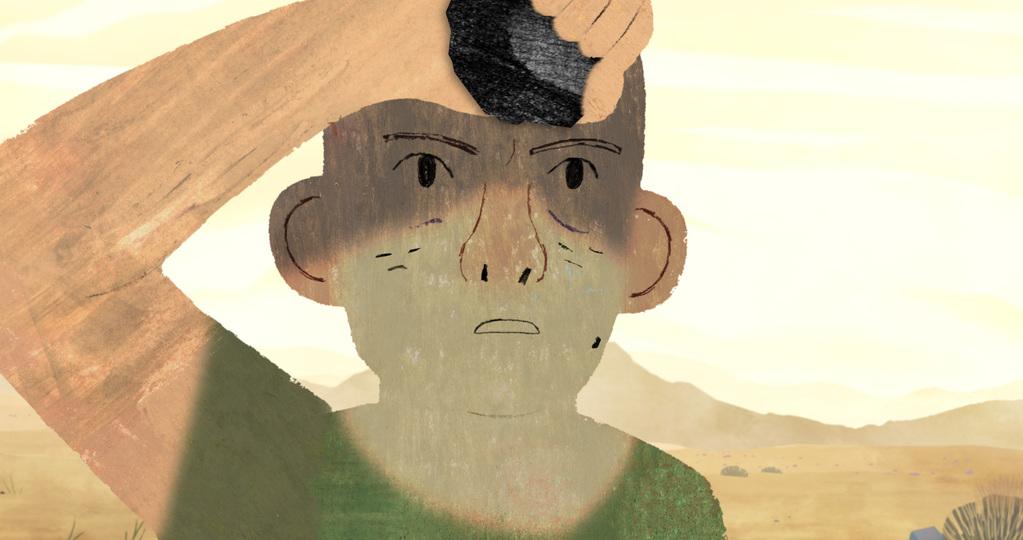
“It’s really a film about a process”, he said, referring to both the making of the film and the process of understanding the complications of the French-Algerian relationships better. He acknowledged that tracing his thoughts about colonialism back to his teen years during production helped him have a clearer image of history, especially as it finds its way into his animations. Ultimately, conversations played a key role in opening up his perspective: “Some people helped bring me out of the fog.”
As far as future projects go, Dubois said that he is actually quite happy to be a mentor for now, running workshops for children, as well as ones for prisoners. Compared to the stress of producing, which he said he dislikes due to the huge financial pressures, educational endeavours offer him a certain type of creative freedom. Generously answering questions about his eclectic style and various journeys, Dubois invited the young students in his audience to engage with their own work, concluding with the encouraging thought that, at this point in his career, he’s most interested in helping other young artists produce their projects.
The 20th edition of Animest Bucharest International Animation Festival took place 3-12 October 2025.
contributed by: Sergiu Inizian
Want to read more free articles like this?
Keep this professional animation journalism effort relevant and updated. Become our patron