
Feature Animation 


An Unsettling Realism: Interview with the'Blaise' Director, Dimitri Planchon (Cannes 2026)
Olivia Popp
Accidentally caught in the middle of a new French Revolution with a bourgeois girlfriend? That’s the life of the titular 16-year-old in ‘Blaise’, a new feature by Dimitri Planchon and Jean-Paul Guigue about an awkward teen with few social skills and two maladjusted parents to boot. Produced by France’s KG Productions, ‘Blaise’ is the only animated entry of this year’s ACID sidebar at the Cannes Film Festival.
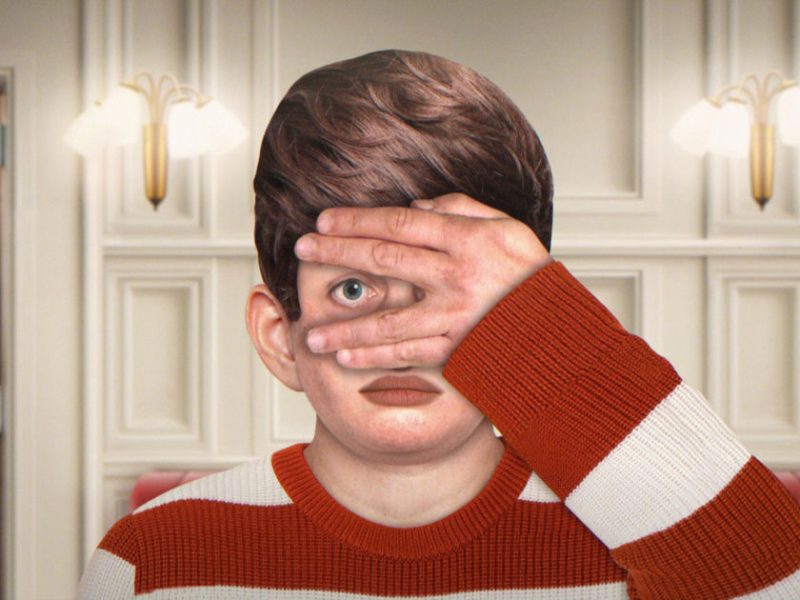
‘Blaise' is adapted from the comics of the same name by Planchon, which he also made into a 2016 television series for ARTE. His tales follow the delightfully dysfunctional Sauvage family, in which each family member is on their own journey for validation. Drawing on Planchon’s unique cutout style of photomontage, the film evokes the uncanny valley in its characters with an intentional half-dose of realism. Its dry and lightly absurdist humor is complemented by a jazzy, overly upbeat scat-sung score that offsets the dialogue’s innate zaniness.
With an original screenplay by Planchon, the film features a voice cast of the multi-César-winning Léa Drucker as Blaise's mother Carole, Jacques Gamblin as Blaise's father Jacques, Timéo as Blaise, and Nina Blanc-Francard as Blaise's love interest Joséphine.
ZF: From a story perspective, how did you land on this particular narrative to adapt from the comics, and why?
DP: The comic was made up of one-page gags about this family that struggles to connect with others. The film's story is completely original; it’s not taken from the comics. In terms of writing, I wanted to push the logic of these characters further than through a collection of short stories. I wanted to move beyond the anecdotal nature of isolated situations and see how far the fear of asserting oneself could take Blaise and his parents. The idea was that this family, obsessed with its image and with conformity, would no longer just serve as the setup for a gag but instead become the starting point of an absurd spiral, a headlong, burlesque escape leading to a philosophical and delirious farce that only a feature film format could contain.
ZF: Much could be said about the unique character design and movement. The aspect that stuck out most to me, however, was the proportions and sizes of the facial features — a bit off-kilter, a bit uncanny, and they are different for each. Can you speak to this part of the design, especially for the main characters, and perhaps the choice to tweak them from the original graphic novels?
DP: It’s difficult for me to explain my own style—it’s instinctive. Technically, my work has always been based on photomontage. My characters are assembled from various photos that I cut up, manipulate, and piece together bit by bit—nose, eye, jaw… a bit like a Doctor Frankenstein. When I started, the photomontage aspect was deliberately very visible: the cuts were sharp, and the papers placed side by side had different textures. Over time, I wanted to make it more invisible, more subtle, moving toward a strange, slightly unsettling realism, inspired more by certain painting movements than by photography. I suppose it’s a graphic shift on my part that naturally accompanied the evolution of my writing. And with Jean-Paul Guigue, the co-director, we worked on finding a minimalist, sometimes odd physicality that would best suit them and bring these characters to life.
ZF: Revolution is such an interesting theme to bring into this film, as it's treated both performatively and dismissively—on the one hand, grenades are purchased online and brought to a protest, and on the other, firearms are flung around to impress a boy. What led you to the topic of revolution in particular as a connective fiber as opposed to another topic that mobilizes communities in often polarising ways?
DP: Among other things, what amused me is that Blaise and his parents are the opposite of revolutionaries. They desperately try to fit in, to go unnoticed. Their only concern is to avoid any kind of conflict, not to displease, and always to agree with whoever they’re talking to. But directions inevitably vary. And it’s precisely this difficulty—these characters trying to navigate a violent, dense, and divided world—that interested me.
ZF: The vocal refrain that recurs as a motif throughout the film reminded me of sitcom transition music or a TV commercial jingle. Was this choice inspired by anything or any media in particular, and how did you develop it?
DP: The film’s music, composed by Alexis Pecharman and Denis Vautrin, makes a lot of use of voices in canon, quite jazzy. Voices trying to harmonize, sometimes clashing, overlapping, contradicting one another. It was also a light, playful way, through music, to reflect our characters' communication problems. It’s also quite directly influenced by the music of French comedies from the 1970s, like those composed by Vladimir Cosma or Michel Legrand.
ZF: Although the film starts with Blaise, it ultimately expands beyond him and into the relationship insecurities of everyone else around him. Blaise's mother, in particular, has a very funny and unexpected journey that twists and turns in increasingly absurd ways. What about her character and the development of her character made it such that she has such an expansive storyline?
DP: I love this character. Her problem is that she feels there’s a strong gap between what she wants to express and what she actually expresses. As a result, she’s constantly trying to correct her own speech—until she ends up losing herself in it. I always try to see how far my characters’ neuroses can take them. In that race, she may well be the one who went the furthest.
Blaise
Blaise will have its world premiere at the 2026 Cannes Film Festival (ACID section). It will also be part of the 2026 Annecy Festival (Contrechamp Competition)
Want to read more free articles like this?
Keep this professional animation journalism effort relevant and updated. Become our patron
Read More About:
Related Articles
Zippy Frames is the premier online animation journal promoting European and Independent Animation animation since 2011
Zippy Frames
Quick Links
