

Just visiting this planet: Momoko Seto’s Masterclass at Animateka 2025 (GoCritic! Review)
ZF Team

First, there was a sodium-chlorine sculpture. Made simply with supermarket salt and rope by Japanese artist Momoko Seto when studying at Le Fresnoy in 2008, it relied on capillarity — the process of water naturally rising up thin channels — so that the strands gradually created intricate salt cubic formations. Dissuaded by the expense of a days-long exhibition tracing the growth of the ‘salt-planet’, Seto instead opted for a time-lapse film: the crystalline ‘Planet A.’
17 years later, Seto is a star guest of the Animateka animation festival in Ljubljana, Slovenia, in a masterclass event recalling the journey which led from ‘Planet A’ to her new, acclaimed feature-length debut ‘Dandelion’s Odyssey’ (‘Planètes’).
Born in Tokyo in 1980, Seto studied at the city’s Lycée Français before moving to France to continue her education at Le Fresnoy’s National Studio for Contemporary Arts. Since graduating, she has established herself as a distinctive filmmaker specializing in documentary-genre hybrids. ‘Dandelion’s Odyssey’ has brought her wider renown since premiering at Cannes in May; at Animateka, she guides the audience at the Slovenian capital's former central power-station — now an exhibition-space named Elektro Ljubljana — through the film’s two-and-a-half-year production. Along the way, she unveils the hidden mechanism behind its mesmerizing visuals.
In 2010, another Seto planet — ‘Planet Z’ — came into being. This time, it was a more lively affair, inhabited by fungi and plants that, simply by growing together, had to learn to co-exist. This project marked a professional turning point and a clear progression from her student work. After submitting it to a script contest at Annecy, she secured the necessary funding.
Working with cinematographer Boubkar Benzabat, she accumulated a series of slow, continuous camera movements over three weeks to capture a ten-minute film. With the support of a programmer friend, she created her first scientific animation. “Feeling like an astronaut, I wanted to go much further in this exploration of different planets,” she recalls, presenting excerpts dense with sprouting fungi, spreading mould, and living insects.
‘Planet Sigma’ (2014) was the first film in Seto’s planetary cycle to feature an actor. Using macro lenses and navigating narrow depths of field, she brought a Godzilla-like creature to life — in actuality, composes of a grasshopper and bees, who are slowly defrosting from the artificial ice-age she created for them. The shoot was challenging, yet this difficulty opened the way to her most ambitious endeavour. “Maybe we can create a narration, a story to go inside and bring people to explore nature more and more,” Seto notes. That impulse ultimately led her towards the largest and most demanding project of the entire saga: ‘Dandelion’s Odyssey’.
The main characters are four seeds of the eponymous dandelion. “It would be nice to have an Indiana Jones movie with those seeds,” Seto says, explaining how the idea for the narrative was born. Alain Layrac, a co-writer known for previous work in television, helped her shape the concept. Each seed is defined with clear contours, possessing emotion and personality — occasionally leaning into familiar tropes, like the plump one that often serves as comic relief or the frail one the others must care for.
| Related: 'Dandelion's Odyssey' ('Planètes'): Film Review |
Even so, the simplicity of these character types does not limit the film’s scope, as the initial premise has been expanded into a narrative that opens onto a much larger and more imaginative journey. Joining the seeds, various animals appear almost as cameos: a futuristic-looking sea urchin plays a welcoming alien from outer space; an Australian frog becomes the iceberg-dwelling inhabitant trapped in stalagmite; the world’s biggest mantis takes on a Dracula-like role, scaring unwelcome visitors from his fungus-filled jungle; French slugs from Seto’s garden embark on a sexually charged desert escape, fleeing from a Dune-esque giant worm.
The odyssey was, of course, not undertaken solely by the protagonists. The entire film crew, led by Seto, travelled across much of the world: from Greenland’s icebergs, through French gardens and studios, to Japanese forests taken straight from Miyazaki’s ‘Princess Mononoke’. After shooting on location, they scaled down the scenery, brought it into reality with a 3D printer, grew all the plants from scratch, and assembled everything on a single miniature set. In this setup, insects — when filmed from the correct angle — appeared as giants, “the horses” (as Seto describes them), ruling the newly discovered planet.
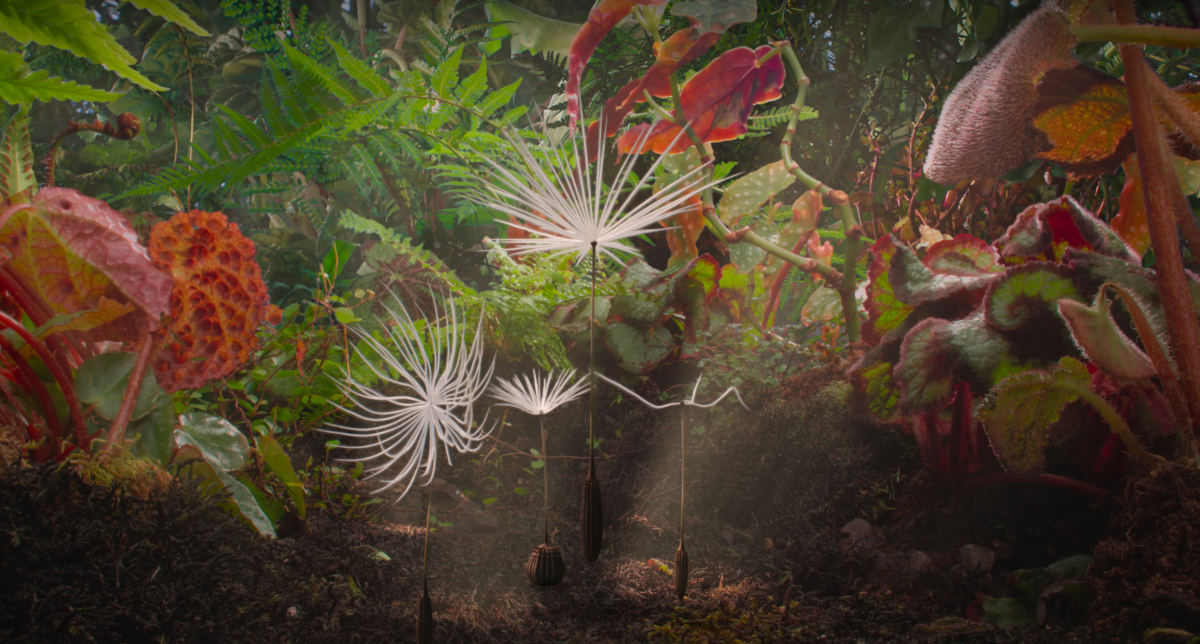
Dandelion's Odyssey
The music, composed by Nicolas Becker (‘Gravity’, ‘Sound of Metal’) and Quentin Sirjacq, was another complex undertaking. “What is the sound of the future today?” Seto asked them. The initial idea was to create music for something that has never existed. At the same time, while focusing on the most primitive elements like animals, planets and seas, the soundtrack needed to sound archaic. Becker and Sirjacq created completely new instruments, built from tree bark, metal, and water, resulting in a score that feels both deeply primal and subtly futuristic.
Showing the French trailer for ‘Planètes’, Momoko Seto concludes her hour-long, densely informative masterclass. The planetary odyssey — described with meticulous attention to detail — culminates later the same evening with the Slovenian premiere of the film at the venerable Kinodvor cinema. By the time the final frame faded, the audience could sense that Seto’s miniature worlds were never truly small. With ‘Dandelion’s Odyssey’, she brings her long-standing experiment to its fullest expression, transforming microscopic elements into something unforgettably vast.
contributed by: Magdalena Nieświec
Want to read more free articles like this?

Keep this professional animation journalism effort relevant and updated. Become our patron

Read More About:
Related Articles


FIND THE RIGHT FESTIVAL


Zippy Frames is the premier online animation journal promoting European and Independent Animation animation since 2011
Zippy Frames
Quick Links