

Matea's Travels: Interview with the 'Paradaïz' Animation Short Director, Matea Radic
Olga Bobrowska
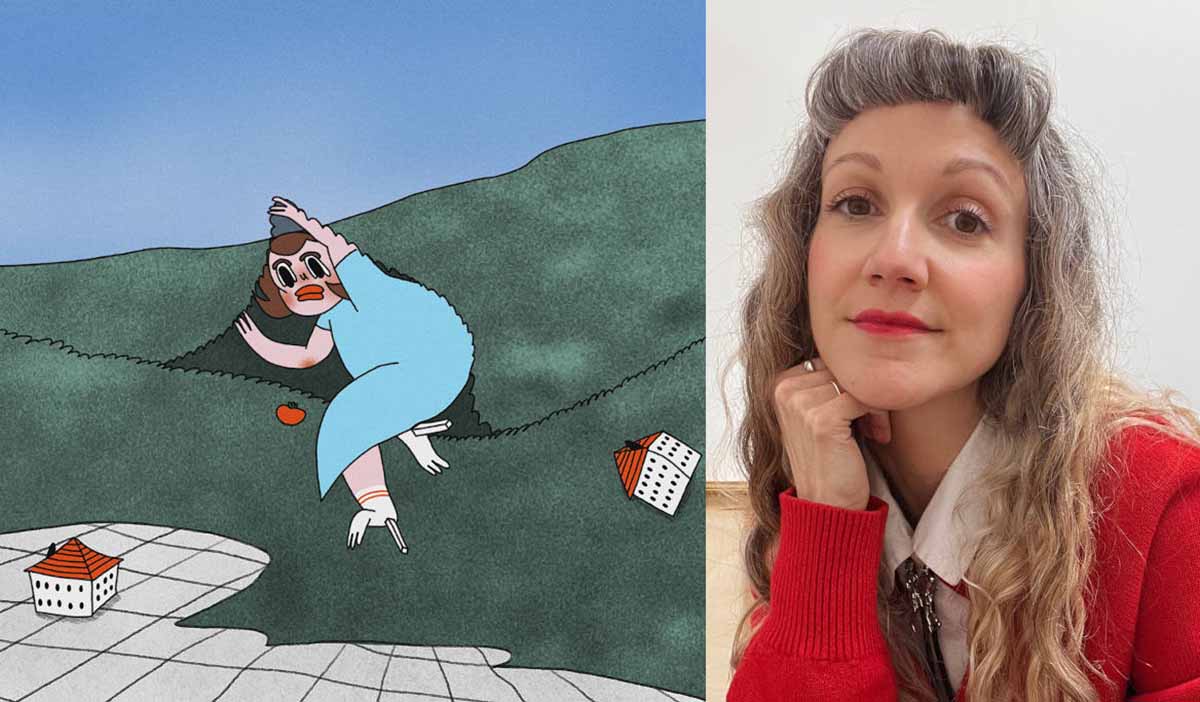
Matea Radic’s ‘Paradaïz’ (2025), a 2D hand-drawn animation created with the use of archival materials and produced at the National Film Board of Canada, will have its world premiere at the 23rd Fantoche in Baden, Switzerland, and a national premiere at OIAF 2025. These are quite impressive beginnings for a debut filmmaker, who passionately but gently revisits traumatic memories of a war-torn childhood. We talk to the Sarajevo-born, and Winnipeg-based animator just a few days before her film comes to screens worldwide.
It was somewhat natural that the conversation with Matea Radic circled around the subjects of travels – geographical and spiritual. I was interested in Radic’s journey to animation, which led her to the offices of the NFB early in her animation filmmaking career; the pathways she explored in the course of this first professional, creative process; and her lifelong journey of escaping and returning to Sarajevo. While Radic has worked as a multidisciplinary artist for some time, she is a newcomer to animation, with experience in creating music videos (most notably Jim Croce’s ‘Time in a Bottle’, 2023), but without much professional training. She recalls: “I went to art school straight out of high school, and I was really focused on making still images – drawing and painting. But I feel that each medium I explore has its own language and can tell different types of stories. And I felt that animation really lent itself to telling this story in a more profound way. Animation allowed me to tell a more robust story and really dig deep to express things I felt I couldn’t have expressed with still images.” Except for courses in 3D animation, motion graphics, and an introduction to 2D, taken at Red River College, Radic is actually a self-taught 2D animator. A breakthrough moment came when watching Zachary Zezima’s ‘It's a Date’ at the Animation Block Party Festival in Brooklyn: “This film really opened my eyes and invited me to explore this medium. It just made me feel so excited.”
In 2017, Matea Radic returned to Sarajevo, Bosnia and Herzegovina, where she was born and where she survived the beginnings of the long and brutal siege (1992-1996). Radic left the city (and the country) a few months into the war (as recalled in the director’s statement: “My mom and I escaped on the last bus taking women and children out of the city, leaving my dad behind”). This sole trip Radic made to her homeland became deeply memorable, for many reasons, among them: “When I went back home in 2017, I had this image in my head, as we were coming into Sarajevo. I was looking outside the window at the hills, and a certain kind of fear struck me, as if the war had started again. I imagined myself pulling up the hill and getting under it, and this image just burned itself into my mind, and it just kept coming back to me.”
Toby Gilies and Natalie Baird (the authors of the film ‘Don't Let the Sun Catch You Crying’, 2024) were essential in connecting Radic with producer, Alicia Smith, and “the ball kind of started rolling from there”. As Radic recalls: “During my development with Alicia Smith, the NFB restructured, and all the projects in their infancy got moved to the animation studio in the Montreal office. It just so happened that Jelena Popović ended up with my project, and she is also from Sarajevo; we immediately bonded.” The whole process took almost five years, including three years of writing and creating the animatic and two years of production. As a debut filmmaker, Radic was actually given a lot of creative freedom (and a small team): “It was scary. And I learned a lot. Now I know how I want to move forward as a filmmaker and as a storyteller. I absorbed so much knowledge", she sums up her production experience.
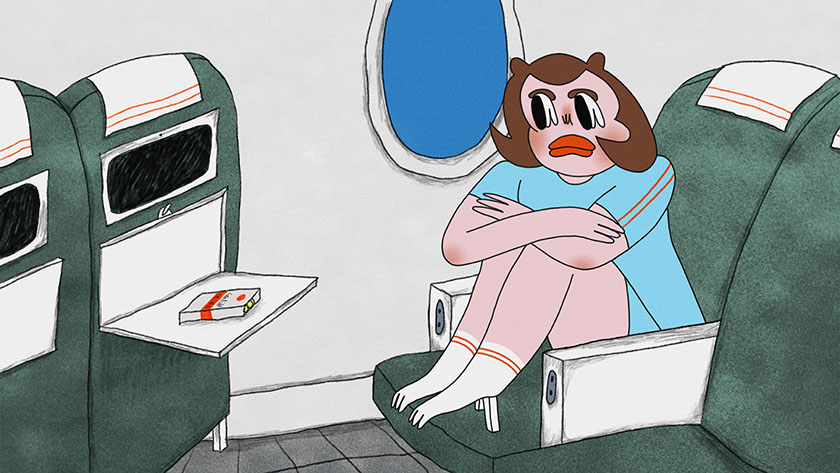
Paradaïz by Matea Radic
Matea Radic’s storytelling and visual styles are distinctive and complementary. The above-described scene, which Radic imagined when landing in Sarajevo nearly a decade ago, actually opens the film, clearly setting its mood. Together with the filmmaker, we indulge in surrealism that combines shape-based absurd representation and somewhat “cartoonish” imagination. Radic follows up on this notion: “I tend to lean on the stream of consciousness in my work. I relied on my mind’s eye to guide me through making this film. I knew what I was searching for, I just didn’t have a roadmap for it”, and she continued: “I spent a lot of time in the bathtub, dreaming of what was going to happen next. There was a lot of writing and rewriting. To be honest with you, if I still had time, I’d still be rewriting, because I feel like I’m still living it.”
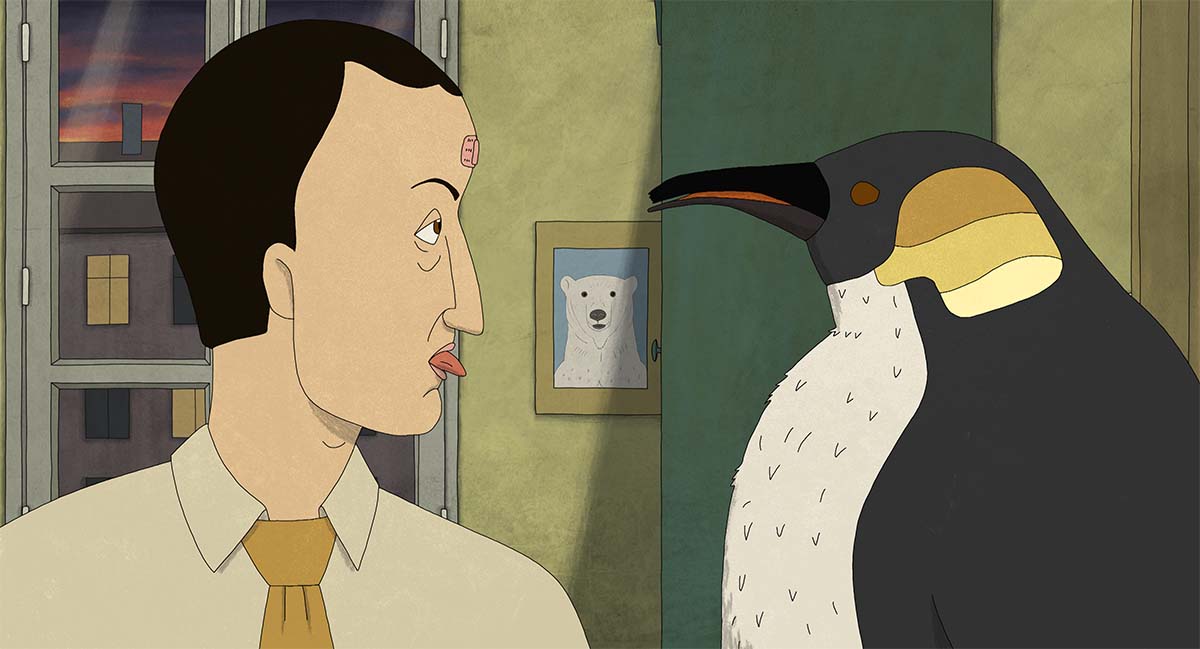
The question lingers – who is Matea Radic, the protagonist of the film? We are sure this is the character’s name because we see the Canadian passport she hands to the border guard at the airport. We also see how the guard adds the letter “ć” to her surname, thoroughly changing the pronunciation – from Western estranged “k” to the Slavic soft and homely-sounding “ć”. With this gesture, he performs an act of “undoing” Matea’s escape and living a whole life abroad. But this cannot be. Radic appears to be her ever-changing self. The character design celebrates the roundness of the shapes, their flexibility, and their imprinted contrasts. The body appears to reconcile fragility with adventurousness, anxiety with curiosity, feminine maturity with girlhood feistiness. We easily notice a kinship between the protagonist and omnipresent snails and slugs. The character of Matea Radic is bestowed with certain characteristic attributes – among them cigarettes, band-aids, or floppy high-heels – which, all together, add new meanings to the unravelling story.
Radic expands on this interpretation: “She went through many iterations, and she is all these identities – this young person and also this woman. She ended up looking like this because that’s how I looked at the time while I was designing her – a little ponytail, a bob, etc. When I was a child, I used to wear pantyhose on my head and pretend I had long hair, so I invented the shoes in a similar manner. So yes, I’m a kid and I pretend to be an adult. I wanted this kind of playfulness behind the design. I always wore two band-aids as a kid, one on each knee – at least. So, this is a nod to this long-lived, unhealed wound that she’s been carrying with her.” A choking charm is added to the character by the fact that she is apparently a chain-smoker. Radic sees smoking as a part of Sarajevian culture, and in the director’s statement, she recalls yet another reason why cigarettes play such a significant role in the film: “My cousin Veronika would (...) teach me how to make paper cigarettes that looked exactly like real cigarettes. We would pretend to stress-smoke like everyone else.”
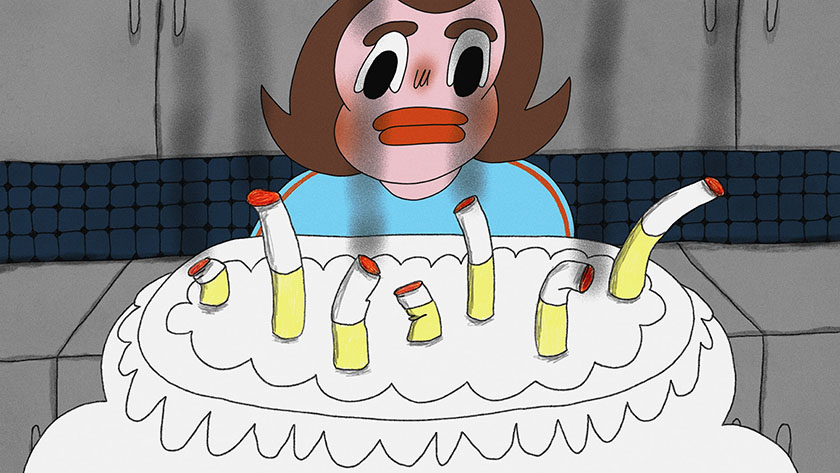
Paradaïz by Matea Radic
‘Paradaïz’ is a film about the multiplicity of place – one that is long gone, one that exists only in memory, and one that has survived but changed forever, becoming one of those eerie phantoms that strangely remain the only possible bridge between the past and the present. The architecture of the presented environment is curled and curvy, which visually harmonizes with the roundness of the character design. The perspective is always somehow distorted, yet it does not recall an expressionist fright; rather, it is charming and warmly inviting, encouraging exploration of its most unexpected corners. Radic does not have any special method for creating this quirky and curious world: “The way I draw happens naturally. I’ve always been attracted to weird, absurdist, and strange imagery.”
Diving deep into the effects of estrangement, Radic balances the surreal with the empirical. The archival material used in the film was retrieved from family photo albums (only the Sarajevo landscape was based on the work of the travel blogger, Kamila Napora) and she inserted in the body of the film an exciting curio, the Šipad Furniture commercial ‘Lako je za razmještaj ako imaš namještaj’ from the 1990s, which uses optical tricks and plays with the idea of defying the laws of gravity. The use of this excerpt triggers significant changes in the film’s dramaturgy. Radic comments on these interventions of the real into the imaginative: “These are all personal things; I built this world from the things that already belonged to me. For example, I remember this commercial vividly. It was something so surreal and so cool to me as a kid. I used to imagine what it would be like to live on the ceiling. It kind of affirmed my belief that anything was possible. And then, when the war started, this commercial, based on the absurd idea of living on the walls, all of a sudden became a reality – we were putting mattresses in the windows to protect ourselves from the glass shattering. Something that was so playful and surreal became a trick for survival.”
Absurd, surreal, and funny, Radic’s work attests to subjective, personal, and unique perspectives on the traumatic disruptions brought by war upon individuals. The strength of ‘Paradaïz’ is that, even though it is so strongly focused on real-life traumatic experiences, it does not attempt to universalize an individual’s life journey as a grand metaphor. Radic shows that the grand narratives (let’s say History, Politics, Global Justice, etc.), which are supposed to hold politicians, war-mongers, nationalists, and other kinds of radical adherents of ideologies and religions accountable, do not change much about the routes the individuals must take in their own, private micro-histories of healing. Among traumatized individuals (or the “collateral damage” of geopolitical chess games), everyone must find peace with themselves in their own way. It takes years (sometimes generations), various media (animation included), and it still might not bring closure. Elsewhere, Matea Radic mentioned that throughout her years in Canada, she transformed into a “chameleon”. The film makes a strong point – it is possible to turn back from a chameleon into a snail with a shell, a creature of modest beauty, but with a strong sense of belonging. How does one do this, I asked.
“I think my body figured out how to feel safe – you had to be like everyone else. The nature of war in Bosnia and Herzegovina was genocide, and since half of my family is Muslim, there was a real fear that we didn’t belong – here, in this place, on this earth. It was important for me to ensure my own safety – to be a chameleon. (…) Making this film was very much a therapy for me. A lot of things became clear, and it helped me to start getting that younger self back, from before all of this happened. Once I finished the film, I felt lighter. I felt as if I had moved through many shadows. Now I’m on the other side. I don’t know if I’m through. It’s a lifelong journey if you have trauma, but I think being aware of these things is the first step toward moving through it”, Matea Radic answered.
| Related: Fantoche International Animation Festival 2025 |
About Matea Radic
Matea Radic is a multidisciplinary artist born in Sarajevo and based in Winnipeg, Canada. She fled her birthplace as a child in the summer of 1992 and has been interested in the concept of home and attachment ever since, infusing her art with a signature mix of nostalgia and dark humour. She has explored a variety of mediums, including illustration, painting and sculpture, and has animated music videos, notably a posthumous clip for Jim Croce. The animated short ‘Paradaïz’, produced by the NFB, is her first film.
For more info, see the NFB distribution page here.
contributed by: Olga Bobrowska
Want to read more free articles like this?

Keep this professional animation journalism effort relevant and updated. Become our patron

Read More About:
Related Articles

Zippy Frames is the premier online animation journal promoting European and Independent Animation animation since 2011
Zippy Frames
Quick Links