

'When The Sea Was Calm' (2026) Oscar-Qualifying Animation Short: interview
Vassilis Kroustallis
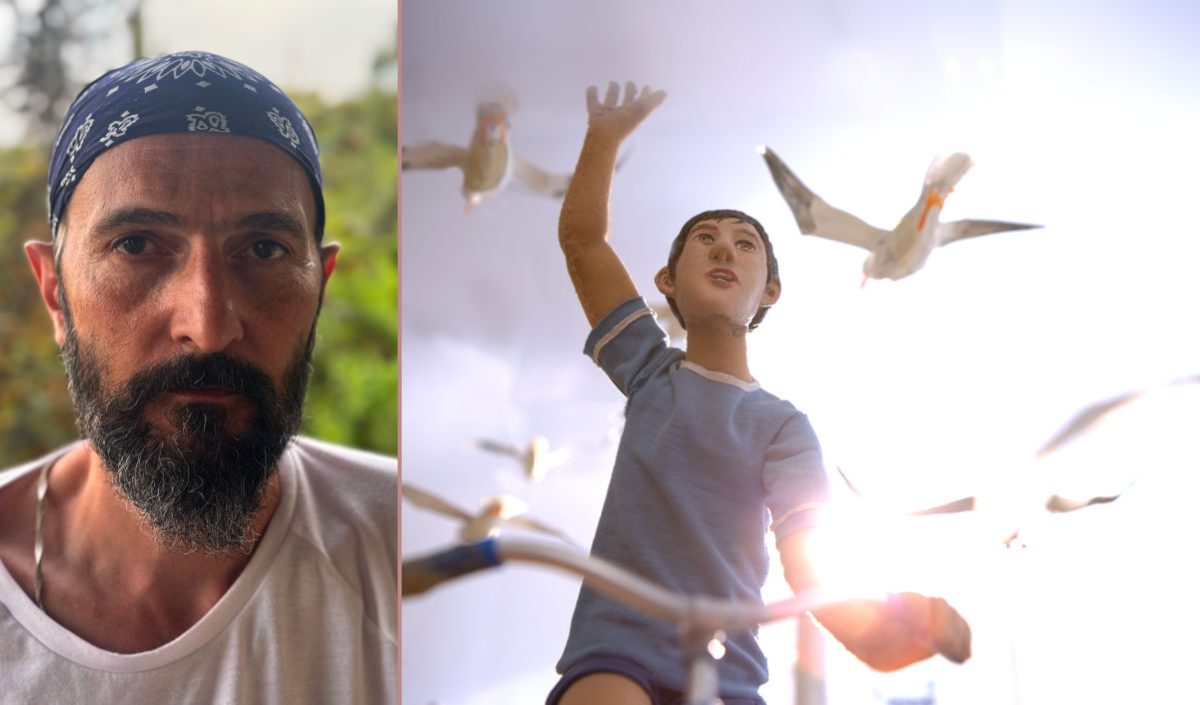
Director-screenwriter Mamuka Tkeshelashvili (his previous puppet animation short was the 2018 'Fisherman and the Girl ') and Vladimer Katcharava, producer (20 Steps) of the CEE Animation Forum-awarded feature film 'Igi') joined forces to create the epic-scale, 18-minute puppet animation film.
'When the Sea Was Calm' documents the 1993 fall of Sokhumi (Sukhumi), the capital of Abkhazeti on Georgia’s Black Sea coast, and its role in the 1992-1993 Georgian-Abkhaz conflict (facilitated by decisive Russian political and military involvement). The fall of Sukhumi in September 1993 led to the forced displacement of more than 200,000 ethnic Georgians.
A deeply personal project from both director-screenwriter and producer, who both had childhood memories from Sokhumi, the film premiered at the 2026 Annecy Festival and went on to major festivals, winning the Animation Guild Craft Award for Best Design at Ottawa International Animation Festival and other festivals, and has now been Oscar-qualified (via US theatrical exhibition) for the upcoming 2027 Academy Awards.
Stop-motion animation in Georgia has been on the rise in recent years, with names such as Ana Chubinidze ( Franzy's Soup-Kitchen, 2021), Elena Tavadze with 'Elene Dariani' (2024) -also including industry activities such as the Black Sea Animation Workshop initiative.
Mamuka Tkeshelashvilli's 'When the Sea Was Calm' is the latest entry in that lineup, combining history and personal memory. We talked to the film's director-screenwriter:
Revisiting National Trauma
I was nineteen when the war began in 1992. I didn't live in Sokhumi permanently, but I spent every summer there as a child. Some of my happiest childhood memories are connected to that city, and I haven't been back since the war.
About ten years before we made the film, I wrote an early outline about a boy, a girl, and a little dog. Later, when I connected the story to Sokhumi, everything fell into place. Returning to those memories was emotional, but I didn't want to remember Sokhumi only through the war. I wanted to recreate the city as I had known it: the streets, the sea, the summer light, the friendships and the freedom of childhood. I think that's what makes the story painful. We spend time in this beautiful, ordinary world before seeing what happens to it.
Documenting the period
I remembered the atmosphere of Sokhumi very clearly, but for the actual streets and buildings, we also studied old photographs. Documentary footage was another important source. One image from the evacuation of Sokhumi stayed with me for years: a dog trying to follow its owner as people left the city by ship. It was such a small detail in the middle of an enormous tragedy, but I could never forget it (it became an essential part of the story afterward).
I wasn't trying to reconstruct every event. I wanted to recreate the city through a child's eyes, where ordinary experiences like playing football, swimming or falling in love are much more important than the political events unfolding around him.
From Film Development to Premiere
The preparation took about a year and a half, followed by another two and a half years of shooting. We were working with a small crew and limited resources, so everything took time.
We actually premiered a 17-minute version at Annecy Festival in 2026. It was already a complete story, but I still wanted to include a few scenes. By the time we reached Ottawa Festival, we had completed another minute. We added shots of the deserted city, a boy jumping into the sea, and boys cycling down the whole street by the seaside. The boys diving may seem like a small addition, but it was important to me. It's exactly the kind of carefree summer moment I remember from Sokhumi.
Numbers, Puppets and Sets
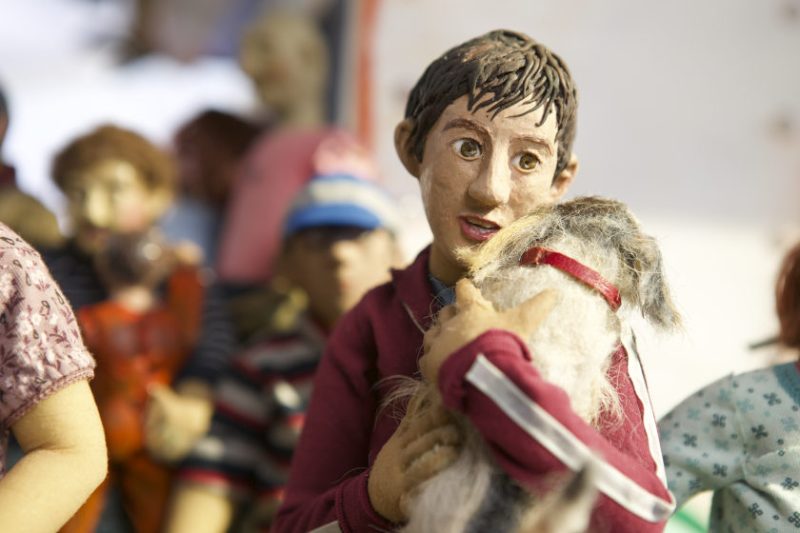
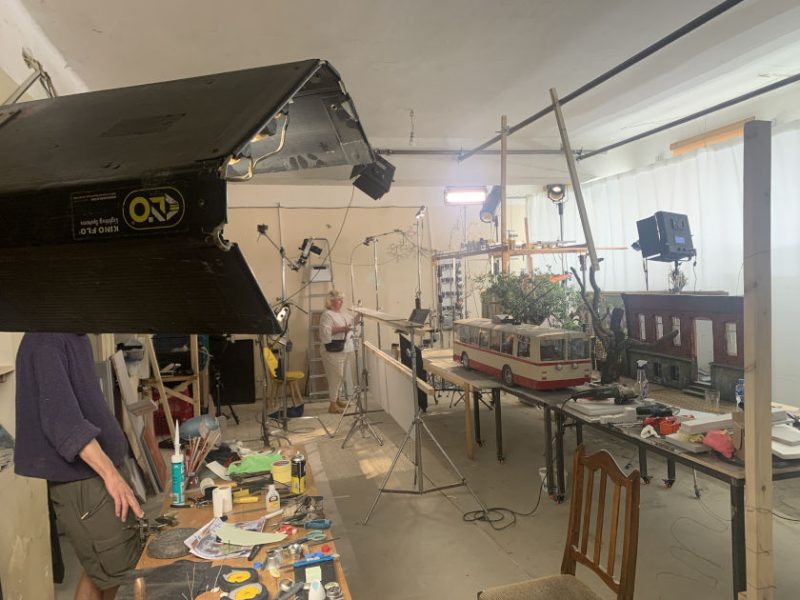
We created three main character puppets, several supporting characters, and approximately 35 to 40 smaller puppets. We worked with three different scales: largest character puppets (50cm), medium-size versions (20-25 cm), and the smallest ones (6-7 cm). We used larger puppets for close-ups, where we needed more detail and expression, while the smaller versions were used for medium and wide shots -and the sets were built to match these different scales.
It was a practical solution, but also a creative one. Building everything at the largest scale when recreating an entire city (buildings, interiors, etc.) would have been extremely difficult. The different-scale puppets let us create the impression of a much larger world while keeping production manageable. Of course, it also meant that everything had to remain visually consistent from one shot to another.
Human Resources in a Grand Scale Animation Work
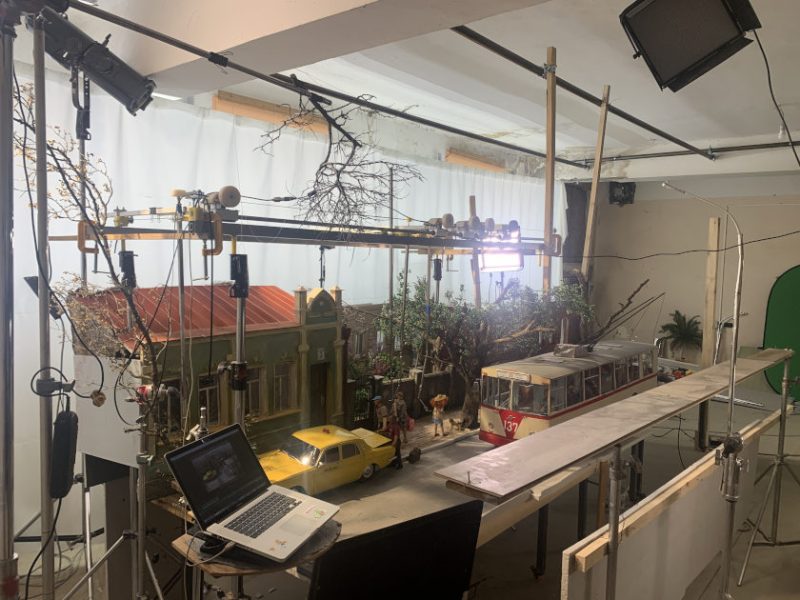
For most of the production, the crew was very small. I handled the directing, character and production design, puppet animation, and much of the camera and lighting work. David Kobakhidze and Ioane Tkeshelashvili worked on sets and props, supported by three assistants. Teona Baramidze worked on graphics.
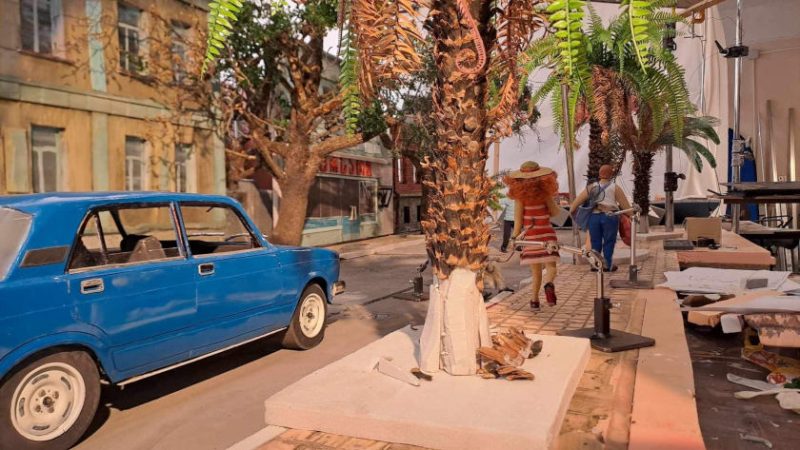
Interestingly, our largest team came in right at the end. We had eight people working on visual-effects cleanup, supervised by Vako Agladze, which was extremely difficult because of the tight timing as the Annecy premiere approached. Their job was painstaking: removing the supports and rigs that held the puppets during animation, frame by frame. In the film, there is no CGI.
The characters and environments weren't created digitally. The visual-effects team was there to make the mechanics of handmade animation disappear -a huge amount of work. Sometimes working with so few people was exhausting, because of my different roles in the film. But that helped me maintain a very close connection with the entire visual world - every puppet, building, and street had to feel as though it belonged to the same city.
Challenges
The biggest technical challenge was camera movement. I wanted the film to have the visual language of a documentary, like walking through the streets of Sokhumi with a handheld camera, witnessing events as they happened. Achieving that feeling in stop-motion is extremely difficult. You have to control every movement frame by frame, but the result must look natural and spontaneous.
I designed and built special camera rigs (after a lot of experimentation) that let us create movements closer to those of a live-action camera. I didn't want the audience to feel that they were simply watching puppets on miniature sets, but to feel present in that city, almost as though the camera were moving through someone's memory.
Also, with a limited budget and a small team, almost every stage demanded more time than we had available. But I think those technical challenges also helped define the film's visual language.
The film's lighting
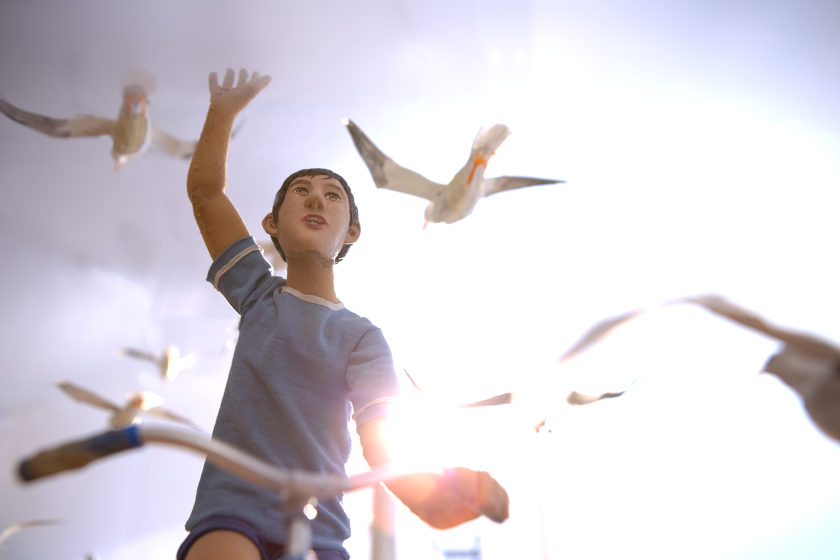
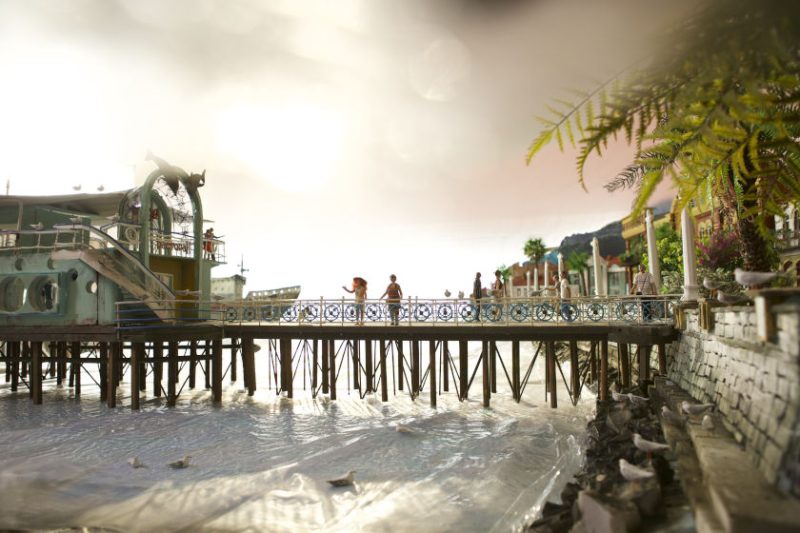
I have worked as a gaffer on live-action productions, so lighting has always been an important part of my filmmaking. In this film, we were working with physical miniature sets, real materials, and practical lighting. The light interacts with those surfaces in a way that's particular to stop-motion.
But my main concern wasn't simply making the images look realistic. I wanted to recreate the feeling of summer (the brightness of the streets, the sea, the warmth) I had experienced.
Also, dramatically, at the beginning, the light belongs to a world where the characters feel completely free and safe. Later, we understand just how fragile that world was. I think the contrast becomes more powerful because the audience has first experienced the city at its most beautiful.
The function of Stop-Motion Animation
What I love about puppet animation is that you are working with something that physically exists. You build a character, put it in an environment, light it, and gradually bring it to life. There is a wonderful moment when a puppet stops feeling like an object.
I think that physical quality was particularly appropriate for a film about memory, for memories are not perfect reproductions of reality -they are made of fragments, feelings, and details that stay with us. The textures of the puppets, the miniature buildings, and even their small imperfections helped me create that feeling.
The same story could have been told in live action, but stop-motion let us approach it more personally, somewhere between reality and memory. I wanted to create a world that felt real enough to believe in, but fragile enough to disappear.
Memories Resurfaced
The last sequence of the old man returning to Sokhumi was essential to the story. Without the final sequence, the film might have remained a story about one summer and the moment that summer came to an end. But the consequences of war don't end when the fighting stops. They remain with people for the rest of their lives. His childhood is still there, even though the places he remembers have changed. This is probably the part of the film I'm happiest with. It's where the animation, documentary footage, music, and the passage of time come together.
The Georgian Animation Production
We have very talented people in Georgia, many of whom are still waiting for the opportunity to show what they can do. Georgia also has a rich cultural and artistic heritage, which gives us plenty of material for original stories and visual approaches.
The biggest problems are financing and production infrastructure. Projects like ours also depend heavily on the commitment of individual artists, who often have to take on several different roles because the resources simply aren't there. But we shouldn't try to imitate the styles of larger industries. Our own experiences, traditions, and artistic voices are precisely what can make our films interesting internationally.
Watch 'When the Sea Was Calm'
as a Vimeo Staff Pick
Read More About:
Related Articles


Zippy Frames is the premier online animation journal promoting European and Independent Animation since 2011
Zippy Frames
Quick Links
