
News 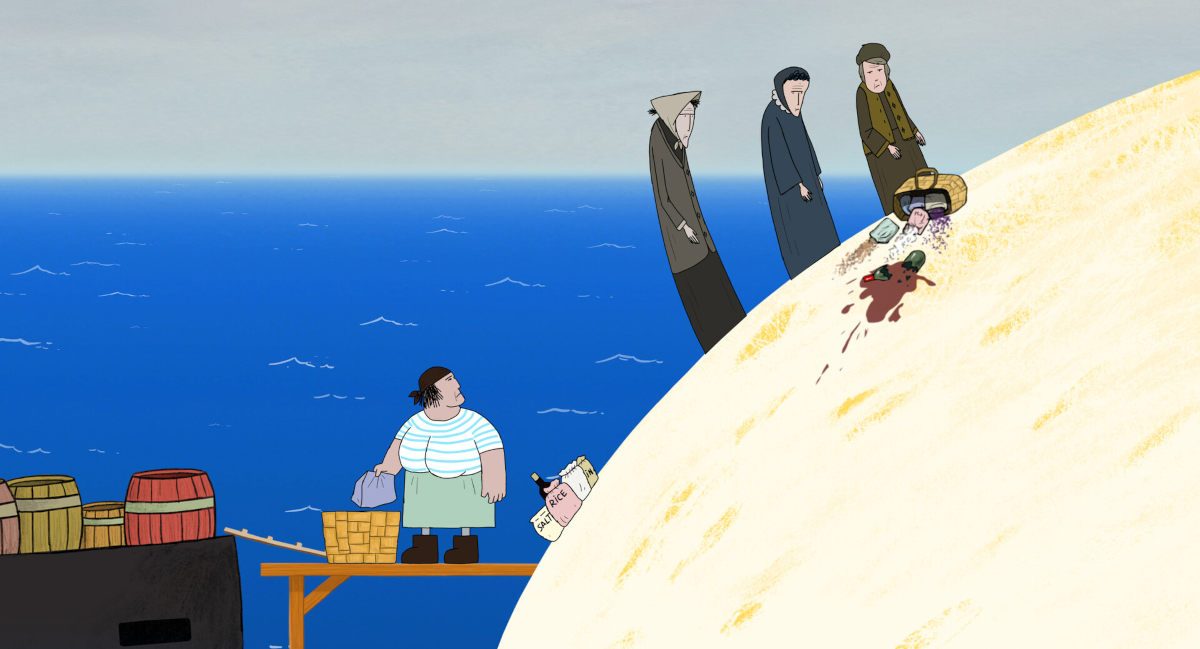


EDITORIAL: We Can Live Without Animation Pranks: Bronzit's 'The Three Sisters' Case
Vassilis Kroustallis
The Animation Story
First, there was the surprise: a Georgian animator, Timur Kognov (unheard of to all), became shortlisted with a 'Cyprus-produced' film (according to the FilmFreeway account).
'The 2D animation film Three Sisters' tells the story of three sisters on an isolated island who have to rent one of their houses. The film was Oscar-qualified at the 2025 Santa Barbara International Film Festival; and later became an Oscar-shortlisted animation short. (To save you the suspense, it has eventually become an Oscar-nominated animation film for the 2026 Academy Awards.
It was later revealed (by the director himself with the 'coming out' celebratory phrase) that the (then) two-time Oscar nominee, Russian animation director Konstantin Bronzit (Lavatory Lovestory, We Can't Live Without Cosmos) was the one behind this animation prank, using not only a fictional pseudonym but a different country than his own (Cyprus) to send his film to the festivals.
Bronzit had an interview with Chris Robinson (at CartoonBrew) and Ramin Zahed (at Animation Magazine), and explained that the rationale behind this was to 'judge the film, not the author. He noticed that many animation and film festivals tend to select films from well-known filmmakers (or reject films by filmmakers they don't sympathize with); so, he decided to submit to the festivals with a fictional name, bio, and a country different from his own.
The Case for Animation Incognito
Are festival programmers really in favor of the auteur theory rather than the merit of the individual film? Maybe yes, maybe not. A completely different argument would state that acclaimed animation filmmakers (like all filmmakers) are rated harsher than newcomers, simply because they are judged according to their previous work and standards they (the filmmakers) imposed. A newcomer has nothing to fear, nothing to lose. Animafest Zagreb has a separate non-competitive 'Time for the Masters' programme, in which acclaimed filmmakers talk to each other via their works. It proves that not all acclaimed animation filmmakers are automatically guaranteed a place in competition; it might also be one of the solutions to the increasing availability of short animation films (and the reducing availability of animation festival slots in the same programme). Yet the current festival world is so vast that individual prejudices don't matter much. The fact that 'The Three Sisters' qualified at a non-animation festival proves that every fine film can have its place.
Should we skip the country qualification and submit all the films incognito? First, country qualification has worked as an early example of inclusivity -before the word was invented. A country's representativeness (hopefully) gives the festival programmers material to think about, and weigh on different narratives, aesthetics, and themes from different countries. Without it, we could easily be left with a programmer's personal preferences from films from a single country -or worse, the rich countries and their production companies dominating the festival programme by simply being able to afford the submission fees festivals have increasingly put forward in recent years (including the 2026 Annecy Festival).
European films -and, of course, animation films- are also predominantly funded by national bodies, so the politics of these funding bodies and their rulers who finance those films need to enter the equation (we'd all like to live in a peaceful world, but we currently don't). Yet even if we brush those considerations aside, filmmakers do not operate in a vacuum; and, even though animation is more elusive in its tradition than live-action national cinema, we wouldn't have been where were are in animation if the Zagreb school of animation, the Polish school of animation, the trademark Estonian animation and its quirky character or innumerable other auteurs in respective countries (and their followers) were not considered as such, but simply as isolated animation films here and there. So, yes, countries and their representatives are important to note -not just for festival reasons, but for historical and academic reasons as well.
On the other hand, pseudonyms or nom de plumes are very frequent in literature, film, etc. They can be freely used, of course. But their use and tradition are different from the experiment the filmmaker of 'The Three Sisters' tried to conduct. These pen names are used by filmmakers (or artists/authors) when external circumstances prevent them from using their real names. Women masquerading as men (think of the Brontë sisters who used male names) or filmmakers who are in danger of being persecuted in their home countries. At Zippy Frames, we had cases where the directors' names of selected films for festivals had to be removed, for exactly the latter reason.
Still, this intellectual hide-and-seek game would have its charms if there were not further repercussions from it. According to the same CartoonBrew interview with Chris Robinson, Cyprus had nothing to do with the production of the film: "If you’re making things up anyway, why not? But Cyprus is also a partial truth. There’s a distribution company there, and also many good freelance animators. It would have worked just as well to write “Canada", Bronzit mentions. So, the country is indifferent -but maybe not so soon.
Winning a Greek/Cypriot film competition
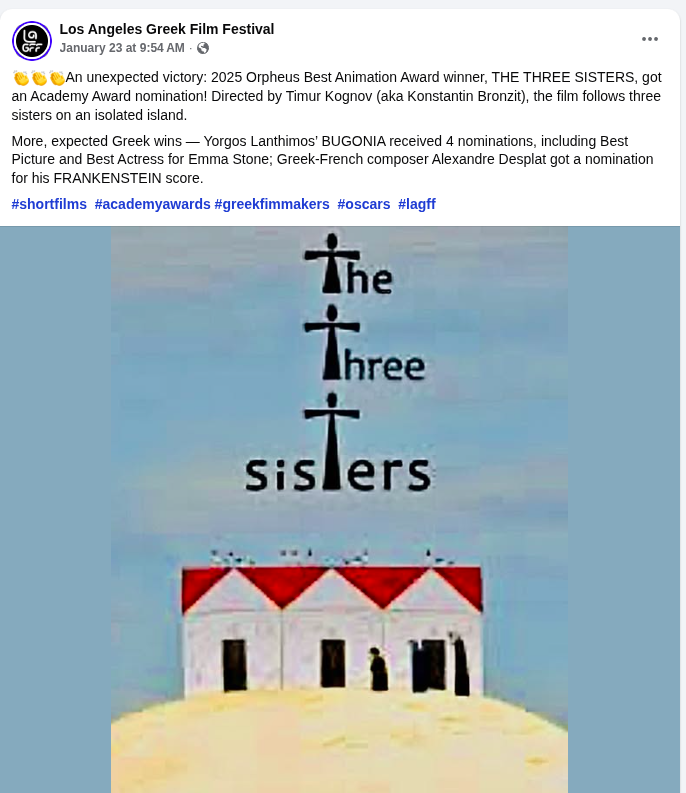
'The Three Sisters' film has won the main animation award at the Los Angeles Greek Film Festival (2025 edition), and it was appropriately celebrated by the festival the moment the film was Oscar-nominated.
The FilmFreeway submission page of the festival states the following:
Eligible Films:
- Films by Greek directors, writers, producers, or actors (in starring roles), (co-directors, co-writers, and co-producers are also eligible) from Greece and Cyprus. Must be credited.
- Films by directors, writers, producers, or actors (in starring roles), (co-directors, co-writers, and co-producers are also eligible) of Greek descent worldwide. Must be credited.
Greek and Cypriot productions.
- Films about Greece and/or with a prevalent Greek theme.
- Films submitted to LAGFF 2024 or 2025 that were not accepted, provided they were completed no earlier than January 2024. New entry fee and a completed submission form are required.
Greek-themed films from emerging local to Los Angeles filmmakers
For the record, the 2024 animation winner in the same awards was the Greek Eirini Vianelli (for the stop-motion film 'Ready'); the 2023 winner was the Greek Aspasia Kazeli, with the 2D animation 'My Mother the Sea'.
You guessed it right, 'The Three Sisters' is not a Greek-themed film; it only entered and won the competition as a Cypriot production (which it wasn't -or at least, it was 'partially true', according to its director).
That left the Cypriot Yiannis Christoforou (who competed with his Annecy-selected film 'Underground') with only a special jury mention. For the record, 'The Three Sisters' (as previously said) did not get its Academy Award qualification from that specific festival (which only fosters Greek/Cypriot film talents).
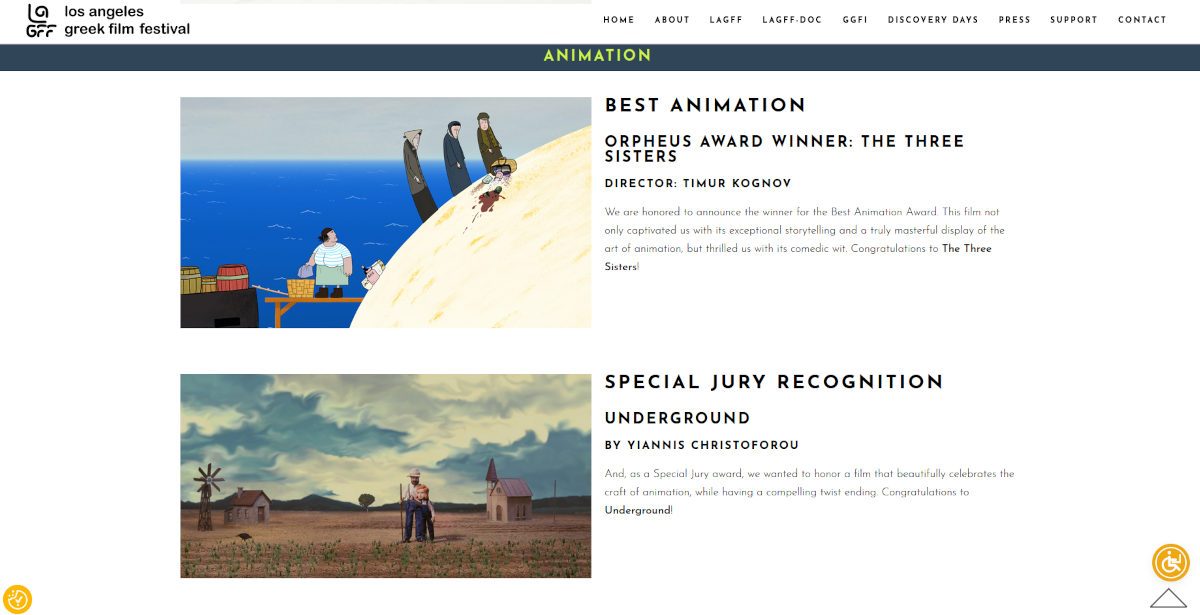
Still, it is one thing to test the perceived limits and prejudices of the festival circuit by submitting a film under a pseudonym and quite another to win the main award in an exclusively Greek/Cypriot film competition with a film that shouldn't have entered there in the first place. According to all evidence (and we would be grateful if we stood corrected), Bronzit simply exercised his 'prank' to the detriment of fellow Greek/Cypriot animation filmmakers who had already entered the same competition and were eligible to do so. One of those could have won the main award and used it for further promo / fostering their careers, etc.
This, of course, doesn't judge the intentions of the Oscar-nominated filmmaker (who might have been completely in line with his 'judge the film' motto), but the havoc they inadvertently created. In our view, the Los Angeles Greek Film Festival should simply reverse its decision and award the prize to a Greek/Cypriot talent (as it was supposed to do in the first place).
Disclaimer
For the record, the now 3-times Oscar-nominated Konstantin Bronzit is a very respected and talented filmmaker, having his films reviewed at Zippy Frames by more than one writer.
He's also one of the Russian animators who signed the petition against the Russian invasion and subsequent war in Ukraine. But, frankly, enough with the pranks that test not the festival programmers but the patience of fellow animation filmmakers, who see their work being sidelined exactly because of those 'tests'. Let's do some serious animation business instead.
27/1, 22:00 EST Update:
Konstantin Bronzit replied on our personal Fb webpage that "The festival did not specify either the nationality of the author or his place of residence" and that "the conditions of the festival did not say that the director must necessarily be Greek or Cypriot!". He further stated that the main production is Cyprus.
The statement in full (original spelling):
Colleagues, I will write here once, and I will not discuss it anymore (life is too short and I try not to spend it in FB too much)) But sometimes, to be fair, you need to know and listen to the other side, no? The mentioned festival contacted Timur Konov by mail to clarify only the production of the film! The festival did not specify either the nationality of the author or his place of residence, especially since in the questionnaire that was always attached to the film, the nationality was indicated - Timur Kognov is Georgian, which is true. The conditions of the festival did not say that the director must necessarily be Greek or Cypriot! That is, I did not deceive anyone on this point, because that was not my goal! (Otherwise there were a lot of possibilities to do that with many festivals, and all of you understand that!) But I confirmed that main production is Cyprus (really it is collective, but the main Cypus) It's all written in an interview with Chris Robinson. I was just very strict about not violating any formal rules of the festivals! And most importantly, this festival and its prize have nothing to do with the Oscar race. This festival is NOT a qualifying one and did not affect anything at all. (The prize also is not moneytary) The only qualifying prize that the film received was the Santa Barbara Prize. Have a nice evening))- Konstantin Bronzit
Our take: For the record, this article never mentioned that the LAGFF award was an Academy Award-qualifying award (on the contrary, we emphatically stated it wasn't). Regarding the Cyprus connection, the onus of conclusive proof (and not just a statement) lies with the director. From the official preview screener of the film sent to this editor, the film credits (the first point of author attribution) reveal no conclusive evidence of Cypriot participation (natural person or legal entity).
Zippy Frames has also reached out to LAGFF for comments -and will update, if necessary.
Vassilis Kroustallis
Want to read more free articles like this?
Keep this professional animation journalism effort relevant and updated. Become our patron
Read More About:
Related Articles


Vassilis Kroustallis



Zippy Frames is the premier online animation journal promoting European and Independent Animation animation since 2011
Zippy Frames
Quick Links